She's 55 and just realized she wipes down the kitchen counter even when it is already clean - runs the cloth over the surface one more time after everything is done and the kitchen is spotless, not because anything is left but because that slow motion across a surface that needs nothing from her is the only transition her nervous system has between the noise of the day and the quiet she has been craving since morning, and a girl who was never allowed to say 'I need a minute alone' found that wiping a counter was the one form of solitude nobody ever interrupted
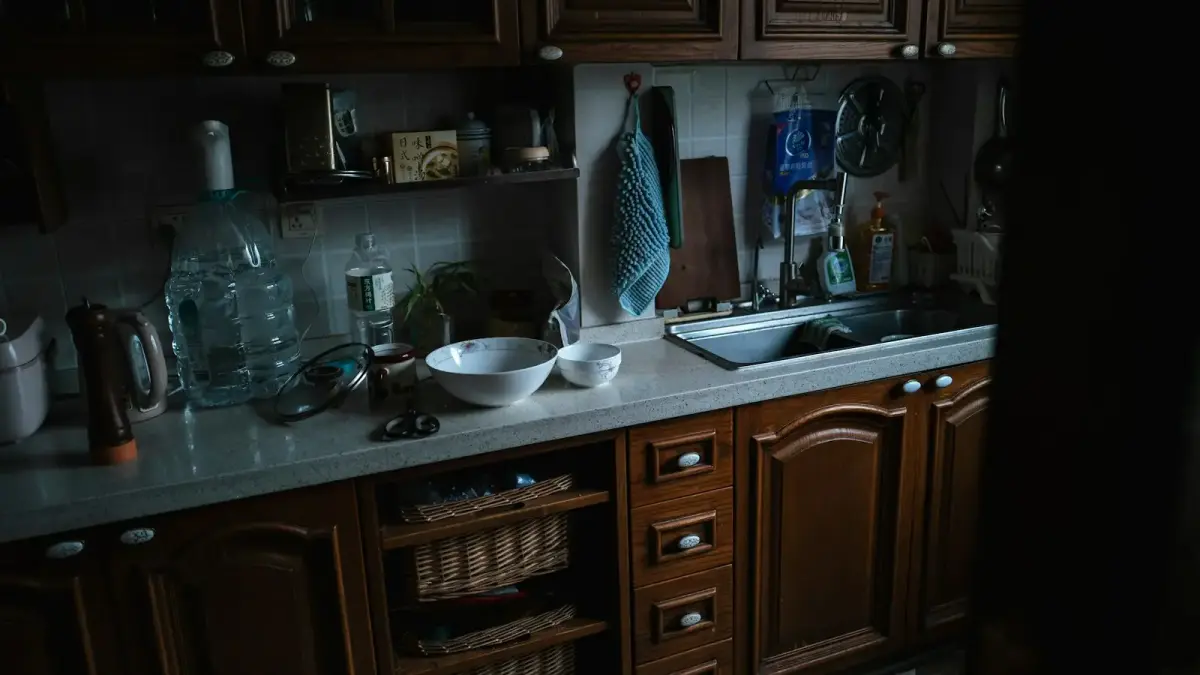
I watched my mother do it every single evening of my childhood. Dinner cleared, dishes washed, leftovers wrapped in foil and tucked into the fridge. And then she would take the dishcloth, wring it out one more time, and wipe the counter in slow, deliberate circles. The counter was already clean. She had just cleaned it.
But she kept going. Back and forth, corner to corner, with this expression on her face that I didn’t have words for when I was eight years old.
Now I’m 55, and I do it too. Every night. The kitchen is spotless and I’m still standing there with a damp cloth, running it across granite that doesn’t need a single thing from me. And last week, mid-wipe, I finally understood what that look on my mother’s face was.
It was relief.
The ritual nobody questions
Here’s the thing about wiping a counter that’s already clean - nobody stops you. Nobody walks in and says, “What are you doing? Come sit down. We need to talk about something.” Nobody hands you a permission slip to be alone. You just stand there with a cloth in your hand, and everyone assumes you’re finishing up.
You’re not finishing up. You’re beginning something. You’re beginning the only version of quiet that was ever available to you.
I’ve talked to so many women my age about this, and the recognition is instant. It’s not always the counter. Sometimes it’s folding laundry that could wait until morning. Sometimes it’s reorganizing the spice rack for the third time this month. Sometimes it’s sweeping a floor that was swept two hours ago.
The task doesn’t matter. What matters is that it looks like productivity, and productivity was the only currency that bought you a few minutes of being left alone.
What your nervous system is actually doing
There’s a reason that slow, repetitive motion feels so necessary at the end of the day. Your body is trying to transition, and it doesn’t know how to do it without something in your hands.
A 2019 study published in Frontiers in Psychology found that repetitive motor activities - things like knitting, sweeping, and rhythmic hand movements - activate the parasympathetic nervous system in ways that closely mirror meditation. The researchers called it “embodied regulation,” and they found that it was especially effective for people who struggle with traditional stillness. People who can’t just sit down and breathe. People whose bodies interpret sitting still as dangerous, because sitting still once meant being visible, and being visible once meant being needed.
That cloth moving across the counter is not a cleaning behavior. It’s a decompression behavior. Your nervous system is using the rhythm of your hands to downshift from the sympathetic state - the alert, responsive, on-call state you’ve been running in since 6 a.m. - into something that finally resembles rest.
You’re not being obsessive. You’re being resourceful. Your body found a workaround for a need that was never allowed to be a need.
The girl who couldn’t say “I need a minute”
If you grew up in a household where solitude was suspicious, you know exactly what I mean. Closing your bedroom door got you a knock and a “What are you doing in there?” Going for a walk alone meant something was wrong with you. Wanting to sit quietly while everyone else was being social meant you were rude, or sulking, or “in one of your moods.”
So you learned. Not consciously - no child strategizes like this on purpose. But your nervous system learned that the only way to be alone without consequence was to be alone while doing something useful.
Washing dishes. Hanging laundry on the line. Wiping the counter one more time.
Dr. Gabor Mate has written extensively about how children in emotionally demanding households develop what he calls “automatic coping strategies” - behaviors that look functional on the outside but are actually sophisticated self-preservation on the inside. The child isn’t choosing to be helpful. The child is choosing to survive in a system where her internal needs were treated as inconvenient.
And then she grows up. And she’s 55. And she’s still wiping the counter.
Why it gets louder in midlife
Something shifts in your forties and fifties. The need for quiet doesn’t just persist - it intensifies. And the old workarounds start feeling less like habits and more like lifelines.
A 2021 study in the Journal of Research in Personality found that introversion-related needs - specifically the need for solitude and low stimulation - become significantly more pronounced after age 45. The researchers suggested that this isn’t decline or withdrawal. It’s clarity. The social masks that people wore for decades start to feel heavier, and the body begins demanding more honest rest.
But here’s the problem. By 55, most women have spent so long disguising their need for solitude as domestic labor that they don’t even recognize it as a need anymore. It just looks like being tidy. It just looks like being responsible. It just looks like being the kind of woman who keeps a clean kitchen.
It’s not about the kitchen. It never was.
It’s about the fact that somewhere between making breakfast and answering the last text message of the day, you lost access to yourself. And that damp cloth on the counter is the bridge back.
The solitude that looks like service
Susan Cain wrote in Quiet that introverted people in extrovert-centered cultures develop elaborate systems for getting the solitude they need without triggering social consequences. She called it “restorative niche” behavior - finding small pockets of alone time disguised as something socially acceptable.
For men, it’s the garage. The workshop. The long drive to the hardware store for one bolt.
For women - especially women of a certain generation - it’s the kitchen. It’s the laundry room. It’s any domestic task that keeps your hands busy and your door metaphorically closed while technically remaining available.
The cruelty of this is quiet and enormous. You found a way to give yourself what you needed, and the cost was that it had to look like you were giving to someone else. Your rest had to be disguised as labor. Your solitude had to wear the costume of service.
And over time, you forgot which one it was. You forgot whether you were cleaning because the counter was dirty or because your chest was tight and your thoughts were loud and the only thing that slowed them down was the sound of a cloth against stone.
Letting the counter be clean
I’m not going to tell you to stop wiping the counter. That would be like telling someone to stop breathing through the only airway they’ve ever known.
But I want you to know what you’re doing when you do it. I want you to stand there with that cloth in your hand and understand that you are not being compulsive. You are not being neurotic. You are not failing to relax properly.
You are a person who found the only door to quiet that nobody ever locked on her, and you’ve been walking through it every evening for decades.
A 2022 study in Psychological Science found that self-awareness around habitual coping behaviors - simply recognizing what the behavior is actually for - reduced stress markers by nearly 20 percent, even when people continued the behavior unchanged. Knowing is enough. Naming the need doesn’t require you to perform the need differently. It just requires you to stop lying to yourself about what the need is.
You need to be alone. You have always needed to be alone. Not forever, not from everyone, not because something is wrong with you. You need it the way you need water - in regular, unglamorous, non-negotiable amounts.
And if the counter is how you get there tonight, then wipe the counter.
But maybe tomorrow, try something. After the kitchen is done and the cloth is wrung out, don’t pick it back up. Just stand there. Hands empty. No task. No excuse. Just you, in your kitchen, in the quiet, needing nothing and doing nothing and letting that be enough.
You might feel a flash of guilt. That’s the old programming - the voice that says standing still without purpose is selfish, that rest without labor is laziness, that you haven’t earned the silence yet.
You have earned it. You earned it decades ago. You’ve been earning it every single day in the most invisible way a person can - by turning your own desperate need for peace into something that looked like a clean kitchen.
The counter doesn’t need you. But you needed the counter. And now, maybe, you can start needing yourself instead.

