She's 57 and still looks both ways on a one-way street - every single time, head turning left and then right even though she knows traffic only comes from one direction - not because she forgot the sign but because a girl who learned early that rules don't always protect you never stopped verifying what the world promised was safe
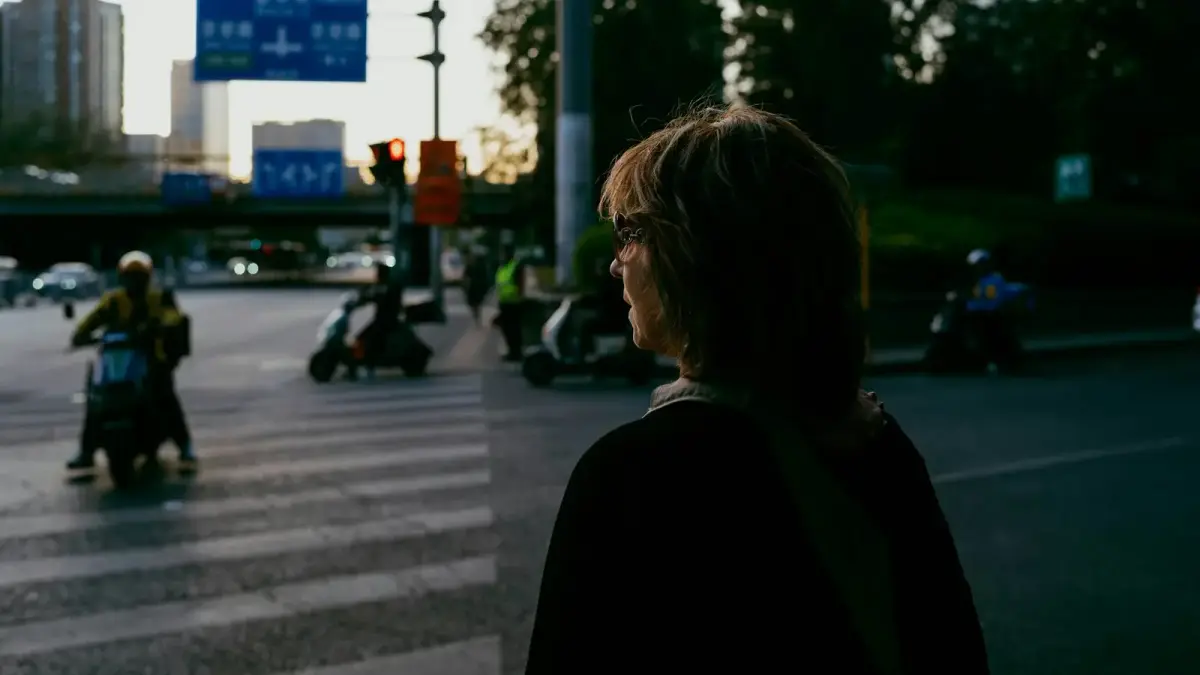
I did it again yesterday. Stepped off the curb on Maple Street - the same Maple Street I’ve walked for fourteen years, the same one-way street where traffic only ever flows east - and my head turned left before I could stop it. Then right. Then left again for good measure.
My husband was beside me. He squeezed my hand and said, “Babe, it only goes one way.” He wasn’t being unkind. He was genuinely puzzled.
I smiled and said nothing. Because how do you explain to someone that your body doesn’t trust signs? That somewhere deep in the wiring of your nervous system, there’s a girl who learned that the world doesn’t always follow its own posted rules - and she never retired from her watch.
If you do this too - if you look both ways where looking one way would technically suffice - I want you to know something. That impulse isn’t absent-mindedness. It isn’t anxiety in the clinical sense. It’s something older and quieter and far more intelligent than people give it credit for.
The architecture of verification
Here’s what I’ve noticed about people like us. The one-way street thing isn’t isolated. It’s one expression of a whole posture - a nervous system orientation toward double-checking what should theoretically need checking only once.
You reread the email after you’ve sent it. You confirm the appointment that was already confirmed. You check that the door is locked, then walk back and check it again - not because you forgot, but because your body doesn’t accept the first verification as final.
You read contracts twice. You arrive early to things. You notice the exit signs in every room you enter, not because you’re planning an escape but because some part of you maps the territory automatically, the way a cartographer can’t look at a landscape without mentally sketching its contours.
People call this overthinking. They say you’re “too careful” or “a worrier.” They mean it affectionately, usually. But they don’t understand that this isn’t a thinking problem. It’s a knowing problem. Your nervous system knows something about the world that their nervous system never had to learn.
The girl who learned that promises are hypotheses
I was nine when I figured out that rules aren’t walls. They’re suggestions with varying enforcement.
My family wasn’t chaotic in any dramatic way. There was no headline-worthy event. But there was inconsistency - the kind that teaches a child to run her own parallel verification system because the official one has gaps.
A bedtime that moved depending on my mother’s mood. A promise of Saturday at the park that might or might not materialize depending on factors I couldn’t predict. A household rule that applied on Monday but got overridden on Wednesday without explanation.
None of this was cruel. Most of it was just human - adults being imperfect, distracted, stretched thin. But to a nine-year-old brain, it taught a very specific lesson: signs are promises, and promises are hypotheses. They describe what’s likely, not what’s guaranteed.
A 2019 study published in the Journal of Personality and Social Psychology found that children raised in unpredictable - not necessarily dangerous, just unpredictable - environments develop heightened environmental monitoring that persists into adulthood. The researchers called it “adaptive vigilance.” The children weren’t damaged. They were calibrated to a world where the stated rules had exceptions.
That’s the thing nobody tells you. You don’t have to come from a terrible home to develop a verification reflex. You just have to come from an inconsistent one. A household where the rules existed but their enforcement flickered like a bulb with a loose connection.
What the nervous system remembers
Your prefrontal cortex - the rational, planning part of your brain - knows perfectly well that Maple Street is one-way. It read the sign. It remembers fourteen years of eastbound-only traffic. It has no concerns.
But your amygdala doesn’t read signs. It reads patterns. And the pattern it absorbed decades ago was simple: systems that claim to guarantee your safety sometimes don’t. So run your own check. Always.
Research from neuroscientist Joseph LeDoux’s lab has shown that threat-assessment circuits in the brain operate on a different timeline than conscious reasoning. They’re faster, older, and far more resistant to updating. Your logical mind can move to a safe neighborhood, marry a reliable partner, build a life where almost nothing is unpredictable anymore - and your amygdala will still run the old protocol.
It doesn’t care that the environment changed. It cares that the protocol kept you safe when the environment was different. So it keeps running it. Not because it’s broken. Because from its perspective, you’re still alive, which means the protocol works.
A 2021 study in Frontiers in Psychology examined what researchers termed “functional hypervigilance” in non-clinical populations - people who showed elevated monitoring behaviors without meeting criteria for any anxiety disorder. What they found was striking. These individuals weren’t more anxious. They were more accurate. They caught inconsistencies faster. They noticed environmental changes that others missed entirely.
Their nervous systems weren’t malfunctioning. They were performing a service.
The cost of the skill
I don’t want to romanticize this. Looking both ways on a one-way street costs you almost nothing - a half-second of your morning, a gentle tease from your husband. But the deeper pattern has real weight.
The emotional cost of verification is exhaustion. When your default setting is “check again,” you spend energy that other people get to save. You proofread what others skim. You prepare for contingencies others never imagine. You carry a low-level alertness that doesn’t fully switch off, even in safety.
And there’s a relational cost too. Partners can feel distrusted when you confirm plans they already made. Friends can feel doubted when you ask “are you sure?” one more time than feels necessary. The people around you experience your verification as suspicion, when really it has nothing to do with them. It’s directed at the world itself - at the gap between what’s promised and what arrives.
Gabor Mate writes about how the body keeps a kind of ledger - an accounting of every time the environment said one thing and delivered another. Your verification habit is that ledger made behavioral. It’s not distrust of the people in your life. It’s distrust of guarantees as a concept.
The reframe you deserve to hear
Here’s what I want to say to you, the person who looks both ways on the one-way street. The person who checks the lock twice. The person whose partner says “you already confirmed that” and who feels a small flush of embarrassment about it.
You are not broken. You are not anxious in some way that needs fixing. You are running a program that was installed by lived experience, and that program has served you well in ways you probably don’t even catalog.
You’re the person who catches the error in the contract. You’re the one who notices when a friend says “I’m fine” but their voice sits a half-tone lower than usual. You’re the one who reads the room before entering it fully, who senses the weather of a conversation before committing to a position.
The people who never look both ways - they aren’t braver than you. They just had the luxury of a world that followed its own posted rules consistently enough that their nervous system never needed to develop a backup system.
Your caution is not a flaw. It’s a skill. And like all real skills, it cost something to acquire.
What I do with mine now
I still look both ways on Maple Street. I’ve stopped apologizing for it. I’ve stopped laughing it off when my husband teases me, though his teasing is gentle and I know he means no harm.
Instead, I’ve started honoring it. That head turn - left, then right, then left again - is my nervous system doing its job. It’s the nine-year-old in me who learned to verify, still standing at her post after all these decades. She kept me safe through a hundred situations where the rules flickered. She earned her vigilance.
If you recognize yourself in this - if you’re the person who checks and confirms and looks both ways where once would do - I want you to feel something in your chest right now. Not shame. Permission.
Your instinct to verify was built by something real. It wasn’t invented by your imagination or magnified by weakness. Somewhere along the way, the world taught you that signs are just paint on metal. And you responded the only intelligent way a person can respond to that lesson.
You kept looking.