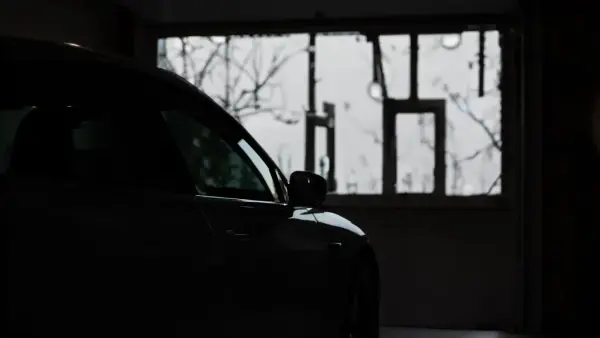
She's 58 and just realized she arrives everywhere fifteen minutes early and sits in the parking lot with the engine running - it was never about punctuality, it was about the girl who watched her mother's visible panic at running late and learned that being seen arriving meant being watched for signs of falling apart

I have been sitting in parking lots for forty years.
Not waiting for anyone. Not killing time. Sitting with the engine running and the radio low, watching the clock on my dashboard count down to the exact minute I’ve decided it’s safe to walk inside. I check my teeth in the mirror. I smooth my hair. I rehearse whether I’ll say “hey” or “hi” or just smile. And then, when it’s time - not early, not late, but precisely, surgically on time - I turn off the car and walk toward the door like someone who just arrived.
No one has ever known about those fifteen minutes. They were mine. They were the only part of the day that felt controllable.
I’m 58 now, and I recently realized that I’ve spent more cumulative hours sitting in parked cars than most people spend on vacation. That’s not a personality quirk. That’s a coping strategy so old I mistook it for who I am.
The clock in my mother’s kitchen ran three minutes fast
She set it that way on purpose. The microwave was four minutes ahead. The clock in the hallway was accurate, but she didn’t trust it. Every morning was a performance of barely-controlled chaos - shoes that couldn’t be found, permission slips unsigned, cereal bowls abandoned mid-bite because the bus was coming and we were, once again, almost late.
My mother wasn’t disorganized. She was overwhelmed. A single parent working two jobs with three kids and a nervous system permanently set to high alert. Running behind wasn’t an inconvenience to her. It was evidence. Evidence that she was failing, that the whole careful structure she’d built was one forgotten lunchbox away from collapsing.
I remember the sound she made when we were late. This tight, hissing inhale through her teeth, followed by silence that felt like standing next to a power line. The car would go faster. Her knuckles would go white on the steering wheel. And we would arrive at school or church or the dentist’s office already mid-apology, already performing the choreography of people who are sorry for existing at the wrong time.
I was maybe nine when I decided I would never make that sound. I would never arrive somewhere already apologizing. I would be early. I would be so early that no one could ever look at me the way they looked at her.
What punctuality actually meant
Here’s what I told myself for decades: I’m just a punctual person. I respect other people’s time. I like being organized.
All of that is true. None of it is the real reason.
The real reason is that arriving on time means arriving when other people are already there. It means walking into a room where heads turn. Where someone might notice you entering. Where there’s a brief, terrible moment when you’re being watched before you’ve had a chance to settle, to find your seat, to compose your face into the expression of someone who belongs.
A 2019 study in the Journal of Anxiety Disorders found that people with social anxiety don’t just fear negative evaluation - they fear being perceived at all during transitional moments. Entering a room, standing up to leave, walking across a space where others are already seated. It’s not the being there that’s hard. It’s the becoming visible.
That’s what the fifteen minutes in the car were always about. Not punctuality. Invisibility management. I needed time to transition from the private self - the one who checks her teeth, who worries about the address, who replays the last conversation she had with the host to make sure she didn’t say anything strange - to the public self. The one who walks in smiling. The one who seems effortless.
The parked car was a decompression chamber between anxiety and performance.
The inheritance nobody talks about
My mother never sat in parking lots. She didn’t have the luxury. She was always running, always behind, always arriving in a cloud of apology and displaced keys. But she taught me something without ever saying it out loud: lateness is a moral condition. Being behind schedule isn’t a logistical problem. It’s a character failure. It means you are the kind of person who cannot hold your life together.
Research from Dr. Gabor Mate has explored how children don’t just inherit their parents’ behaviors - they inherit their parents’ nervous system responses. A child who grows up watching a caregiver in chronic stress around time doesn’t learn to manage time. They learn to manage terror. They learn that the clock is not a tool. It’s a judge.
I didn’t learn time management from my mother. I learned time fear. And the fifteen minutes early was my way of making sure the verdict always came back in my favor.
There’s a particular kind of woman my age who does this. You might recognize her. She’s the one who arrives at the restaurant before everyone else and chooses the seat facing the door. She’s the one who knows exactly how long it takes to drive anywhere because she’s timed every route twice. She has a backup outfit in case the first one feels wrong. She’s checked the weather, the parking situation, and whether the venue has changed its hours since the last time she went.
She looks put-together. She looks like someone who has it figured out.
She is exhausted.
The thing about the car
There’s a reason the car became the place where this ritual lives. A car is private in public. You’re visible but enclosed. No one can hear you breathing. No one can see you checking your face in the mirror for the fourth time. No one knows that you’ve been sitting here since 5:43 for a 6:00 dinner.
The car is the last place where you’re allowed to be nervous before you have to perform calm.
I’ve had entire emotional experiences in parked cars that no one in my life knows about. I’ve cried before baby showers. I’ve done breathing exercises before work meetings. I’ve called my sister from a grocery store parking lot because I suddenly couldn’t remember if I was supposed to bring something to a gathering and the not-knowing felt like it was going to swallow me whole.
A 2021 study published in Psychological Science found that people who engage in elaborate pre-social rituals - checking appearance, rehearsing conversations, arriving early to scope out environments - often score high in conscientiousness and empathy. They’re not anxious because they don’t care. They’re anxious because they care enormously. About being appropriate. About not burdening others. About taking up exactly the right amount of space.
That’s the cruel trick of this kind of anxiety. It disguises itself as consideration.
When being early is actually being afraid
I want to be careful here because punctuality is genuinely a good quality. Respecting other people’s time matters. Planning ahead is a skill. I’m not pathologizing any of that.
But there’s a difference between arriving early because you want to and arriving early because you can’t tolerate the alternative. There’s a difference between liking to be on time and needing to be on time the way you need to breathe.
When the thought of being five minutes late makes your chest tight. When you’ve cancelled plans because you realized you wouldn’t be able to get there with your usual buffer. When you leave a party thinking about whether your arrival was smooth enough. That’s not preference. That’s a nervous system still responding to a threat that ended thirty years ago.
The girl in the backseat who watched her mother’s knuckles go white on the steering wheel - she’s still in there. She’s still bracing. She’s still making sure that this time, this time, no one will look at her with that specific expression that says you are the kind of person who cannot hold it together.
What I’m learning at 58
I still arrive early. I probably always will. But something shifted when I finally named what those fifteen minutes actually were. They weren’t discipline. They weren’t preference. They were a little girl’s best attempt at safety, carried into a grown woman’s life and polished until it looked like a virtue.
Brene Brown has written about how our most ingrained coping mechanisms often start as survival strategies that outlive the original danger. The behavior stays long after the threat dissolves. And we keep doing it not because it works but because stopping feels more dangerous than continuing.
I’m trying something new. Not arriving late - that would feel like jumping out of a plane. But I’m trying to notice the fifteen minutes. To be honest with myself about what they are. To sit in the car and say, out loud sometimes, “You’re not late. You’re not in trouble. Nobody is going to look at you the way they looked at her.”
It doesn’t always work. The nervous system has a longer memory than the mind.
But last week I arrived at a friend’s house at 6:02 for a 6:00 gathering. Two minutes late. I walked in and she was still setting out napkins. Nobody looked up. Nobody noticed. Nobody assessed my entrance for evidence of disorder.
I stood there in her kitchen, holding a bottle of wine, and felt something I can only describe as the opposite of bracing.
If you recognize yourself in this - if you’re the woman in the parking lot, engine running, mirror checked, fifteen minutes ahead of everyone and somehow still not quite ready - I want you to know something. That ritual kept you safe when you needed it. It was intelligent. It was adaptive. You built it when you were small and the world felt like it was watching.
You’re allowed to keep it if it still serves you. But you’re also allowed to know what it is. And you’re allowed to walk through a door two minutes late and discover that the world doesn’t end.
It just keeps setting out napkins.