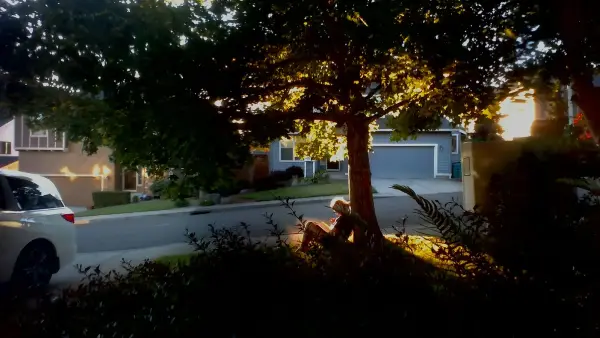
She's 58 and has never once gone to bed with an unresolved argument in the house - not because she forgives easily, but because the girl who lay awake listening to her parents argue through the bedroom wall at night learned that unresolved tension after dark is the most dangerous weather in a home, and the woman she became stays up talking it through because she is standing guard over a silence she swore would never settle into her walls

I used to think I was good at conflict. That I was one of those evolved, emotionally available people who could sit in the discomfort and talk it through. I even took a quiet pride in it - the fact that my husband and I had never gone to sleep in the middle of a fight.
Thirty-one years of marriage. Not one unresolved argument at bedtime. Not one.
It sounds like a virtue when you say it that way. It sounds like something a therapist would applaud, like a sign of a healthy relationship. And for a long time, I let myself believe that’s what it was. But then I turned 58, and I started noticing the girl who was still awake inside me - the one who couldn’t let it go, who had never been able to let it go, not because she was mature but because she was terrified. And I realized the protocol I’d been running my entire marriage wasn’t communication. It was surveillance.
The bedroom wall
I was nine years old the first time I became aware that the house was still awake after I was supposed to be asleep.
My bedroom shared a wall with the kitchen. Thin drywall, old house, the kind where you could hear the hum of the refrigerator if you pressed your ear to the plaster. And that’s where they argued - my parents, standing on opposite sides of the kitchen island, their voices starting low and climbing.
I don’t remember what the fights were about. That’s the thing about being a child in a volatile home - the content disappears, but the architecture stays. I remember the sound of a cabinet closing too hard. I remember my mother’s voice going flat, which was worse than loud, because flat meant she had stopped trying. I remember the clock on my nightstand, the red digital numbers, and how I would watch them change - 10:47, 10:48, 10:49 - as if counting the minutes could somehow keep me safe.
A 2004 study published in the journal Child Development found that children exposed to interparental conflict show heightened physiological stress responses even during sleep, with elevated cortisol levels that persist into the following day. The researchers described it as a nervous system that never fully powers down. I could have told them that. My body learned, long before I had words for it, that nighttime was not for resting. Nighttime was for listening.
The silence that was worse
People think the yelling is the hard part. It’s not.
The yelling was predictable. When my parents raised their voices, I could track the trajectory. I knew the arc - the escalation, the peak, the door slam, the engine starting in the driveway. Terrible, yes. But legible.
The silence was the thing that undid me.
Because silence meant the argument hadn’t ended. It had just gone underground. My father would stop talking, and that meant he had left the conversation without leaving the room. My mother would go quiet, and that meant she was cataloguing something, adding it to a ledger that would surface in three days or three weeks with interest.
The silence after 11 PM in that house was a held breath. It meant the walls were storing something that would come back louder. And I lay in my bed tracking it - the absence of footsteps, the missing sound of the TV turning on, the way the house itself seemed to clench.
I didn’t know it then, but I was installing a rule. An absolute, non-negotiable operating principle that would run quietly in the background of every relationship I ever had: nothing unresolved after dark. Not ever. Not once.
The protocol
I met my husband, David, when I was twenty-six. We were married by twenty-seven. And from the very first disagreement we had - something small, about whose turn it was to call the landlord about the broken heater - I felt the protocol activate.
It was 9:30 PM. He was tired. He wanted to drop it and deal with it in the morning. And something inside me went cold.
Not angry. Not hurt. Cold. Alert. The way you feel when you hear a smoke detector chirp at 2 AM - your body decides it’s an emergency before your brain has any say.
“We need to finish this,” I said. And my voice was calm, but underneath the calm was something that had nothing to do with a landlord or a heater.
We talked for another hour. He didn’t understand why it couldn’t wait. I couldn’t explain it, because I didn’t understand it myself yet. All I knew was that going to bed with that small, unresolved friction sitting between us felt physically dangerous. Like leaving a candle burning in an empty room.
That pattern held for thirty-one years. Every disagreement, no matter how small, gets talked through before the lights go out. I have kept my husband awake until 1 AM, until 2 AM, until the sky starts to lighten. I have stood in the kitchen at midnight, exhausted, eyes burning, and said, “I just need to understand what you meant by that.”
David learned, early on, to stay awake. Not because he agreed with the urgency, but because he understood - perhaps before I did - that this was not negotiable for me. That something in me would rather collapse from exhaustion than lie down next to him in the dark with a sentence still unfinished between us.
What it costs
I want to be honest about this, because the internet loves to romanticize “never going to bed angry” as if it’s a simple choice made by emotionally healthy people. It isn’t. Not the way I do it.
The way I do it is relentless.
I cannot let a small thing go. A comment that stung, a tone that felt dismissive, a plan that was made without consulting me - these are things that other people might sleep on and forget by morning. I cannot forget them by morning because I cannot allow them to exist in the dark.
Dr. John Gottman’s research at the University of Washington showed that couples who repair conflicts quickly tend to have more stable relationships over time. That finding is real, and it probably applies to us. But Gottman also talks about the difference between repair and hypervigilance. One is a choice. The other is a compulsion wearing the mask of a choice.
There have been nights when David looked at me with genuine bewilderment and said, “Julia, this is not a big deal.” And he was right. It wasn’t a big deal. But the girl inside me - the one pressed against the wall at 10:47 PM, tracking the silence - doesn’t know the difference between a small deal and a catastrophe. To her, every unresolved thing after sundown is the same shape.
The cost is exhaustion. The cost is that my husband sometimes feels like he’s not allowed to process anything on his own time. The cost is that I have occasionally turned a minor irritation into a two-hour conversation that left us both drained, not because the issue required it, but because my nervous system demanded it.
The thing nobody says about “never go to bed angry”
“Never go to bed angry” is one of those pieces of marriage advice that sounds wise and universal. You hear it at weddings. You see it on throw pillows. And there’s truth in it - letting resentment calcify is genuinely corrosive to intimacy.
But nobody asks why someone follows that rule.
For some people, it’s a value. They learned it, chose it, practice it with flexibility. They can also recognize when something is small enough to shelve until morning, when sleep would actually help, when the conversation would be better had with rested minds.
A 2017 study in the Journal of Neuroscience found that sleep actually helps consolidate emotional memories in a way that reduces their intensity - meaning that sometimes, going to bed and revisiting a conflict in the morning genuinely produces better outcomes. The participants who slept before re-engaging with the upsetting material showed lower amygdala reactivity than those who stayed awake trying to resolve it.
I read that study and felt something shift inside me. Because it meant that my protocol - the one I’d been treating as wisdom - might sometimes be making things harder. That in my determination to never let the dark hold unresolved tension, I was occasionally forcing resolution at the exact moment when resolution was least available.
But knowing that doesn’t make the protocol stop. That’s the thing about childhood installations. They don’t respond to new information. They respond to the original threat, which lives in the body, not the mind.
The girl and the woman
Here is what I’ve come to understand at fifty-eight.
The woman who keeps her husband up until 2 AM working through a disagreement is not patient. She is not unusually communicative. She is not following advice she read in a marriage book.
She is standing guard.
She is protecting the nighttime for the girl who never had safe darkness. She is making sure that when the house goes quiet, the quiet is real - not a held breath, not a deferred explosion, not a silence that will grow teeth by morning.
Psychologist Dr. Gabor Mate has written extensively about how childhood survival strategies become adult personality traits - behaviors that once kept us safe hardening into patterns that we mistake for identity. I didn’t choose to be someone who resolves every conflict before bed. That pattern chose me, in a bedroom with thin walls, when I was too young to know there was any other way to survive a night.
And here’s the part that catches in my throat when I say it: the protocol works. My marriage is strong. David and I have weathered things that would have broken other couples, and part of the reason is that nothing festers between us. We don’t carry undiscussed hurts for weeks. We don’t let distance accumulate in the dark.
But the reason it works is not the reason I thought. It works not because I’m good at communication, but because the girl inside me is still awake, still listening, still tracking the silence for signs of danger. And the woman I became built an entire marriage around making sure that girl never has to hear what she heard.
What I would tell her
If I could go back to that bedroom - the thin wall, the red clock, the muffled voices rising and falling like weather I couldn’t control - I would tell that girl something I’ve only recently learned to tell myself.
You were not responsible for the silence.
You were not supposed to be the one monitoring the emotional weather of the house. That was never your job. And the fact that you took it on anyway - that you taught yourself to track every shift in volume, every pause, every cabinet closed too hard - speaks to how brave you were, not how broken.
The woman you became carries your vigilance like a lantern. She holds it up in every room she enters after dark, checking the corners, making sure nothing is hiding. And that lantern has kept her marriage warm in ways she doesn’t always recognize.
But you can put it down sometimes. Not every silence is dangerous. Not every quiet room is holding its breath. Some nights, the house is just a house, and the dark is just the dark, and the man sleeping beside you is not going anywhere - not even if the conversation waits until morning.
I’m still learning that. At fifty-eight, I’m still learning to let small things be small. To trust that a disagreement about whose turn it is to call the plumber can survive eight hours of sleep without metastasizing into something that threatens the foundation.
Some nights I manage it. Some nights I don’t.
But I want that girl to know that either way - whether I stay up talking or finally, finally let myself rest - the house is safe. The walls are not storing anything. And the quiet, when it comes, is just quiet.
Nothing more.