She is 58 and just realized she has never once sat down to eat before everyone else had their plate - not at a holiday dinner, not at a weeknight with her family, not even alone in her own kitchen where nobody would know - because a girl who watched her mother eat standing at the counter picking at what was left after the family was served learned that a woman's hunger is the last item on any list, and the plate she finally makes for herself at fifty-eight is always the smallest one at the table
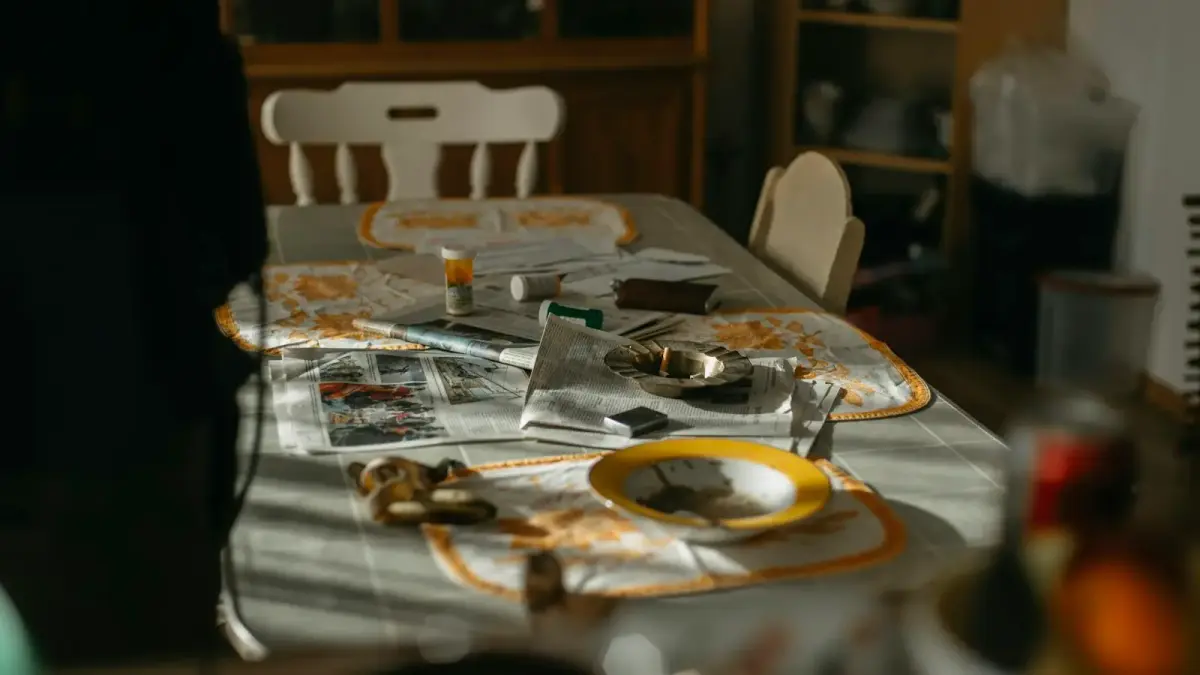
Last Thanksgiving, I stood in my kitchen at 3:47 in the afternoon, hip pressed against the counter, eating stuffing out of the serving dish with a wooden spoon. Everyone else had been seated for twenty minutes. Their plates were full, their wine poured, their napkins in their laps.
I had made the entire meal. And I was eating it standing up, alone, in the kitchen - like it was something I needed to finish quickly before anyone noticed.
My daughter walked in to get more cranberry sauce and stopped. She looked at me. She looked at my empty chair in the dining room. And she said something so simple it cracked me open.
“Mom, why don’t you ever sit down?”
I didn’t have an answer. Not one I could say out loud, anyway. Because the truth is that I have never - not once in fifty-eight years - sat down to eat before everyone else had their plate. Not at holiday dinners. Not on regular Tuesday nights. Not even when I’m alone in my own house with no one to serve, no one to watch, no one who would care if I ate first or last or not at all.
And I didn’t know why until I saw my mother’s face in my own reflection against the dark kitchen window.
The woman at the counter
My mother was a beautiful woman who never sat down for a meal the way other people did. She served. She circled. She stood at the counter and ate what was left - the broken pieces of chicken, the potatoes that stuck to the pan, the salad no one wanted.
She ate like someone who had already decided her hunger wasn’t urgent.
I remember being maybe nine or ten, watching her during a family dinner. My father and brothers were at the table. Their plates were enormous. My mother was at the stove, scraping the last of the green beans onto a plate she’d grabbed - always the smallest one, always the one with the chip on the rim.
She never complained. She never named what she was doing. She just did it with this look on her face like it was as natural as breathing - of course you feed everyone else first. Of course your plate comes last. Of course you stand.
I didn’t know I was learning anything. I thought I was just watching my mother make dinner.
But what I was actually learning was that a woman’s hunger - for food, for rest, for attention, for space - is the last item on any list. And that learning went so deep I couldn’t find the bottom of it for nearly five decades.
How it shows up when you’re not looking
Here’s the thing about this kind of inheritance. It doesn’t announce itself. It doesn’t feel like a wound. It feels like good manners.
I serve everyone first and it feels polite, not painful. I make my plate last and it feels considerate, not compulsive. I eat standing in the kitchen and it feels efficient, not erasive.
That’s what makes it so hard to see. The pattern disguises itself as virtue.
A 2019 study published in the Journal of Family Psychology found that women in heterosexual partnerships spend significantly more time on what researchers call “invisible labor” - the mental and physical work of feeding, organizing, and anticipating other people’s needs. But the study also found something more revealing: many women didn’t identify this labor as a burden. They described it as simply what they did. As who they were.
That’s the trick. When self-sacrifice becomes identity, you can’t separate the two. You’re not a woman who happens to eat last. You’re a woman whose eating last is proof of her love.
And you pass that proof down like a recipe, without writing it on a card.
The smallest plate
I started paying attention after my daughter’s question. Not just to meals, but to everything.
I noticed that when my husband and I go out to dinner, I automatically order less than he does. Not because I’m less hungry. Because something in me believes I should take up less room on the table.
I noticed that I pour my coffee last. That I take the seat closest to the kitchen. That if there’s one piece of cake left, I will cut it in half and offer the bigger piece to whoever is nearest, even if they’ve already had dessert and I haven’t had any.
I noticed that on vacation - on my own birthday vacation - I packed snacks for everyone else and forgot to bring anything for myself.
These aren’t conscious choices. They’re reflexes. They’re what Dana Jack, a psychologist who spent decades studying women and depression, called “self-silencing” - the systematic suppression of your own needs, voice, and desires in order to maintain relationships. Jack’s research, published in her landmark work and later validated in studies across multiple cultures, found that women who self-silence don’t just lose their voice. They lose their ability to recognize they had one.
That’s what happened to my mother. And that’s what happened to me.
The inheritance nobody names
My mother didn’t teach me to eat last. Not with words. She taught me the way mothers teach almost everything - by doing it in front of me a thousand times until it became the water I swam in.
She taught me that love looks like a woman standing while everyone else sits. That devotion looks like giving away the best piece and keeping the broken one. That being a good mother means your needs come last, your rest comes last, your plate comes last.
And she learned it from her mother. Who learned it from hers.
A 2021 study in Frontiers in Psychology examined what researchers call “intergenerational transmission of gender role attitudes” and found that daughters don’t just absorb their mothers’ beliefs about women’s roles - they absorb their mothers’ behaviors. The gap between what a mother says (“You can be anything, sweetheart”) and what a mother does (eats standing up at the counter every night for thirty years) almost always closes in favor of the behavior.
We don’t learn what we’re told. We learn what we witness. And I witnessed a woman who treated her own hunger as an afterthought for my entire childhood.
The grief I feel about this isn’t anger. I’m not angry at my mother. She was doing the best she could with what she inherited. She wasn’t trying to teach me that I didn’t matter. She was trying to show me that she loved us enough to matter last.
But the cost of that lesson was a fifty-eight-year-old woman who still can’t sit down first.
It was never about the food
Here’s what I understand now, standing in my kitchen at fifty-eight with stuffing on a wooden spoon and an empty chair in the next room.
It was never about the food.
The plate was just the most visible version of something much larger. I put myself last everywhere. At work, I volunteered for the tasks no one else wanted and never asked for recognition. In friendships, I was always the one who drove, who hosted, who checked in. In my marriage, I carried the mental load of the household like it was a job I’d been hired for - except the pay was being allowed to stay.
Brene Brown has written about the way women confuse self-sacrifice with worthiness - the belief that you earn your place at the table by making sure everyone else is comfortable first. That if you sit down before the serving is done, if you take the biggest piece, if you eat before anyone else has been fed, you are somehow failing at the one thing you were put here to do.
But here’s what I’ve come to believe in the last year, slowly and with great difficulty.
A woman who never sits down isn’t showing love. She’s showing a wound. And the people she’s feeding - her children, her partner, her family - are learning that wound as love. They’re watching her, the way I watched my mother, and they’re absorbing the lesson that a woman’s hunger always comes last.
The plate she makes at fifty-eight
I’m trying to change this. I want to be honest about that - I’m trying, not succeeding. Not yet.
Last week I made dinner, and I served myself first. It took every ounce of willpower I had. My hands felt wrong holding a full plate while the serving dishes were still on the counter. My body wanted to keep moving, keep circling, keep making sure everyone had enough before I took any.
I sat down. I put my napkin in my lap. And I waited for my family to serve themselves.
Nobody died. Nobody went hungry. Nobody even noticed, except my daughter, who looked at me from across the table and smiled.
The plate I made for myself that night was still the smallest one. I’m not going to pretend I’m cured of fifty-eight years of programming. The portion was modest. The serving was careful.
But I was sitting down when I ate it.
And somewhere - I know this doesn’t make logical sense, but I feel it in my body - somewhere, my mother was sitting down too. For the first time. In a kitchen that doesn’t exist anymore, at a table where no one needed anything from her, finally making a plate of her own.
Not the scraps. Not the leftovers. Not the broken piece stuck to the bottom of the pan.
Just a plate. A full one. And a chair.