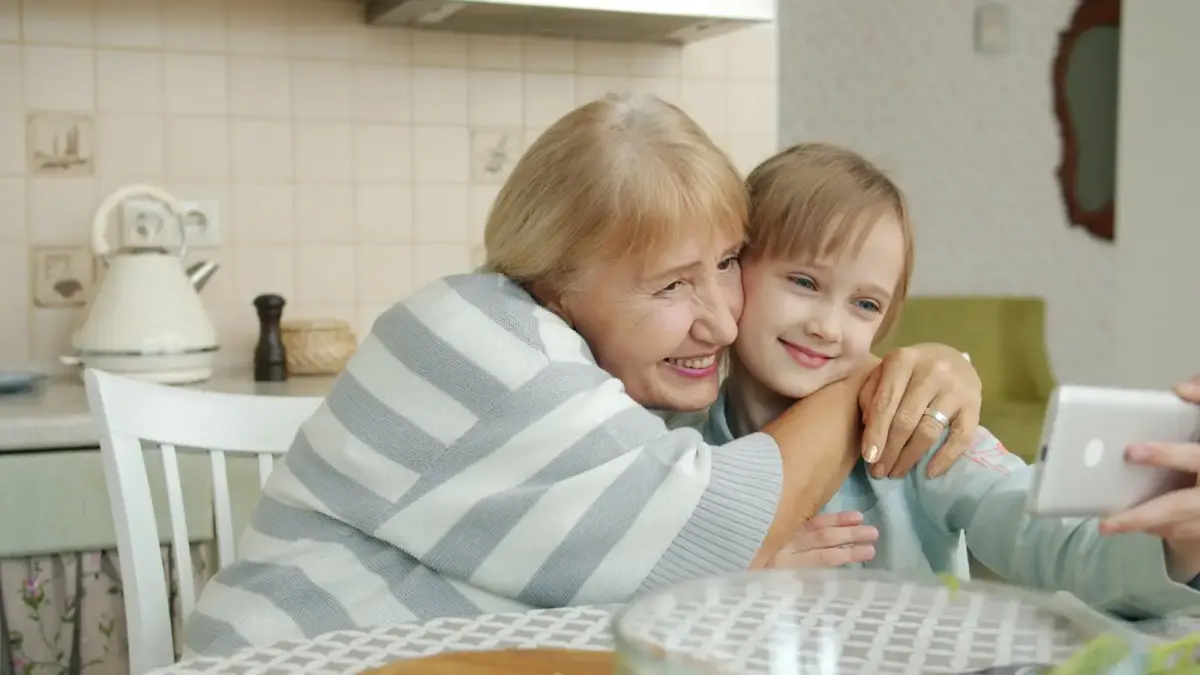
She's 59 and has quietly realized that the tightness she feels when she watches her daughter scroll through her phone during a conversation is not about phones or rudeness - it is that she grew up in a generation where the only proof someone was listening was their eyes, and a woman who spent fifty years reading faces to know whether she was safe has no way to decode a person who is looking down
I noticed it again last Tuesday.
My daughter was telling me about a trip she’s planning with friends - somewhere warm, somewhere with good food - and she was genuinely excited. I could hear it in her voice. She was mid-sentence, scrolling through photos on her phone to show me the hotel she’d found, and I felt it. That familiar tightness across my chest. That quiet contraction behind my ribs that I used to mistake for irritation.
I almost said something. I almost did the thing I’ve trained myself not to do anymore, which is to say, “Can you put that down and look at me when you’re talking?” Because I’ve said that before, and it never lands the way I mean it. She hears criticism. I mean something else entirely, something I couldn’t name until very recently.
It is not about the phone. It was never about the phone.
The language I learned before I had words for it
I grew up in a house where you watched faces the way other people watch weather.
My mother’s mood lived in her jaw. If it was soft, the evening would be easy. If it tightened - even slightly, even just a shift in the way she held her mouth while stirring something on the stove - you adjusted. You got quieter. You made yourself smaller or more helpful or more invisible, depending on what the jaw seemed to need.
My father’s love lived in his eyes. He wasn’t a man who said much. But if you told him something and his gaze stayed on your face, steady and unbroken, you knew you had him. You knew you mattered. You knew, for that moment, you were the most important thing in his world.
I didn’t learn this consciously. No one sat me down and explained it. But by the time I was seven or eight, I had a fluency in faces that most adults never develop. I could walk into a room and tell you, within seconds, whether it was safe to speak.
A 2009 study published in Psychological Science found that children raised in emotionally unpredictable households develop heightened sensitivity to facial microexpressions - particularly around the eyes and mouth. The researchers called it “adaptive vigilance.” The children weren’t anxious by nature. They became highly skilled readers of faces because their safety depended on it.
I read that study three years ago, and I sat with it for a long time.
Fifty years of reading the room
Here is what nobody tells you about growing up as a face-reader: it doesn’t stop when you leave home.
You carry it into every friendship, every job, every marriage, every parent-teacher conference. You walk into a dinner party and within ninety seconds you know who’s angry, who’s pretending, who had a fight in the car on the way over, and who is about to cry if one more person asks them how they’re doing.
You carry it into love. When my husband and I were young, I could tell whether he’d had a hard day before he said a single word. Not from his posture or his tone. From the space between his eyebrows. From whether his eyes found mine when he came through the door, or whether they drifted past me toward something neutral - the counter, the mail, the dog.
Eyes that found you meant you were still chosen. Eyes that drifted meant something had gone wrong, and you needed to figure out what, quickly, before it settled into something permanent.
I know how this sounds. I know it sounds exhausting. But when it’s the only emotional language you’ve ever known - when eye contact is the only reliable signal for love, safety, and belonging - it doesn’t feel like a skill. It feels like breathing.
You don’t notice you’re doing it until someone takes it away.
What the phone actually removes
My daughter is thirty-one. She is kind, thoughtful, and genuinely interested in my life. She calls me more than most of her friends call their mothers. She remembers things I’ve told her. She sends me articles she thinks I’ll like.
She also looks at her phone during almost every conversation we have.
And for years, I told myself the tightness I felt was about manners. About respect. About a generational gap in what constitutes politeness. I told myself I was being old-fashioned, that this is just how younger people communicate now - half in the room, half in the screen - and that I needed to get over it.
But it wasn’t about manners. It was never about manners.
When my daughter looks down at her phone while I’m talking, she removes the only signal I have ever trusted to tell me whether I’m being heard. She doesn’t know she’s doing this. She has no idea that her downcast eyes feel, to me, like a door closing.
Because she grew up in a different world. She grew up in a world where attention is ambient - where you can listen deeply while your eyes are somewhere else, where love doesn’t require a locked gaze, where being present doesn’t demand the same physical proof it demanded of me.
She is listening. I believe that. But my nervous system doesn’t.
The body keeps the old rules
Research on attachment and nonverbal communication helps explain why this gap feels so visceral. A 2017 study in the Journal of Nonverbal Behavior found that for individuals who developed secure or anxious attachment in childhood, mutual gaze during conversation activates the same neural reward pathways as physical touch. Eye contact doesn’t just signal attention. For people wired this way, it signals safety.
When that eye contact disappears - even for a neutral reason, even because someone is checking a text - the body doesn’t process it as a minor interruption. It processes it as withdrawal.
This is not rational. I know my daughter loves me. I know she’s listening. I know the phone is not a verdict on my worth.
But I spent fifty years in a world where the only proof of love was a face turned toward yours. Where the only evidence that you were safe was a pair of eyes that stayed. Where attention wasn’t something you assumed - it was something you watched for, tracked, measured in real time by the direction of someone’s gaze.
You can’t unlearn that in a decade. You can’t override it by telling yourself to be more modern.
The body keeps the old rules long after the mind has accepted the new ones.
She doesn’t know what she’s speaking
Here is the part that is hard to say out loud.
When my daughter looks down at her phone while I’m telling her something that matters to me, she is accidentally speaking a language she doesn’t know she’s using. In the dialect I grew up with, averted eyes meant one of three things: boredom, disapproval, or emotional departure. There was no fourth option. There was no version of “I’m listening but my eyes are somewhere else” that registered as anything other than loss.
She doesn’t know this. She has no reason to know this. Her generation developed a completely different grammar for attention - one where presence is measured in responses, not in gaze. She proves she was listening by referencing something I said three days later. She proves she cares by sending a follow-up text that evening. Her love has receipts. They’re just not the kind my nervous system recognizes in real time.
And I think this might be one of the quietest heartbreaks between generations - not that we love each other less, but that we prove it in languages the other person can’t fully read.
Learning to translate
I haven’t solved this. I want to be honest about that.
I still feel the tightness. I still notice, every single time, when her eyes leave my face and drop to the screen. My body still tenses. The old part of me - the seven-year-old who learned to scan her mother’s jaw - still whispers that something is wrong, that I’ve lost her, that I need to adjust.
But I’ve started doing something different with that feeling. Instead of reacting to it - instead of saying “put that down” or going quiet in a way that punishes us both - I let it sit. I notice it. I name it privately.
That’s not rejection. That’s a phone. She’s still here.
Sometimes I say it out loud, gently, in a way that isn’t an accusation. “I know this is my thing, but can you look at me for this part? This one matters to me.” And she does. Every time. Without defensiveness, without rolling her eyes. She looks up, and her face is open, and the tightness releases.
She didn’t know she’d looked away. She wasn’t leaving. She was just existing in the way her generation exists - partially here, partially there, attention distributed rather than fixed.
Daniel Goleman writes about this kind of emotional recalibration - learning to separate what your body is telling you from what is actually happening. He describes emotional intelligence not as the absence of old reactions, but as the growing space between the reaction and what you do with it. I think about that a lot.
What I want her to know someday
I don’t want my daughter to feel guilty about her phone. I genuinely don’t. She is not doing anything wrong. She is not being rude. She is living in her time the way I lived in mine.
But I do want her to know, someday, perhaps when she’s older - perhaps when she has a daughter of her own who communicates in some way she can’t quite decode - that the women who raised her came from a world where love was proven with the face.
Where the most intimate thing another person could do was hold your gaze and stay.
Where safety wasn’t a concept. It was a direction someone’s eyes were pointing.
I want her to know that when I asked her to look up, I wasn’t being controlling. I was asking her to speak to me in the only language my heart has ever fully trusted.
And I want her to know that I’m learning hers. Slowly. Imperfectly. With all the awkwardness of a woman who started studying a new language at fifty-nine.
But I’m learning.
That has to count for something.