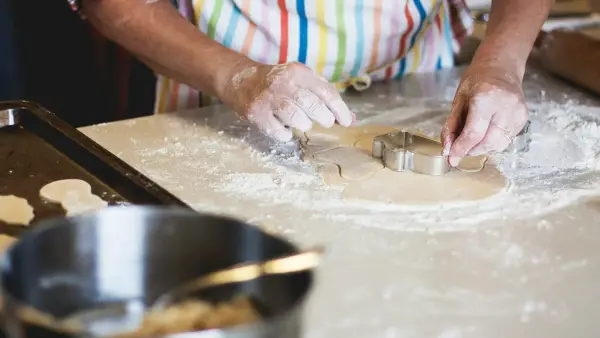
She's 60 and just counted the meals in her freezer - fourteen full dinners, labeled and dated, stacked in an order she has memorized, ready for anyone who might be going through something - because a girl who watched her mother show up at every neighbor's door with a casserole dish wrapped in a towel learned that love is a container you fill and carry to someone's front step
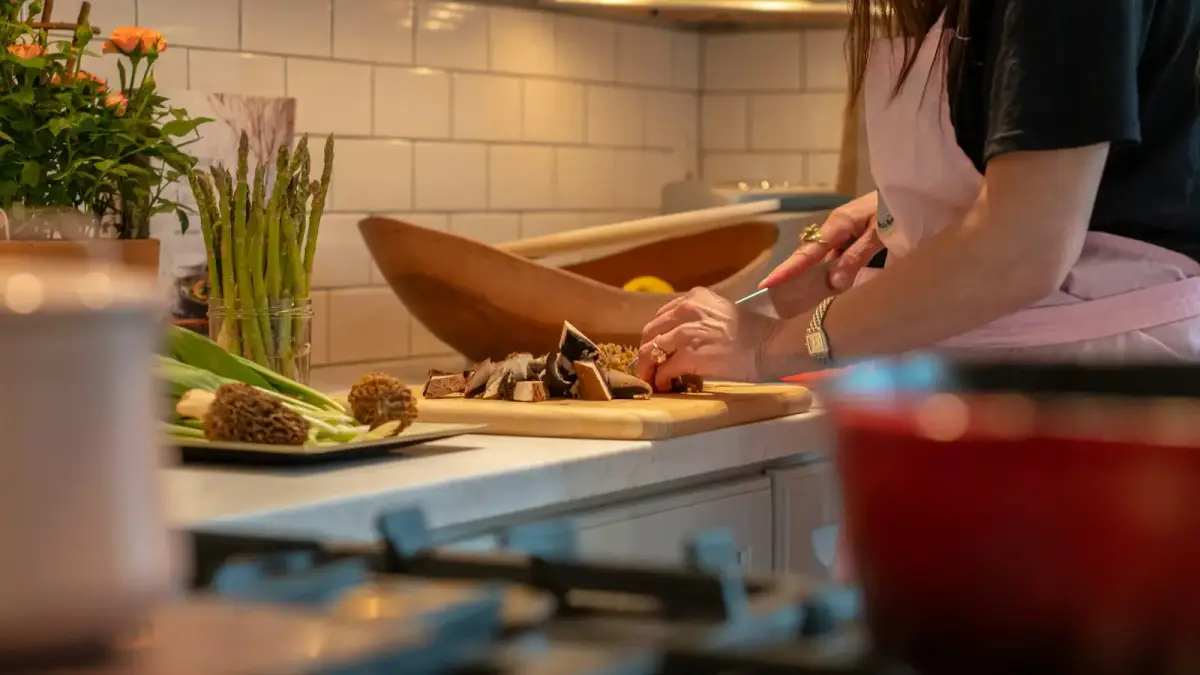
She Knows Exactly What Is in There
I watched a woman open her chest freezer last week. She didn’t rummage. She didn’t dig through frosted bags or push aside mystery containers. She reached in with the confidence of a librarian who knows every title on every shelf and pulled out a foil-wrapped lasagna dated October 14th.
“That one’s for heavy situations,” she told me. “Lasagna is what you bring when someone dies or gets a diagnosis. Soup is for when someone’s just tired. Chili is for the families with teenagers who need something fast. Pot pie is for the people who live alone - it reheats in single servings.”
She is sixty years old. There are fourteen full meals in that freezer right now. She could tell you every one of them without looking.
And the thing that stopped me cold - the thing I haven’t been able to shake - is that nobody asked her to do this. No one placed an order. No organization assigned her a rotation. She simply maintains this inventory the way some people maintain a savings account. Not because she expects disaster, but because she has decided she will never be caught without something to offer when someone she loves is hurting.
This is not a hobby. This is not a quirk. This is what happens when a girl grows up watching her mother wrap a dish in a towel and walk it across the street every single time the world got hard for someone nearby.
The Mother With the Towel-Wrapped Dish
She talks about her mother like she’s describing weather. Matter of fact. Constant.
“Mom didn’t ask people what they needed,” she said. “She just showed up. Someone’s husband left - she was there with chicken and rice before the kids got home from school. Someone had a baby - she brought enough food for three days. Someone lost a job - she’d leave something on the porch so they didn’t have to answer the door and pretend they were fine.”
Her mother never called it love. Never framed it as generosity. It was just what you did. You heard something happened and you started cooking. The feelings came later, or they didn’t come at all, because the food was the feeling. The act of wrapping aluminum foil around a warm dish and carrying it with both hands to someone’s front step - that was the entire emotional vocabulary.
A 2000 study by psychologist Shelley Taylor and her colleagues at UCLA fundamentally changed how we understand stress responses. Taylor’s research on the “tend and befriend” response showed that women, in particular, respond to stress and threat not primarily through fight-or-flight but through caregiving behaviors and strengthening social bonds. The tend-and-befriend response is mediated by oxytocin and is deeply wired into how many women process difficult emotions - their own and everyone else’s.
The woman with the full freezer didn’t learn this from a textbook. She learned it from a mother who never sat still when someone was suffering.
The Inventory She Keeps in Her Head
Here is what I find remarkable. She doesn’t use a list. She doesn’t label the containers for her own reference. She labels them so that whoever receives the meal knows what it is and when it was made - because she remembers that her mother always told people, “It’s fresh, I made it Tuesday,” and that detail mattered. It said: I didn’t grab something old from the back of my freezer. I made this. Recently. With you in mind, even before I knew it would be for you.
The labeling is not organizational. It is emotional. It is a woman saying, through Sharpie on aluminum foil, that this food was prepared with intention.
She rotates the meals every six weeks. Anything older gets cooked for her own dinners or given to her grown children. The freezer is never stale. It is curated.
And she has a mental map of who in her life might need something soon. Her neighbor whose husband has been doing chemo. Her friend from church whose daughter just moved across the country. The young couple down the street who just had twins and probably haven’t slept more than three consecutive hours in a month.
She is not waiting for a crisis. She is reading the room of her entire community and staying one step ahead of the moment when someone will need to be fed.
Why Food and Not Words
I asked her why she doesn’t just call people. Why she doesn’t send a card or a text message. She looked at me like I’d asked why she doesn’t just describe water to someone who is thirsty.
“You can’t eat a phone call,” she said.
There is a whole body of research that supports what she knows instinctively. John Gottman’s decades of work on relationships has shown that emotional connection is built far less through grand gestures and declarations than through small, consistent, anticipatory acts of care - what Gottman calls “turning toward” your partner’s bids for connection. But this principle extends well beyond romantic relationships. The person who notices you’re struggling before you’ve said anything, and who shows up with something tangible - that person is building the kind of trust that words alone cannot construct.
Food, in particular, operates on a level that bypasses our intellectual defenses. You can refuse comfort. You can wave away sympathy. You can insist you’re fine and close the door. But a warm container of soup left on your porch enters your house whether your pride is ready or not. And when you’re standing at your counter at nine o’clock at night, too exhausted and too sad to cook, and you open that container and the smell fills your kitchen - that’s when the love lands.
She knows this. Not because she read Gottman. Because she was once the kid who watched a grieving widow open the door and burst into tears at the sight of her mother holding a casserole dish with both hands.
The Casserole Culture Nobody Talks About Anymore
There is a tradition in certain communities - Southern, Midwestern, rural, church-going, working-class - that has quietly sustained millions of families through the worst moments of their lives. It doesn’t have a formal name in most places. Sociologists sometimes call it “casserole culture” or “food-based mutual aid.” But the women who practice it don’t call it anything at all. They just do it.
It works like this. Something happens. Word travels. And within twenty-four hours, food starts arriving. Not coordinated by an app. Not organized by a committee. Just women who heard, and who started cooking, and who showed up.
A 2019 study published in the journal Appetite found that the act of preparing food for others activates neural pathways associated with caregiving and social bonding - the same pathways that light up during nurturing physical contact. Cooking for someone in distress is not metaphorically like holding them. It is, neurologically, a version of the same impulse.
The woman with the fourteen meals in her freezer is part of a lineage of women who understood something the self-help industry keeps trying to monetize and complicate: that presence is best when it is practical. That showing up means bringing something. That love, when it is real, has weight and temperature and can be reheated at 350 degrees.
What People Get Wrong About Her
Someone once told her she should “set boundaries” around her cooking. That it was “codependent” to maintain a freezer full of meals for people who hadn’t asked for them.
She laughed when she told me that.
“Codependent,” she repeated. “I’m not doing this because I need them to need me. I’m doing this because when my mother died, six women brought food to my house within four hours. And I sat at my kitchen table surrounded by containers of things that people had made with their hands, and I thought - this is what it looks like when you are not alone. This is proof.”
She’s right, and the psychology backs her up. There is a meaningful difference between compulsive caregiving driven by anxiety and what researchers call “proactive prosocial behavior” - the deliberate, self-directed choice to prepare for the needs of others. A 2021 study in Frontiers in Psychology found that individuals who engage in planned, anticipatory acts of kindness - what the researchers termed “emotional provisioning” - report higher levels of life satisfaction and lower levels of depression than those who help only reactively.
She is not over-functioning. She is not compensating for emptiness. She is a woman who has decided that one of the ways she will move through the world is with her hands full of something warm, ready to set it down on the counter of whoever needs it next.
The Fourteen Meals Are Not About Food
This is what I keep coming back to.
The lasagnas and the soups and the labeled containers of chili are not really about feeding people. They are about a woman who has made a promise to herself that she will never witness suffering and have nothing to offer. That she will never stand in someone’s doorway, empty-handed, saying “let me know if you need anything” - which, as she pointed out to me, is the most useless sentence in the English language.
“People in pain don’t know what they need,” she said. “That’s the whole point. You don’t ask. You just bring it.”
She is sixty years old. Her mother has been gone for twelve years. And every time she labels a container with a date and slides it into its place in the freezer, she is continuing a conversation with a woman who taught her that love is not a feeling you describe. It is a thing you make with your hands and carry with both arms and leave on a doorstep without being asked.
The freezer hums in her garage. Fourteen meals, waiting.
Not because anyone has asked.
Because she promised herself she would always be ready.
And she is.