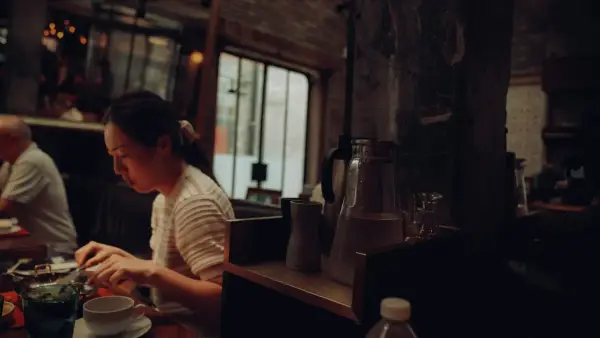
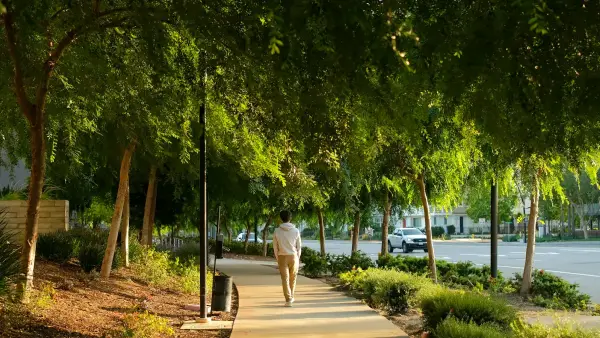
She is sixty-one and has just realized that every vacation she has ever planned included at least one afternoon alone - a museum visit she did not invite anyone to, a walk she took while everyone else was at the pool, a coffee shop three blocks from the hotel where she sat for two hours reading - and the girl who used to hide in the bathroom at family reunions just to hear herself think has spent forty-nine years building socially acceptable excuses for the one thing she has always needed and never been able to ask for without apology: time by herself that nobody takes personally
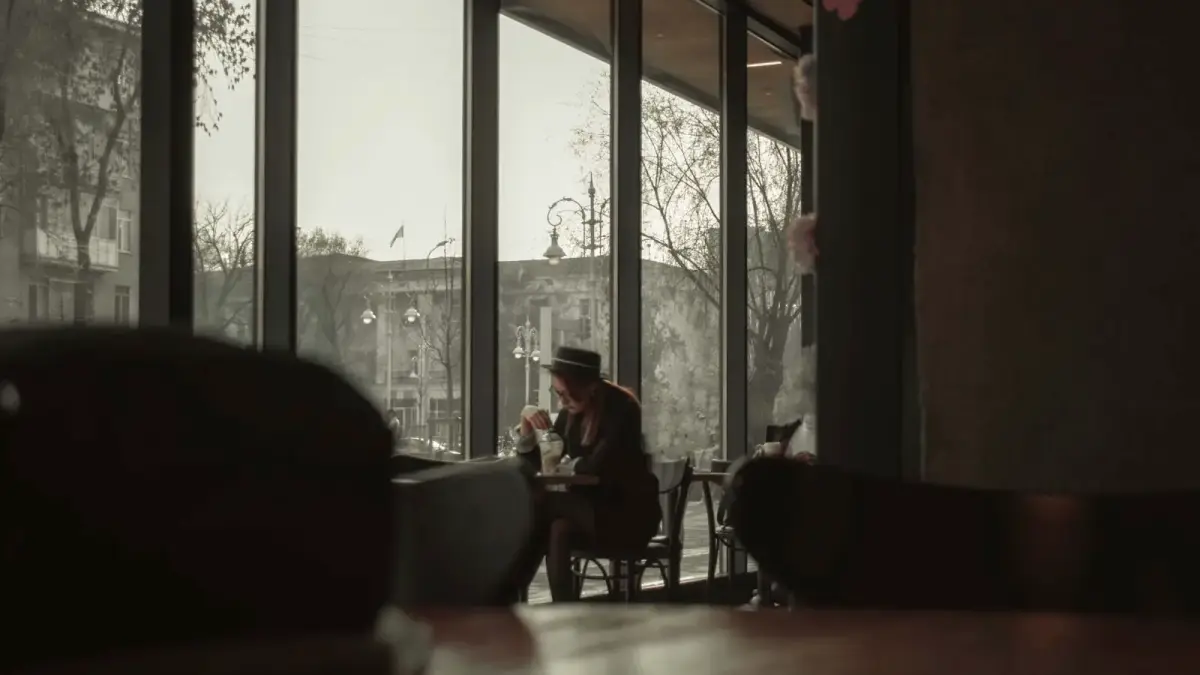
I found the pattern on a Tuesday evening, flipping through old travel photos on my laptop. Cancun, 2004 - there I am at a tiled courtyard cafe, alone, a novel cracked open beside a cup of something I don’t remember ordering. Lake Tahoe, 2011 - a photo my sister took of the cabin’s empty porch with the caption “Where did you go?” Paris, 2017 - a museum ticket stub tucked into my journal for an exhibit I never mentioned to anyone on the trip.
Every vacation I have ever planned - every single one across four decades of marriage, motherhood, and friendships I genuinely treasure - included at least one afternoon where I quietly disappeared.
Not a full day. Never a full day. That would have required an explanation I didn’t have language for. Just an afternoon. A few hours. Enough time to sit somewhere nobody knew my name and breathe in a way I apparently cannot breathe when people I love are in the next room.
I am sixty-one years old, and I just realized I have been building architecturally precise escape routes my entire adult life - not from people I dislike, but from the simple, relentless weight of being perceived.
The Bathroom at the Family Reunion
I was twelve the first time I understood that wanting to be alone was something I needed to hide.
My mother’s family gathered every July at my aunt’s house in Connecticut - thirty-some cousins, uncles who talked over each other, aunts who moved through the kitchen in choreographed rotations. I loved them. I still love them. But by two in the afternoon, something inside me would start to fray, like a rope pulled from both ends, and I would slip away to the upstairs bathroom and sit on the edge of the bathtub with the door locked and just listen to myself think.
My cousin Diane found me once. She knocked, then tried the handle, then pressed her mouth to the crack in the door and asked if I was okay.
I said I had a stomachache.
That was the first lie. The first in a long, elaborate series of lies I would tell for the next forty-nine years - not because I was doing anything wrong, but because I had no way to say “I need to be alone for twenty minutes” without someone hearing “I don’t want to be around you.”
Learning to Disguise It
By high school, I had developed a sophisticated vocabulary for the thing I could never name.
“I’m going to run to the store.” “I think I’ll take a walk.” “I just need to clear my head.” “I’m going to turn in early - I’m exhausted.” “I’ll catch up with you guys later.”
Every phrase was a small architectural achievement - a door that opened outward, away from the group, without making anyone feel like they were the reason I was leaving. Because they weren’t. That was the part I could never make land. The leaving was never about them.
A 2020 study published in the Journal of Personality and Social Psychology found that people consistently misinterpret others’ desire for solitude as a sign of social rejection or depression. Researchers called it the “solitude stigma” - the cultural assumption that choosing to be alone signals something broken rather than something deliberate. The people in the study who most valued solitude reported the highest levels of guilt about pursuing it.
I read that and felt seen in a way that almost hurt.
Because the guilt was always the second wave. The first wave was the relief - that enormous, physical exhale of walking into a room where nobody needed anything from me. And then, right behind it, the guilt of feeling relieved. As if the people I loved were a burden I was setting down, when really what I was setting down was the performance of being endlessly available.
The Architecture of the Alone Afternoon
Over the years, I perfected it.
On family vacations, I volunteered for the grocery run. I would drive to the store, buy what we needed in fifteen minutes, and then sit in the parking lot for forty-five more, reading in the car with the windows down. When I came back, nobody questioned the hour I’d been gone. Grocery stores are unpredictable. Lines are long.
I woke up before everyone else. Five-thirty, sometimes five. Not because I am a morning person - I am not - but because those pre-dawn hours in a quiet kitchen were the only ones that belonged entirely to me. No one asks why you’re up early. Early rising is coded as virtuous. It is the most socially rewarded form of solitude available.
I went to bed early with a book and called it tiredness. I took the dog for walks that lasted twice as long as they needed to. I sat in my car in the driveway for ten minutes after coming home from work, and if anyone noticed, I was “finishing a podcast.”
The hotel room, though. The hotel room was the masterpiece.
There is a specific quality to a hotel room at eleven in the morning when everyone else has left for the beach or the theme park or the guided tour. The door clicks shut. The air conditioning hums. The bed is made by someone who doesn’t know you and doesn’t care what you do next. And for two hours, you are no one’s mother, no one’s wife, no one’s friend, no one’s colleague. You are just a woman sitting on a bed that doesn’t belong to her, reading a book in a city that doesn’t know her name.
That was never escape. I understand that now. That was maintenance.
The Energy Budget Nobody Can See
Susan Cain wrote in Quiet that introversion is not about disliking people. It is about where your energy comes from. Extroverts are charged by social interaction the way a phone charges on a wireless pad - passively, just by being near the source. Introverts are drained by the same interactions that fuel everyone around them, and they recharge in silence and solitude the way the rest of the world recharges in company.
I have read that passage maybe thirty times, and every time it rewires something in me.
Because for most of my life, I believed that needing to be alone meant something was wrong with me. That the right kind of woman - the good mother, the engaged wife, the fun friend - would never feel that tug toward an empty room. That the pull toward solitude was a deficiency, a failure of warmth, proof that I loved people less than I should.
But it was never about loving people less. It was about managing an energy budget that nobody around me could see.
A 2022 study in Frontiers in Psychology drew a critical distinction between chosen solitude and imposed solitude. Chosen solitude - the kind you seek out deliberately - was associated with increased creativity, emotional regulation, and a deeper sense of self. Imposed solitude - loneliness, isolation, exclusion - was associated with depression and anxiety. The researchers emphasized that the two states are neurologically distinct. They light up different regions of the brain entirely.
I did not want to be alone because I was lonely. I wanted to be alone because the world is loud and I needed somewhere to set it down.
What Nobody Tells You About Needing Less
There is a particular kind of shame that belongs to people who need less social contact than the culture prescribes.
You learn young that there is a correct amount of togetherness, and that falling below it makes people nervous. You learn that “I’d rather stay home” is heard as “I’d rather not be with you.” You learn that reading a book at a party is rude, that leaving early is suspicious, that closing your bedroom door is a statement.
And so you compensate. You overcorrect. You become the person who plans the trip, organizes the dinner, hosts the holiday - because if you’re the one holding it all together, nobody notices when you slip away for an hour. The hostess can always disappear into the kitchen. The organizer can always step outside to make a call.
I spent decades being the most socially competent introvert in every room. Warm. Engaged. Genuinely interested in people - because I am. That part was never performance. I love conversation. I love my friends. I love sitting at a long table with people I’ve known for thirty years, passing wine and talking about nothing important.
I just can’t do it for eight hours straight without something inside me going quiet in a way that frightens me.
A 2017 study published in the Journal of Research in Personality found that introverts who regularly achieved their preferred level of solitude reported significantly higher life satisfaction than introverts who did not. The researchers noted something else: the introverts who were most satisfied were not the ones who spent the most time alone. They were the ones who felt the least guilt about the alone time they did take.
That sentence stopped me cold when I first read it.
The Permission She Is Learning
I am sixty-one.
My children are grown. My husband knows me well enough by now to recognize the look - that particular softening around my eyes that means I’ve been “on” for too long. He’ll say, “Go read for a while,” and he means it, and I love him for meaning it. But it took thirty-four years of marriage for me to stop hearing that offer as proof that I was failing at closeness.
I am learning, slowly and imperfectly, to say “I need an hour” without adding “because” after it.
No because. No reason. No errand to justify the departure, no tiredness to explain the early retreat, no headache to excuse the closed door. Just the bare, undecorated truth: I need an hour alone, and that need is not a commentary on you.
It sounds simple. It is the hardest sentence I have ever tried to say without flinching.
Because underneath every excuse I built across five decades - every fake grocery run, every early bedtime, every museum visit I did not invite anyone to - was a girl sitting on the edge of a bathtub in Connecticut, pressing her palms against her ears, trying to find the frequency of her own thoughts underneath all that noise.
She was never hiding from her family. She was looking for herself.
And the afternoon alone - the one she has tucked into every vacation, every holiday, every long weekend for forty-nine years - was never an escape hatch. It was a love letter to the person she could only find in silence.
At sixty-one, she is done apologizing for that person. She is done disguising the search as errands. She is learning to walk out of a room full of people she loves and say nothing more than “I’ll be back in an hour,” and to let that be enough.
It is enough. It was always enough. She just didn’t know she was allowed to believe that.