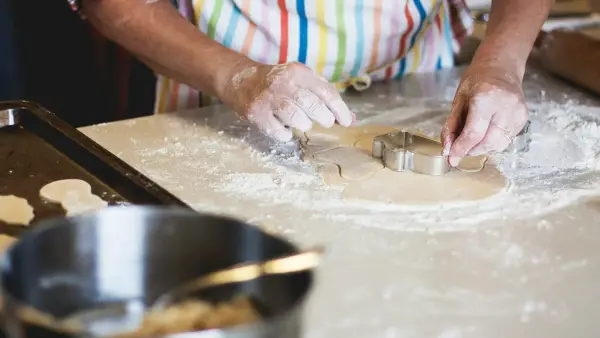
She is 62 and just realized she still hand-addresses every envelope she mails - the Christmas cards, the birthday cards, the thank-you notes, the occasional letter to a friend who moved three states away - even though she owns a printer, even though address labels exist, even though most people will glance at the front and never notice the handwriting, because a girl who watched her mother sit at the kitchen table every December and write fifty-three addresses from memory in that steady, careful cursive that no school teaches anymore learned that your name in someone else's handwriting on the outside of an envelope is not information but proof that a person sat down and thought about you long enough to shape every letter
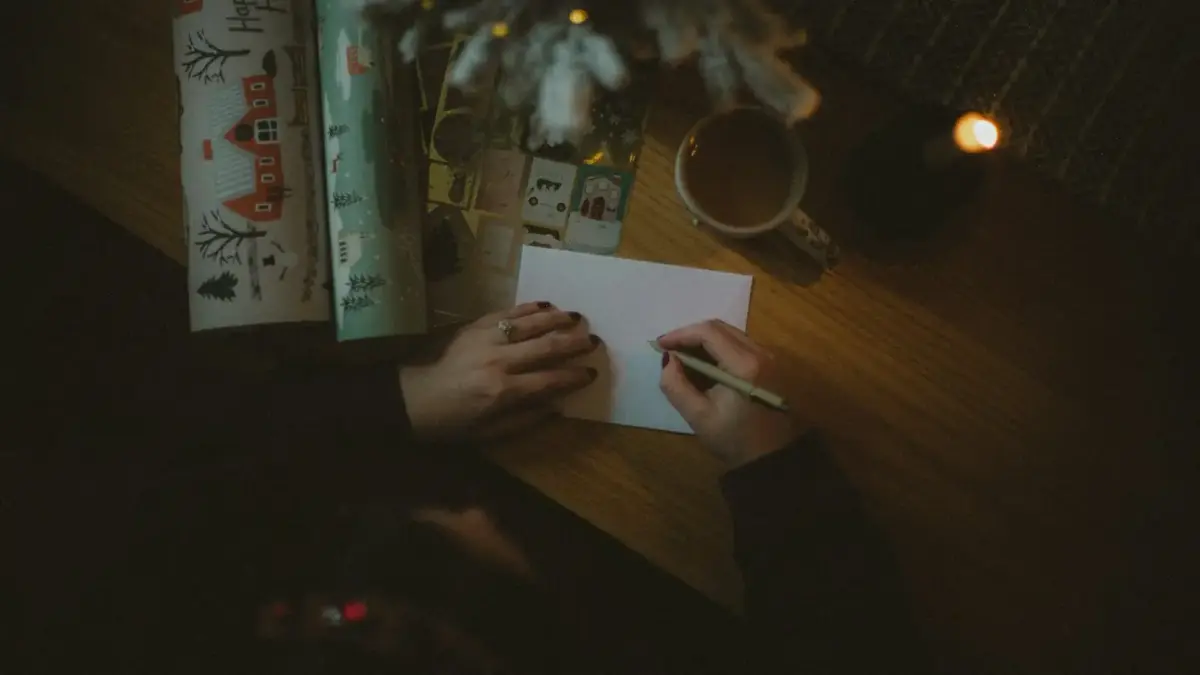
I caught myself doing it again last Tuesday. Sitting at the dining room table with a stack of holiday cards, a blue pen, and my reading glasses sliding down my nose. Writing addresses by hand. Every single one.
My daughter walked through the room and stopped. “Mom, you know I can print those for you in about four minutes, right?” She said it gently, the way you say things to someone who is doing something slightly inefficient and slightly beautiful at the same time.
I told her I knew. And then I kept writing.
It wasn’t until later that night, standing in the kitchen with a cup of tea going cold in my hand, that I understood something I’d been doing for forty years without ever examining it. I hand-address every envelope I send. Not because I’m a Luddite. Not because I forgot printers exist. But because a long time ago, a woman at a kitchen table taught me - without saying a single word about it - that handwriting someone’s name is a small, deliberate act of love.
The Kitchen Table in December
My mother started her Christmas cards the week after Thanksgiving every year. Same table. Same chair. Same box of blue ballpoint pens from the drugstore because she said they didn’t smear.
She had a green address book that was falling apart. Pages held in with tape. Names crossed out and rewritten when people moved. A few names with no addresses at all anymore, just the name and a date next to it. I didn’t understand those entries when I was eight. I understand them now.
She would sit there for hours. Not rushed. Not distracted. Just writing. Fifty-three cards was her average, though some years it was more and some years it was fewer, depending on who had entered or exited her life since the previous December.
I would sit across from her sometimes and do homework. Or pretend to do homework while actually watching her hand move across envelope after envelope. She wrote every address from memory. No checking the book unless it was someone new. She just knew where people lived, the way you know the phone number of the house you grew up in.
A 2019 study published in the journal Frontiers in Psychology found that handwriting activates neural networks associated with memory, emotion, and identity in ways that typing simply does not. Researchers observed increased activity in areas of the brain linked to emotional processing when participants wrote by hand versus using a keyboard.
My mother did not know this research existed. She just knew it felt wrong to print a label for someone you loved.
What Gets Lost When Everything Gets Efficient
I own a very nice printer. It sits on the desk in what we call the office, which is really just a corner of the spare bedroom with a bookshelf and too many candles. The printer works perfectly. I use it for insurance forms and return shipping labels and the occasional recipe I want to keep.
I have never once used it to print an address on an envelope.
There’s a reason for that, and it took me sixty-two years to put words around it. When you type someone’s address into a template and press print, you produce information. Accurate, legible, efficient information. The mail carrier can read it. The sorting machine can read it. The envelope arrives exactly where it should.
But something is missing. Something the recipient might not consciously notice but would feel the absence of, the way you feel the absence of a hand on your back even though nobody told you they were going to put it there.
What’s missing is evidence. Evidence that a living, breathing person sat down and gave their time - which is the only resource that cannot be manufactured - to the act of thinking about you.
The Quiet Language of Cursive
My mother wrote in cursive. Real cursive, the kind where the letters connect and the pen barely leaves the paper. The kind that looks like a river when you squint at it.
Most schools stopped teaching cursive years ago. My grandchildren can barely read it, let alone write it. When I showed my grandson a birthday card from my mother - one I’d kept in a drawer for two decades - he looked at it like it was written in another language.
In a way, it was.
A 2014 study in the Journal of Research in Personality found that people consistently rated handwritten messages as more sincere, more effortful, and more emotionally meaningful than identical messages delivered digitally. The content was the same. Word for word, the same. But the handwritten version carried something extra. The researchers called it “perceived effort.” I would call it something simpler.
I would call it presence.
When my mother wrote your name on an envelope, her hand was making shapes that belonged only to her. No two people write the same way. The slant of the letters, the pressure of the pen, the way certain letters get a little wild when she was tired - all of that was hers alone. It was as unique as a fingerprint and as intimate as a voice.
You cannot replicate that with a laser printer. You can replicate the information, but not the person.
Why Some of Us Cannot Stop
I’ve tried to explain this to people who think I’m being stubborn or sentimental. They smile politely and say things like, “That’s so sweet.” Which is a nice way of saying, “That’s so unnecessary.”
But here is what I want them to understand. It is not about efficiency. It was never about efficiency. If everything we did for the people we love had to be efficient, we would stop cooking meals from scratch. We would stop driving to visit when a phone call would do. We would stop sitting with someone in silence when there is nothing useful left to say.
Love is not efficient. It is not supposed to be.
Psychologist Dr. John Gottman, whose research on relationships spans more than four decades, has written extensively about what he calls “small bids for connection.” These are the tiny, seemingly insignificant gestures that signal to another person: I see you. I am thinking about you. You matter to me.
A hand-addressed envelope is a bid for connection that arrives in a mailbox.
It says: I sat down. I picked up a pen. I wrote your name. I remembered your zip code or I looked it up. I licked the envelope. I put a stamp on it. I walked it to the mailbox. And at no point during that process did I try to make it faster.
The Names She Wrote From Memory
My mother passed away eleven years ago. I inherited the green address book. Some of the pages are so brittle they crack if you turn them too quickly.
I don’t use it for addresses anymore. Most of the people in it have moved or are gone. But I keep it in the drawer next to my own address book - a newer one, with a floral cover and pages that still lie flat.
Sometimes I open her book just to look at the handwriting. Her G’s had a particular loop. Her S’s leaned a little to the left. Her numbers were always precise, like she was giving the postal service its due respect.
I realize now that what she was really doing, all those December evenings at the table, was not addressing envelopes. She was naming the people who mattered to her, one by one, in her own hand. She was making a list not of addresses but of love. And she was teaching me, without a single lecture, that the way you do a small thing tells the truth about how you feel about a big thing.
What Your Handwriting Carries
If you are someone who still writes by hand - addresses, grocery lists, notes tucked into lunchboxes, birthday cards with actual sentences inside them instead of just your name - I want you to know something.
You are not being old-fashioned. You are not being inefficient. You are not failing to keep up with the world.
You are leaving proof.
Proof that you were here. That you thought about someone. That you gave your time, your hand, your particular way of shaping the letter A or crossing the letter T, to another human being who may or may not notice but who will, on some level beneath language, feel it.
A 2021 study in Psychological Science found that the physical act of handwriting engages what researchers call “embodied cognition” - the idea that thinking is not just a brain event but a whole-body experience. When you write someone’s name by hand, your body participates in the act of remembering them. Your muscles remember. Your fingers remember.
My mother’s fingers remembered fifty-three addresses every December. And somewhere in my own fingers, her cursive lives on. Not the same loops, not the same slant. But the same intention.
The same quiet, stubborn, beautiful refusal to let a machine do what love should do by hand.
I will never print an address label. Not because I think there is anything wrong with them. But because a girl who sat across from her mother at a kitchen table learned something that no printer can teach.
Your name, in someone else’s handwriting, on the outside of an envelope, is not just information.
It is someone saying: I thought about you long enough to shape every letter.
And that, I think, is worth being a little slow for.