She's 63 and has just realized that the way she stirs her coffee every morning - three slow circles with the spoon and then two taps against the rim of the cup, the same sequence every time, the same small sound echoing off the ceramic - is the exact rhythm her mother made in the kitchen at six in the morning, and the daughter who has been recreating a sound she memorized before she learned to read was never stirring coffee but conducting the only morning orchestra that ever made her feel the day would be all right
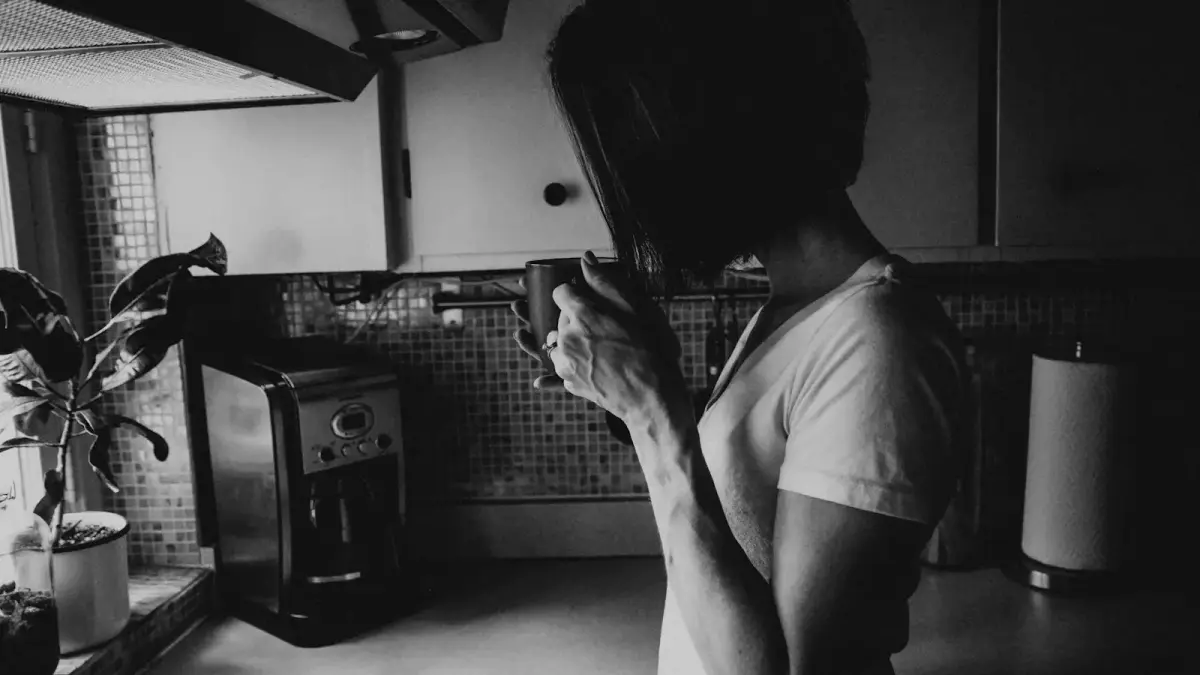
I have this thing I do with my coffee every morning. Three slow circles with the spoon, then two taps against the rim. Always three, always two. Always the same quiet metallic ring against ceramic before I set the spoon down and bring the cup to my mouth.
I never thought about it. Not once in the forty-some years I’ve been making my own coffee.
It was my sister who noticed. She was visiting last October, standing in my kitchen doorway in her bathrobe, and she went completely still. Her face changed. She didn’t say anything for a long moment, and then she said, very quietly, “You sound exactly like Mom.”
I didn’t understand at first. I looked down at my hand, at the spoon resting against the rim, and I felt something shift in my chest - something old and deep and wordless. Because she was right. I could hear it. Three circles. Two taps. The exact tempo, the exact pressure, the exact small sound that used to float down the hallway of our house before dawn.
I was four years old when I memorized that rhythm. I didn’t know I was memorizing anything. I was just lying in bed, listening to the sound of my mother being awake before me, and feeling safe.
The kitchen before language
There is a particular kind of memory that lives below words. It doesn’t store itself as a story or an image. It stores itself as a rhythm, a tempo, a specific pattern of sound that your body learned before your mind had any way to catalog it.
I’ve been thinking about this for months now, ever since my sister stood in my kitchen and gave me back something I didn’t know I’d been carrying. The sound of my mother’s spoon against her coffee cup. The sound of six in the morning. The sound of someone being up and present and preparing for the day in a way that told a small child: the world is holding together. You can stay in bed a little longer. Someone is already here.
My mother made coffee the same way every single morning for as long as I knew her. She was a creature of consistency. Not rigid - warm. Her routines weren’t about control. They were about creating a kind of acoustic architecture in our home, a structure made entirely of small familiar sounds that told everyone in it where they were and that things were fine.
The kettle. The cabinet door. The clink of the spoon. Three circles. Two taps.
I memorized the whole sequence before I could read.
What the body remembers
A 2021 study published in Psychological Science found that procedural memories - the kind stored in motor patterns rather than conscious recall - can persist for decades without any deliberate rehearsal. Your hands remember things your mind has completely forgotten. Your body carries sequences and rhythms that were encoded during early childhood, and it performs them with startling accuracy long after the original context has disappeared.
This is not nostalgia. Nostalgia is something you choose to visit. This is something else entirely. This is a rhythm living inside your muscles, a pattern your hands execute without consulting your brain, a sound you’ve been making every morning for forty years without ever once connecting it to its source.
I wasn’t stirring coffee. I was playing a recording.
Dr. Daniel Levitin, the neuroscientist who wrote “This Is Your Brain on Music,” has written extensively about how the auditory cortex encodes rhythmic patterns with extraordinary precision during early childhood. The sounds of your first home - the specific cadence of footsteps, the particular way a door closed, the rhythm of someone preparing food - become part of your neurological infrastructure. They wire themselves into who you are.
You don’t remember learning them. You just perform them, the way you breathe.
The inheritance no one talks about
We talk a lot about what gets passed down. The china. The recipes. The quilt. The ring. We talk about physical objects as vessels of memory, and they are. But we almost never talk about the sounds.
The specific way your father cleared his throat before speaking. The rhythm your grandmother used when she rocked in her chair. The two-note hum your mother made while she was reading. These are inheritances too - maybe the most intimate ones, because they weren’t given deliberately. They were absorbed. They entered you through repetition and proximity and love, and they stayed.
A 2019 study in the Journal of Research in Personality explored what researchers called “behavioral echoing” - the unconscious reproduction of a loved one’s habitual gestures and patterns, often surfacing years or decades after the original observation. The study found that these echoes were most powerful when they originated from a primary caregiver during early childhood, and that participants were almost universally unaware they were performing them until someone else pointed it out.
That’s the part that gets me. The unawareness.
I made my mother’s sound every morning for over forty years. I performed her exact rhythm with my exact hands in my own kitchen, thousands of mornings, and I had no idea. The inheritance was so complete, so seamlessly integrated into who I am, that it became invisible. It just felt like the way I stir coffee.
It wasn’t. It was the way she stirred coffee. And now it’s the way I stir coffee. And the line between those two things doesn’t really exist.
The morning orchestra
My mother woke up before everyone. Always. I think about this now with different eyes, because I do the same thing. I’m up at five-thirty, padding into the kitchen in the dark, turning on the small light above the stove - not the overhead, never the overhead, too harsh - and beginning the quiet sequence of making coffee.
And I realize now that the whole thing is hers. Not just the stirring. The sequence. The order of operations. Kettle first, then cup, then the quiet standing and waiting, the particular patience of those few minutes before the house wakes up.
She used to call it “my time.” I remember that. She’d say it without any resentment, just fact. “This is my time.” Meaning: the half hour before everyone else needs something from me. The half hour where the house is still and I can hear myself exist.
I inherited that too. Not the words - the practice. The understanding that a woman needs a few minutes of silence before the day starts claiming her. That coffee isn’t really about caffeine. It’s about a small pocket of sovereignty in a life spent attending to other people.
Three circles. Two taps. The spoon set down. The first sip taken standing up, looking out the window at nothing in particular.
I was never just making coffee. I was conducting the only morning orchestra that ever made me feel like the day would be all right.
When someone points out your ghost
My sister cried in my kitchen that morning. I cried too. Not sad crying - the other kind. The kind where your body releases something it has been holding so tightly that you forgot you were holding anything at all.
She said, “I can’t believe you do that. I can’t believe you do the exact same thing.”
And I said, “I didn’t know.”
That’s the part that still breaks me open. I didn’t know. I had been performing my mother’s morning ritual - her exact sounds, her exact timing, her exact small ceremony of preparing for the day - and I didn’t know. My body knew. My hands knew. Whatever deep, pre-verbal part of me that first recorded those sounds in a dim hallway at four years old knew.
But I didn’t know.
Grief does this strange thing where it convinces you that the person is gone. Fully gone. That what you have left are photographs, maybe some handwriting, a few objects that smell less and less like them every year. Grief tells you the sensory connection is over.
But it’s not. It was never over. It was in my hands the whole time.
The sounds that outlive us
I’ve started listening differently since that morning. Not just to myself - to everyone. I notice the way my friend’s laugh has the same break in it that her father’s had. The way my neighbor hums the same three notes while gardening that her grandmother hummed while hanging laundry. The way my son - my son, who never met my mother - taps his fingers on the table in a rhythm that makes me go absolutely still.
Because that’s the other thing nobody tells you. These sounds don’t just pass from parent to child. They ripple. They transmit through observation, through proximity, through the simple act of sharing a kitchen with someone for years. My son watched me stir coffee his entire childhood. He absorbed his own version of the rhythm. He carries a trace of a woman he never knew, encoded in his motor patterns, living in his hands.
Psychologist Gabor Mate has written beautifully about how our earliest experiences of safety become templates for self-regulation throughout life. The routines that soothed us as children don’t disappear - they become the routines we unconsciously build for ourselves as adults. We re-create the sensory conditions of our first experiences of “everything is okay.” For some people, that’s a specific smell. For others, it’s a texture, a temperature, a quality of light.
For me, it’s a sound. Three circles. Two taps. The quiet ring of metal against ceramic in a kitchen before dawn.
You are someone’s morning sound
I want to tell you something, and I want you to really hear it.
You are carrying someone right now. Not in your memory - in your hands, in your posture, in the specific way you perform some small daily act that you’ve never thought about. Someone you loved taught you a rhythm, and you’ve been playing it back every day without knowing.
That’s not sad. I know it sounds like it could be, but it’s not.
It means they’re not gone the way you think they’re gone. It means the body is a more faithful record than the mind. It means that love doesn’t only survive in the things we consciously remember - it survives in the things we do without thinking, the small sounds we make in empty kitchens, the rituals we perform that feel like ours but are really theirs, passed to us through nothing more than proximity and time and the quiet devotion of showing up to the same kitchen every morning and making the same small sounds.
My mother has been dead for eleven years.
Every morning, her kitchen still sounds exactly the same.