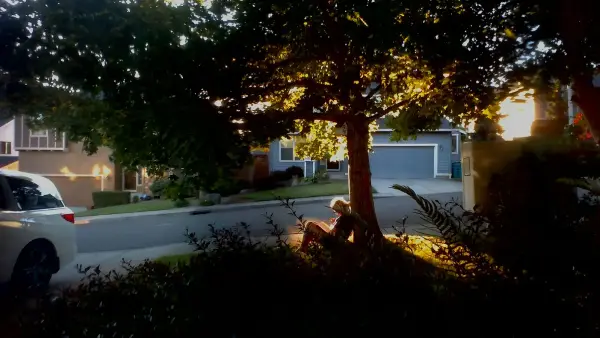
She's 63 and still turns the car radio down every time she needs to park, the same instinctive reach for the volume knob her mother made whenever anything required concentration, because she didn't inherit a preference for silence but a nervous system that believes the world gets clearer when it gets quieter

I caught myself doing it again last Tuesday. Pulling into a crowded parking lot at the grocery store, my right hand left the steering wheel and found the volume knob before my brain even registered the movement. The music dropped to nothing. The world went still. And somewhere in that stillness, I could finally see the parking space.
I’ve done this my entire driving life. Thirty-seven years behind the wheel, and I still believe - somewhere beneath thought, somewhere in the wiring - that I can see better when it’s quiet.
It’s ridiculous if you think about it logically. Sound has nothing to do with sight. The radio doesn’t make parking spaces harder to find. But my hand doesn’t care about logic. My hand remembers something older than reason.
The Reach That Wasn’t Mine
My mother drove a tan Buick Century with cloth seats that smelled like coffee and hand lotion. She was a careful driver - not nervous exactly, but deeply attentive. She treated the road the way she treated everything: with the quiet intensity of someone who believed that paying full attention was the minimum you owed to anything that mattered.
And whenever the world asked more of her behind the wheel - a tricky merge, an unfamiliar exit, a parallel parking situation she hadn’t planned for - her right hand would drift to the radio dial. She’d turn it down slowly, almost reverently, as if she were dimming the lights before something important.
She never announced it. Never said “I need to concentrate.” The gesture was so automatic it didn’t even register as a choice. It was her body’s way of saying: the world is getting complicated, so I need to make it simpler.
I watched that hand reach for that dial a thousand times before I was old enough to drive myself. And when I finally sat behind my own steering wheel at sixteen, I discovered that her hand had somehow become my hand. Her reach had become my reach. Not because she taught me to do it, but because my body had been taking notes the entire time.
When the Body Takes Notes
We talk about inheriting our parents’ eyes, their bone structure, their tendency toward high cholesterol. We understand genetic inheritance because we can see it in the mirror. But there’s another kind of inheritance that doesn’t show up in any reflection - the kind that lives in your reflexes, your startle responses, your body’s small negotiations with a world that sometimes feels like too much.
A 2019 study published in Psychological Science found that children as young as twelve months begin mirroring the stress-regulation strategies of their primary caregivers. Not imitating them consciously - absorbing them. The researchers called it “co-regulation transfer,” and what they meant was this: the way your mother calmed herself down became the blueprint for how your nervous system would calm itself down for the rest of your life.
You didn’t choose it. You didn’t even know it was happening. Your body simply watched, recorded, and filed it away as protocol.
This is why you might fold your arms exactly the way your father did when he was thinking. Why you hold your breath when you’re threading a needle, just like your grandmother held hers. Why you hum when you cook, the way someone hummed to you in a kitchen you barely remember.
These aren’t quirks. They’re love letters your nervous system wrote to itself, in handwriting it borrowed from the people who kept you safe.
The Quiet That Helps You See
There’s actually something real happening when you turn the radio down to park. Neuroscientists call it “cognitive load theory” - the idea that our brains have a finite amount of processing power at any given moment, and when we need more of it for one task, we instinctively reduce input from other channels.
Daniel Kahneman explored this in his research on attention. When the brain is working hard on something visual and spatial - like fitting a car into a tight spot - it genuinely benefits from having fewer competing signals to process. Turning down the radio isn’t irrational. It’s your brain requesting bandwidth.
But here’s the part that fascinates me: most people don’t arrive at this behavior through rational analysis. They arrive at it because they watched someone do it. The habit didn’t come from understanding cognitive load. It came from sitting in the passenger seat of a Buick Century, watching a woman’s hand reach for the dial.
The science validates the instinct. But the instinct came from love.
What Your Mother Was Really Teaching You
My mother wasn’t teaching me to turn down the radio. She was teaching me that it’s okay to need the world to be quieter sometimes.
She was teaching me that focus is a form of care. That when something matters, you give it room. You clear space for it. You don’t try to navigate difficulty while the noise stays at full volume - you honor the difficulty by adjusting your environment to meet it.
This is an extraordinary thing to teach a child, even if you never say a word about it.
A 2021 study in Frontiers in Psychology examined how parents’ sensory regulation habits influence their children’s lifelong approaches to stress management. The findings were striking: adults whose caregivers modeled deliberate environmental adjustment - turning off background noise, dimming lights, creating calm before addressing something challenging - showed significantly higher distress tolerance and emotional regulation in adulthood.
They didn’t just inherit a habit. They inherited a philosophy. The world can be managed. Overwhelm is not permanent. You are allowed to make things easier for yourself.
My mother never articulated any of this. She just turned the radio down. But my nervous system heard the whole lecture.
The Inheritance We Never Discuss
We spend so much time in therapy talking about what our parents said to us. The criticism, the praise, the silence where words should have been. And that work matters. It matters enormously.
But there’s a whole other layer of inheritance that rarely makes it into the conversation - the physical layer. The way your father cleared his throat before delivering bad news. The way your mother pressed her lips together when she was trying not to cry. The way someone’s shoulders dropped when they finally felt safe.
You carry these gestures in your muscles. They activate before you think. They are the oldest language you know, older than your first word, older than your name.
Gabor Mate has written extensively about how the body stores the emotional patterns of our earliest relationships. Not just trauma - though that too - but the everyday rhythms of regulation and dysregulation that made up the atmosphere of your childhood home. Your parents’ nervous systems were your first environment. You didn’t just live in their house. You lived in their bodies.
And now their bodies live in yours.
When I turn the radio down to park, I am not making a decision. I am being my mother’s daughter. I am running software she installed before I could speak, and it still works perfectly, decades after the original programmer is gone.
The Small Negotiations
I think about all the tiny ways we manage the world without realizing it. The way you might close your eyes when you’re trying to remember something. The way you tap your fingers on the counter when you’re waiting for news. The way you take a deep breath before opening a difficult email.
These are not random. These are inherited strategies for being a human in a world that regularly asks more of you than feels comfortable.
A 2018 study in the Journal of Research in Personality found that people’s unconscious self-soothing behaviors - touching their face, adjusting their posture, seeking quiet - were more strongly correlated with their caregivers’ behaviors than with their own personality traits. In other words, the way you calm yourself down looks more like your mother than it looks like you.
This should be unsettling, maybe. But I find it beautiful.
Because it means that long after the people who raised us are gone, they are still taking care of us. Still reaching for the volume knob. Still making the world a little quieter when it gets to be too much. Still whispering, through the body’s ancient language: I’m here. Let me help. Let’s make this simpler.
The Radio Is Still Playing
I called my sister last week and told her about the parking lot revelation. She laughed so hard she had to pull over - which she did, after turning down her own radio.
“Mom did that,” she said. “Every single time.”
“I know,” I said. “We all do it.”
There was a pause on the line, and I could feel us both sitting in the same memory - the back seat of that Buick, the smell of coffee and hand lotion, the sound of music fading as our mother made the world manageable. Made it clear. Made it quiet enough to navigate.
I’m sixty-three years old. I’ve read the neuroscience. I understand cognitive load theory and sensory processing and co-regulation transfer. I know exactly why I turn the radio down when I park.
But knowing why doesn’t change the reaching. And I don’t want it to.
Because that reach isn’t a flaw. It isn’t a limitation or a crutch or a sign that I can’t handle the full volume of life.
That reach is my mother’s hand, still guiding mine. Still saying, without words, the thing she said best: when the world gets complicated, you’re allowed to make it quieter. You’re allowed to give yourself what you need. You’re allowed to believe that clarity lives on the other side of calm.
And you know what? She was right. It does.