She's 64 and every night she places a glass of water on her nightstand before bed, and every morning she pours it untouched down the sink, because the glass was never about thirst - it was the last surviving gesture of a mother who wanted her daughter to fall asleep knowing someone was still thinking of her after the light went out
I do something every night that makes no practical sense.
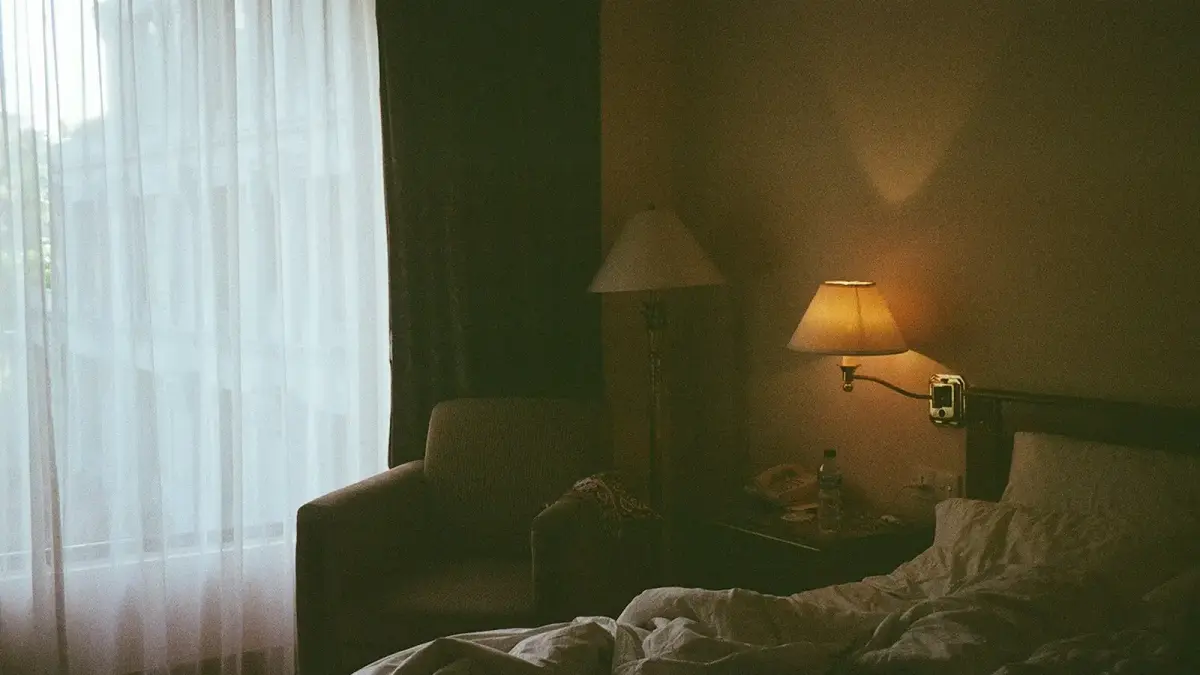
Around ten o’clock, sometimes a little later, I walk to the kitchen and fill a glass with water. I carry it to my bedroom. I set it on the nightstand, on the left side, close enough to reach but far enough that I won’t knock it over if I shift in the dark. Then I turn off the lamp and go to sleep.
In the morning, the glass is full. I haven’t touched it. I pick it up, carry it to the bathroom, and pour it down the sink.
I’ve done this for over forty years. My husband once asked me about it - early in our marriage, still in that phase where you’re cataloguing each other’s habits like specimens under glass. “You never drink it,” he said. “Why do you keep filling it?”
I didn’t have an answer then. I do now.
The glass my mother set beside my bed
My mother was not a woman who said “I love you” easily. She came from people who showed care through labor - through meals that appeared on time, through sheets that smelled like lavender, through school uniforms pressed the night before. Words were luxuries her family never learned to spend.
But every night of my childhood, after she’d checked the locks and turned off the television and walked the hall to my room, she’d set a glass of water on my nightstand.
She didn’t announce it. She didn’t make it a lesson. She just placed it there, quietly, the way you’d leave a candle burning in a window for someone still on their way home.
I almost never drank it. That was never the point.
The point was the sound of her footsteps in the hallway after the lights went out. The point was knowing that someone had thought of me one last time before the house went quiet. The glass wasn’t water. It was evidence - proof that even after the day was finished and the goodnight had been said, there was still one more act of care left.
What rituals actually carry
A 2020 study published in the journal Psychological Science found that rituals - even ones with no functional purpose - reduce anxiety and increase feelings of personal control. The researchers noted something interesting: the effectiveness of a ritual had almost nothing to do with its content and everything to do with its consistency. The act didn’t need to make sense. It needed to be repeated.
But I think the study misses something. Rituals don’t just soothe us because they’re predictable. They soothe us because they’re inherited. When I set that glass on the nightstand, I’m not performing a habit. I’m continuing a conversation with someone who is no longer in the room.
My mother died eleven years ago. She was seventy-eight and had spent her last year in a facility where someone else made her bed and someone else locked the doors at night. I don’t know if anyone set a glass of water beside her in those final months. I hope they did. I hope she felt that small weight of it on the table beside her and remembered, somewhere in the fog, that it meant something.
When she was gone, I kept the ritual. I never considered stopping. Not because I’d formed a habit I couldn’t break, but because putting down that glass was the last place I could still find her.
The love that arrives after the light goes out
There’s a particular kind of love that only happens in the dark. Not romantic love - not that kind of dark. I mean the love that appears after the performance of the day is over. After the school lunches are packed and the bills are paid and the arguments are either resolved or shelved. After everyone has said goodnight and the house has gone still.
That’s when my mother’s love showed up. In the soft click of the glass on wood. In the faint shuffle of her slippers retreating down the hall.
Psychologist John Bowlby, whose attachment theory reshaped how we understand human bonding, wrote that a child doesn’t need constant attention. A child needs to know that someone is reliably there. Not always visible. Not always speaking. Just there - a presence that can be counted on even when it can’t be seen.
That glass of water was my mother’s way of being there after she’d already left the room.
And I think that’s the kind of love most of us ache for without knowing how to name it. Not the dramatic kind. Not the kind that writes poems or makes grand gestures. The kind that shows up in the margins. That does one small, useless, beautiful thing every single day and never expects to be thanked for it.
What we inherit without being taught
Nobody taught me to set the glass out. My mother never said, “This is what I’m doing for you, and someday you should do it too.” There was no instruction. There was only the watching - years of watching someone perform a small act of devotion so quietly that it embedded itself in me like a seed I didn’t know had been planted until decades later, when I found myself standing in my own kitchen, filling a glass for no reason I could name.
A 2019 study in the Journal of Research in Personality found that people often replicate their parents’ behavioral rituals without being consciously aware of doing so. The researchers called these “implicit transmissions” - emotional habits passed down not through language but through observation and felt experience. We absorb the way our parents loved us, and then we perform it again, sometimes for ourselves, sometimes for people who were never part of the original story.
My daughter noticed the glass once. She was visiting for the weekend, maybe twelve years ago, and in the morning she saw me carrying it to the sink. “You didn’t drink any of it,” she said, the same words my husband had used decades before.
“No,” I said. “I never do.”
She didn’t ask why. Maybe she already understood something I couldn’t explain.
I don’t know if she sets a glass of water on her own nightstand now. Part of me hopes she does. Part of me hopes she’s found her own version of it - her own small, quiet gesture that nobody else understands, that connects her backward through time to a woman who couldn’t say I love you but could fill a glass and carry it through the dark.
The things that don’t make sense are often the things that matter most
We live in a culture that wants everything to have a function. Every behavior needs a reason. Every routine needs a productivity justification. If it doesn’t serve a measurable purpose, we’re supposed to optimize it away.
But some of the most important things we do are completely useless by any practical standard.
The way you still fold towels the way your grandmother taught you, even though your method is objectively less efficient. The way you tap the doorframe twice before leaving the house, the way your father did. The way you hum a melody while you cook that you didn’t choose and can’t remember learning, because it lived in your mother’s kitchen before it lived in yours.
These aren’t inefficiencies. They’re inheritances. They’re the way love survives the people who first offered it.
Brene Brown has written about how human beings are fundamentally wired for connection, and that much of our emotional suffering comes from feeling disconnected from the people and traditions that once anchored us. I think she’s right, but I’d add something: we’re also wired to maintain connection with people who are gone. And the way we do that isn’t through memory alone. It’s through repetition. Through doing the thing they did, in the place they did it, with the same quiet faithfulness they brought to it.
Every night when I set that glass on the nightstand, I am not preparing for thirst.
I am saying goodnight to my mother.
The offering nobody sees
There’s a word in Japanese - komorebi - that means the sunlight filtering through leaves. There’s no single word for it in English because we haven’t decided that particular beauty deserves its own name. I sometimes think we need a word like that for the love that shows up in gestures nobody else notices. The love that fills glasses and folds blankets and checks the locks one extra time. The love that performs itself in silence and never once asks to be recognized.
My mother gave me that love every night for eighteen years. A glass of water I never drank. A footstep in the hallway I never acknowledged. A presence I didn’t fully appreciate until it was no longer there.
I’m sixty-four now. My knees ache when I walk to the kitchen late at night. Sometimes I stand at the sink longer than I need to, watching the water fill the glass, and I feel her so close I could swear the air shifts behind me, the way it does when someone passes through a doorway just out of sight.
The glass is full.
I carry it to the nightstand.
I set it down.
And somewhere, in the quiet that follows, I know she knows I understood. Not then - I was a child, and children take love the way they take air, without noticing. But now. I understand now.
The glass was never about water.
It was her hand on my life one last time before the dark.
And every night, when I set one down for no one, I am telling her that the gesture landed. That it took root. That the smallest thing she ever did turned out to be the thing I carry with me everywhere, the thing I cannot put down, the thing that still - after all these years - makes me feel like someone is thinking of me after the light goes out.