She is 64 and just realized she writes the date on the inside back cover of every book she finishes - a small pencil notation in the bottom corner, the month and the year, sometimes the season - not because she is cataloging anything but because a girl whose reading life was never once witnessed by another person in her house, whose books were never asked about and whose thoughts were never invited, discovered that the only record of her inner life was the one she made with her own hand, and the woman who opens a novel twenty years later and finds 'March 2006' in her own handwriting is not reading a date but finding proof she was alive and paying attention even when no one else was
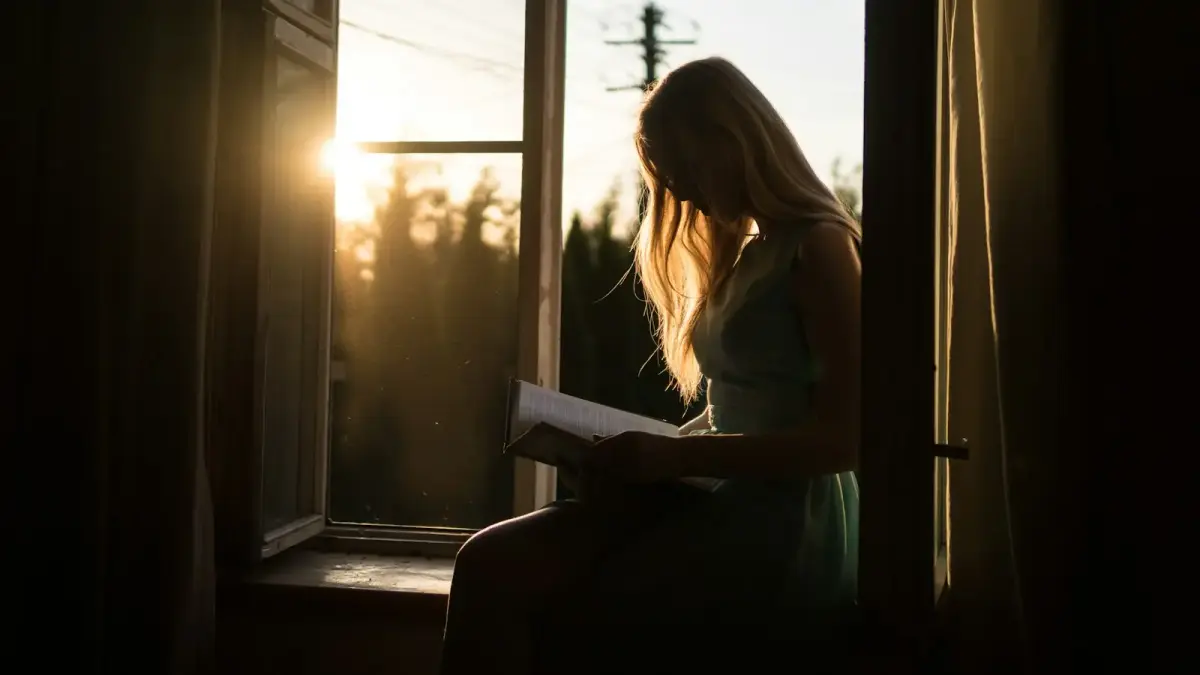
I found a copy of East of Eden on my shelf last Tuesday. It was the old paperback with the cracked spine and the coffee ring on the front cover, the one I bought at a used bookstore sometime in my thirties. I opened it to the last page out of habit, the way you check the back of a photograph for a date.
There it was. Bottom right corner, inside the back cover. In my own handwriting, in pencil: October 2003.
I stood there in my living room holding that book and something shifted in my chest. Not sadness, exactly. Something quieter than sadness. Something like being recognized by a version of yourself you had almost forgotten existed.
I am sixty-four years old and I have been writing the date inside every book I finish for as long as I can remember. The month and the year. Sometimes just the season. A small pencil notation in the bottom corner that no one has ever seen and no one has ever asked about. I never thought about why I did it until last week, when I pulled three old novels off a shelf I was reorganizing and found my own handwriting waiting for me inside each one like a note slipped under a door by someone who knew I would eventually come back.
The habit nobody taught her
I did not learn this from anyone. That is the first thing I want you to understand.
Nobody in my house growing up wrote in books. Nobody in my house growing up talked about books. My mother read magazines at the kitchen table and my father read the newspaper in his chair and my two brothers read nothing at all, and the girl curled on the floor of her bedroom with a novel pressed open against the carpet was not being educated or enriched or witnessed. She was just being quiet somewhere, which was what the household preferred.
No one ever asked me what I was reading. Not once, in eighteen years of living in that house. No one asked what I thought about what I was reading. No one noticed when I finished a book or started a new one. My inner life - the one that was exploding with feeling and language and desperate questions about what it meant to be a person - happened in complete silence, observed by no one.
A 2009 study published in the Journal of Research in Personality found that children who grow up without what researchers call “emotional witnessing” - having their internal experiences acknowledged by a caregiver - often develop elaborate private rituals to mark their own existence. They become their own witnesses. They learn to notice themselves because no one else did.
I did not know that when I was twelve. I just knew that when I closed a book, something important had happened to me and there was no one to tell.
A pencil mark is not a note - it is a timestamp on a life
Here is what I think was happening, though I could not have named it then.
When you finish a book that matters to you, something has changed. You walked into the first page as one person and you are walking out of the last page as someone slightly different. The story rearranged something. You understood something you did not understand before, or you felt something you had been refusing to feel.
That change deserves a witness. It deserves someone who says, I see that you are different now. I see that this mattered to you.
When no one is there to say that, you pick up a pencil. You write the month and the year on the inside back cover. And what you are really writing is: I was here. This happened to me. I was paying attention to my own life even though no one else was paying attention to it either.
The pencil mark is not a cataloging system. It is not a reading log. It is a timestamp on the experience of being alive and being moved by something, left by the only person who noticed.
The accidental autobiography inside a bookshelf
Here is what I did not understand until last week, standing in my living room with East of Eden in my hands and twenty-three years of my own handwriting staring back at me.
I have been writing my autobiography for over fifty years, and I did not know it.
Not in a journal. Not in letters. Not in any of the ways people are supposed to record their lives. I wrote it in pencil, in the back corners of other people’s stories, one date at a time. And the autobiography it tells is not about what happened to me. It is about who I was becoming.
June 1987 inside a copy of The Color Purple. I was twenty-five that summer. I had just moved to a new city where I knew no one. I remember nothing else about that month, but I know that I sat somewhere alone and read that book and was changed by it and marked the moment with a pencil because no one else was going to mark it for me.
Winter 1994 inside a copy of Beloved. I had started writing the season instead of the month by then. I had two small children. I must have read that book in fragments, late at night, in the small window between everyone else’s needs and my own exhaustion. I do not remember reading it. But my handwriting remembers.
April 2011 inside a copy of Gilead. My mother had died three months earlier. I know that only because of the date. The book is about a father writing letters to his son, knowing he will die before the boy is old enough to understand them. I must have been wrecked by it. The pencil mark does not say that. It does not have to.
The shock of meeting yourself in your own handwriting
Psychologist Dan McAdams, who has spent decades studying what he calls the “narrative identity” - the internal story we construct about who we are - has written extensively about how people need external confirmation that their life story is coherent and real. A 2015 study in Psychological Science found that people who lack this confirmation often create what McAdams calls “self-authoring rituals” - small repeated acts that serve as proof of continuity. Proof that the person you were last year is connected to the person you are today.
I did not know any of that research when I started writing dates in my books. I just knew something that every unwitnessed child knows in their body long before they can say it out loud.
If you do not leave proof that you were here, it is as though you were never here at all.
What I was not prepared for - what caught me standing in my living room last Tuesday with tears running down my face - was what happens when you find that proof decades later. When you open a book you forgot you owned and your own handwriting is waiting inside it, patient and steady, written by a woman you barely remember being.
It is like getting a letter from someone who loved you. Except the someone is you. And the love is the kind that shows up not in grand declarations but in the tiniest act of noticing - a pencil, a date, a corner of a page, a quiet insistence that this moment mattered.
The girl who witnessed herself
I want to tell you something about that twelve-year-old girl on the bedroom floor with her book.
She was not neglected in any way that would have alarmed anyone. She was fed and clothed and driven to school. Her parents were not cruel. They were simply uninterested in the life that was happening inside her, the way many parents of that generation were uninterested in the inner lives of their children. Feelings were not the currency of that household. Silence was.
Jonice Webb, who coined the term “childhood emotional neglect,” describes it as the absence of something rather than the presence of something harmful. It is not what happened to you. It is what did not happen. The question that was never asked. The interest that was never shown. The inner world that was never, not once, treated as though it mattered.
That girl figured something out, though. She figured out that if no one was going to witness her life, she would witness it herself. And she did it in the smallest, most private way imaginable - a pencil notation that no one would ever see, in a place no one would ever look, recording a moment that no one would ever ask about.
She became her own proof of existence.
What the date really says
I have been going through my bookshelves slowly this past week. Pulling out novels and memoirs and poetry collections and opening them to the back cover, one by one.
Some of the dates I recognize immediately. Some of them are mysteries - I cannot remember reading the book at all, but there is my handwriting, steady and certain, telling me that I did. That I was there. That in some month of some year, I sat down with this particular collection of words and let them move through me and came out the other side different.
The ones that undo me are the ones in handwriting I almost do not recognize. The loopy, unsure cursive of my twenties. The cramped, hurried print of my years with young children. The shaky letters from the year after my hip surgery when holding a pencil was an act of will.
Each one is a self-portrait drawn in a single line. Not of what I looked like, but of what I was paying attention to. What I needed. What stories I reached for when the world was not reaching for me.
If you do this too - if you write dates in books, or fold corners, or keep a list somewhere that no one has ever seen - I want you to know what you have been doing.
You have been keeping a record of your own aliveness. You have been saying, in pencil, in the quietest voice imaginable, I was here and I was paying attention and this is the proof.
That is not a habit. That is not a quirk.
That is a girl who was never witnessed, learning to witness herself. And the woman she became - sixty-four years old, standing in her living room, finding her own handwriting inside a book she read in a life she almost forgot she lived - that woman is not reading a date.
She is reading a love letter she has been writing to herself for fifty years. And she is only just now realizing it was a love letter all along.