There is a particular kind of person who says 'sorry, can I ask you something?' before every question - who apologizes for needing directions, for asking if the seat beside them is taken, for wondering aloud whether the meeting time has changed - because a child who was told she asked too many questions and took up too much space and had too many needs learned that curiosity was only safe when it arrived already wearing an apology, and she has spent her entire adult life paying admission to conversations other people walk into for free
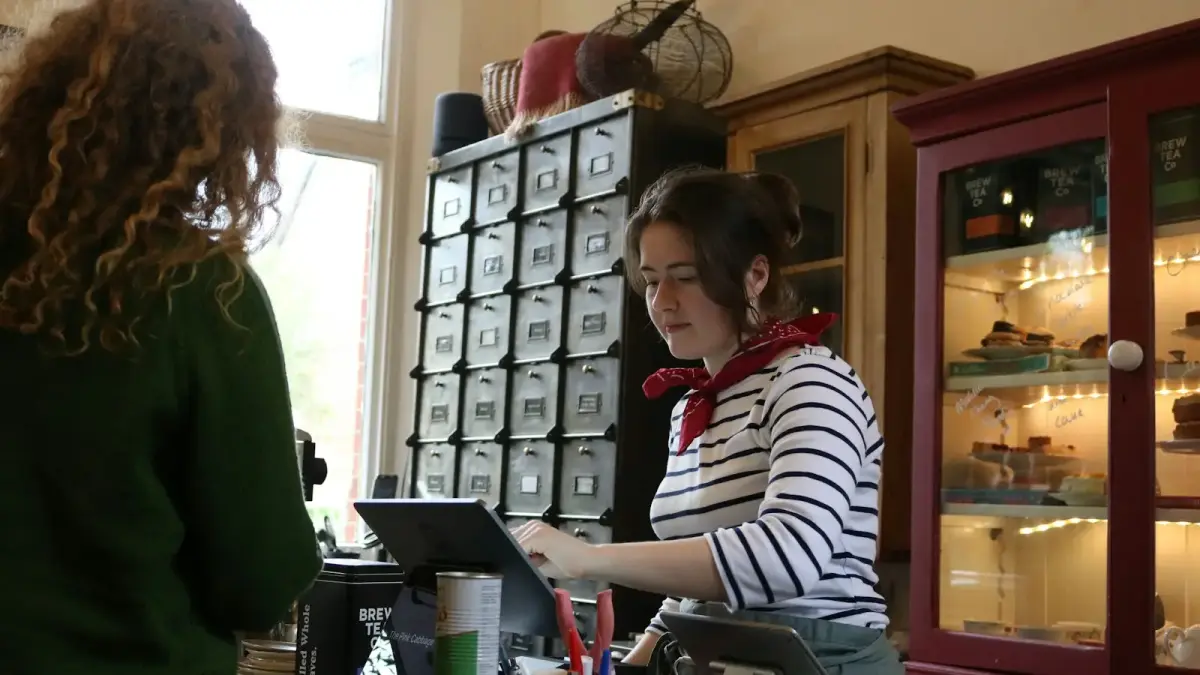
I watched a woman in front of me at the coffee shop this morning apologize three times before she finished ordering. “Sorry, can I get a medium - sorry, is it okay if I add oat milk? Sorry, one more thing.” She wasn’t being difficult. She was ordering coffee. But something in her body language told me she’d been rehearsing this interaction in her head for the last four minutes in line, planning how to take up the least possible space while still getting what she came for.
I recognized her immediately. Not her face. Her posture.
Because I have been that woman. At the help desk. In the meeting. Standing in a doorway trying to figure out how to ask a simple question without making someone wish I hadn’t.
If you’ve ever started a sentence with “sorry, this might be a dumb question” or “I’m sorry to bother you, but” - not once, not in an especially stressful moment, but as your default setting for engaging with other humans - then this is probably going to feel familiar. And it might sting a little, the way it always stings when someone names a thing you thought you’d hidden well enough that nobody would notice.
The anatomy of the pre-apology
There’s a rhythm to it, and once you hear it, you can’t unhear it.
“Sorry - is this seat taken?”
“Sorry, quick question.”
“Sorry, I just wanted to check - ”
“Sorry, I know you’re busy, but - ”
The apology comes before the ask, every time. It’s a little payment you slide across the counter before you make your request. A deposit on permission. An acknowledgment that you know your curiosity is an imposition and you’d like to be forgiven for it in advance.
People who don’t carry this pattern barely notice it. They ask questions the way they breathe - automatically, without preamble, without guilt. “Hey, is this the right room?” “What time does this start?” “Can you help me with something?”
No preface. No apology. No admission fee.
But for you, every question has a cover charge. And you’ve been paying it so long you forgot that most people walk in for free.
Where the toll booth got built
Children are born asking questions. It’s one of the first complex things a human brain learns to do - not just observe the world, but interrogate it. Why is the sky that color. Where do dogs sleep. What happens when you die. How come that man is sad.
A 2019 study published in the journal Psychological Science found that children between the ages of two and five ask an average of 107 questions per hour during peak curiosity periods. That’s nearly two questions a minute. That’s the natural throughput of a mind trying to build a model of reality from scratch.
Now imagine what happens to that throughput when it meets a parent who is tired. Or overwhelmed. Or carrying their own unprocessed pain. Or simply raised in a generation that believed children should be seen and not heard.
“Stop asking so many questions.”
“Why do you always need to know everything?”
“Can you just be quiet for five minutes?”
“You’re too much.”
None of these sentences are violent. None of them would make a headline. But repeated often enough, across enough formative years, they install something in a child’s operating system that never fully uninstalls.
The message is clear: your curiosity is a burden. Your need to understand is an inconvenience. You are taking up more than your share of space in this conversation, in this room, in this family.
And so the child adapts. She doesn’t stop asking questions - she’s too smart for that, too hungry to understand. But she learns to pay for them. She learns to apologize first. She learns to make herself smaller before she makes a request, so that the request itself takes up less room.
The tax on adult curiosity
The thing about childhood adaptations is that they don’t retire when you grow up. They get promoted.
The girl who learned to apologize before asking becomes the woman who starts every email to her boss with “Sorry to bother you.” She becomes the colleague who prefaces every contribution in a meeting with “This might be off base, but.” She becomes the friend who texts “Sorry, are you free to talk?” to people who would drop everything for her.
She’s not insecure in the way people usually mean when they use that word. She’s not fishing for reassurance. She’s performing a ritual that once kept her safe - the ritual of announcing her smallness before she dares to need something.
Gabor Mate has written extensively about how children in emotionally unsafe environments learn to suppress their authentic impulses in order to maintain attachment with their caregivers. The child doesn’t choose between curiosity and connection - she finds a way to keep both, but at a cost. The cost is the apology. The cost is the constant, low-grade performance of “I know I’m too much and I’m trying not to be.”
You can see it in workplaces everywhere. A 2021 study in Frontiers in Psychology found that individuals with high rejection sensitivity - often rooted in early experiences of being dismissed or shamed for self-expression - were significantly more likely to use preemptive self-deprecation in professional settings. They apologized more. They hedged more. They qualified their competence before demonstrating it.
Not because they were less capable. Because they’d learned, bone-deep, that capability was only welcome when it arrived quietly.
The difference between politeness and submission
People will tell you it’s just good manners. That saying “sorry” before a question is polite. Considerate. That you’re just being respectful of other people’s time.
And sometimes that’s true. There’s a version of “sorry to interrupt” that is genuinely about social awareness - reading a room, noticing someone is busy, choosing your moment.
But that’s not what this is.
This is the version where you apologize for asking a barista what size the medium is. Where you say “sorry” before asking a stranger if they know what time it is. Where you preface a Google search with guilt because even the internet feels like it might judge you for not already knowing.
Real politeness is about the other person. This is about you - about managing a fear so old you can’t remember when it started. The fear that your question will be the one that confirms what you’ve always suspected: that you are, in fact, too much.
Susan Cain, whose work on introversion reshaped how we think about quiet people, has noted that many introverts aren’t actually afraid of speaking. They’re afraid of the social cost of speaking. They’ve calculated, often unconsciously, that the risk of being perceived as intrusive outweighs the benefit of being heard.
For the chronic pre-apologizer, the calculation is even more specific. It’s not “what if they think I’m annoying?” It’s “what if this question is the proof that I need too much from people?”
What you’re actually protecting
Here’s the part that breaks my heart a little.
The pre-apology isn’t protecting other people from your question. It’s protecting you from the possibility that your question might not be welcome. It’s a tiny shield held up in advance so that if someone does react with impatience - a sigh, a clipped answer, a glance away - you can tell yourself you tried. You warned them. You gave them an out. You did everything you could to make your need as small as possible before presenting it.
It’s the emotional equivalent of wrapping a gift in three layers of disclaimers before handing it to someone. “It’s probably not what you wanted. I can return it. You don’t have to like it. Sorry.”
And what that tells me - what that tells anyone paying attention - is not that you’re weak. It’s that you are someone who was taught your curiosity had a price, and you decided to keep paying it rather than stop being curious.
Read that again.
You didn’t shut down. You didn’t stop asking. You didn’t let the world convince you that your questions weren’t worth asking. You just found a way to keep asking that felt safe enough to survive.
That’s not a flaw. That’s an adaptation made by a very intelligent child who needed to stay connected to people who couldn’t handle her fullness.
Putting the apology down
I’m not going to tell you to stop apologizing. I don’t think that’s how this works. You can’t just override decades of neural patterning with a motivational poster.
But I will tell you what I’ve been practicing, slowly, in my own life.
I’ve been noticing the moment before the apology. That half-second where my mouth is about to form the word “sorry” and my brain is already bracing for rejection. I’ve been sitting in that half-second. Not pushing through it. Not performing confidence I don’t feel. Just noticing it.
And in that noticing, something shifts. Because the half-second is where the old story lives. The story that says your question is a burden. And when you can see the story, you can start to recognize that it’s a story. Not a fact. A story written by a seven-year-old who was trying to figure out why the people she loved kept telling her to be less.
Daniel Goleman’s work on emotional intelligence suggests that the first step toward changing an emotional pattern isn’t willpower - it’s awareness. Simply recognizing the pattern as it’s happening begins to loosen its grip. Not all at once. Not dramatically. But steadily, the way water loosens a knot that force only tightens.
You don’t have to stop being considerate. You don’t have to become someone who barges into conversations without reading the room.
But you might consider, the next time you’re about to apologize for asking a perfectly reasonable question, that the apology isn’t yours to make. It never was.
Someone taught you that your curiosity was an imposition. You believed them because you were small and they were everything.
You’re not small anymore. And your questions - every single one of them - were always free.