There are men who mow their lawn every Saturday morning not because the grass needs cutting but because the roar of the engine is the only sound in their marriage that makes conversation impossible, and the man pushing the mower back and forth across a yard that was fine three days ago is not maintaining his property but maintaining himself
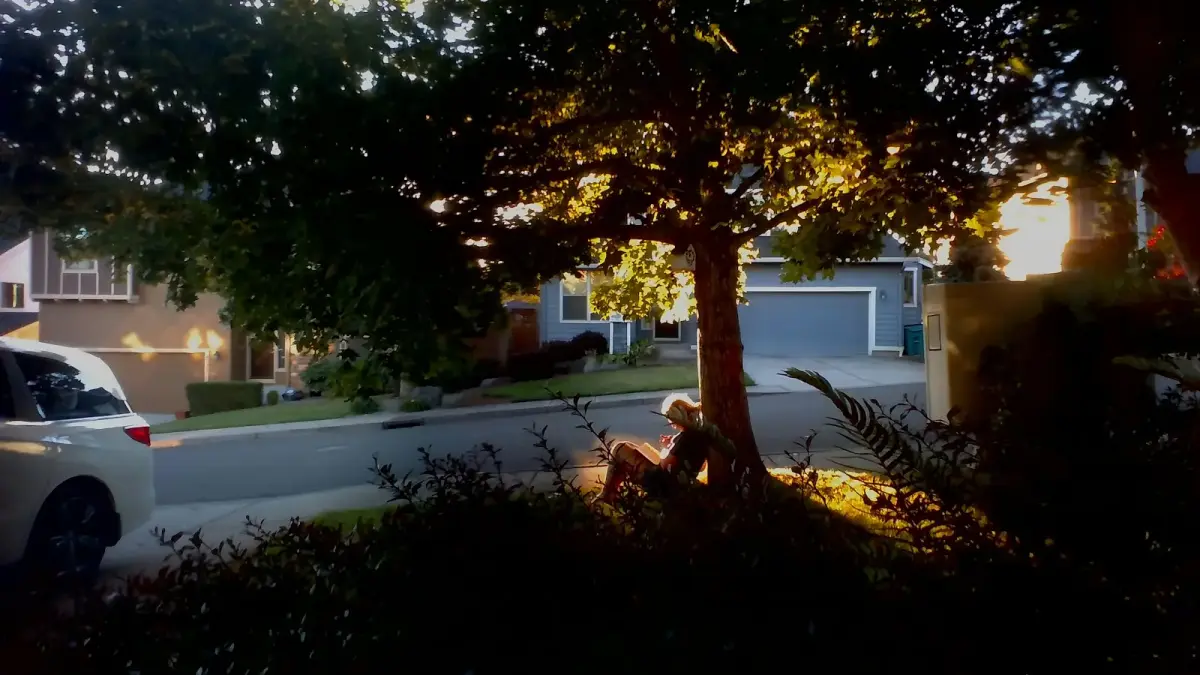
The garage door goes up at seven forty-five. I know the time because it’s always the same time. Coffee first, standing at the kitchen counter, not sitting down because sitting down invites conversation. Then the walk to the garage, the smell of gasoline and cut grass from last week still hanging in the air, the pull of the cord, and the engine catches.
That sound.
That sound is the door closing between me and everything that needs something from me. Not slamming. Just closing. Gently, the way you’d close a door on a sleeping child.
My wife thinks I love yard work. She has said this to friends at dinner parties. “Marcus is obsessed with that lawn,” she’ll say, and everyone laughs, and I laugh too, because it is easier to be the man who loves his lawn than to be the man who needs an hour alone and doesn’t know how to ask for it.
I don’t love yard work. I never have. What I love is the hour where no one can reach me - where the noise wraps around me like a wall, and the walking goes nowhere but back and forth, and my thoughts are finally allowed to move at their own pace without someone asking where they’re going.
The sound that protects you
There’s a particular genius in the lawnmower, and it has nothing to do with landscaping.
It’s the volume. A lawnmower is loud enough to make conversation physically impossible. Not rude - impossible. Nobody can accuse you of ignoring them when the machine itself has made hearing irrelevant. The noise doesn’t push people away. It simply makes their approach unnecessary.
I started noticing this about fifteen years into my marriage. Every Saturday, same ritual. Same path across the yard. And the lawn didn’t need it. The lawn was fine. The lawn had been fine since Wednesday. But I was out there anyway, pushing the mower in lines so straight you’d think I was being graded, and the real reason had nothing to do with grass height.
The real reason was that the roar of the engine created a forcefield. Inside that noise, I was unreachable. Not hiding. Not avoiding. Just briefly, beautifully, alone.
Susan Cain wrote in Quiet that introverts don’t recharge through isolation because they dislike people. They recharge because their nervous systems process stimulation differently - they need less input, not less love. When I read that, I thought about every Saturday morning for the past two decades, and something heavy and unnamed finally had a word.
I wasn’t neglecting my family. I was regulating myself so I could return to them.
The only permitted withdrawal
Here’s the part nobody talks about. A man sitting on the porch doing nothing gets asked what’s wrong. A man lying on the bed at two in the afternoon gets checked on. A man who says “I need some time alone” watches his wife’s face change, watches the worry arrive, watches the question form before it’s even spoken: Are we okay?
But a man mowing the lawn is doing something productive. He’s contributing. He’s maintaining the property. Nobody asks a man what’s wrong when he’s pushing a mower across a Saturday morning. They wave. They nod. They think, “He’s got his routine.”
The routine is the disguise.
I think a lot of men figured this out without ever naming it. The garage workshop. The fishing trip. The long drive to the hardware store for a single bolt that could have waited until Monday. These aren’t hobbies. They’re architectures of solitude built by men who were never given permission to simply be alone.
A 2019 study published in the Journal of Research in Personality found that men who regularly engaged in repetitive, rhythmic physical activities - walking, gardening, woodworking - reported significantly lower levels of perceived stress than those who used passive forms of relaxation like watching television. The researchers noted that the combination of physical movement and low cognitive demand created a state similar to meditation, allowing the mind to process emotions without actively focusing on them.
That’s what the mower does. It turns the yard into a walking meditation that nobody questions because it looks like work.
What the lines mean
I mow in straight lines. Perfectly parallel. I overlap each pass by exactly two inches to avoid missed strips. I do the edges first, then work inward. This is not because I care about lawn aesthetics. It’s because the repetition quiets something in me that nothing else can reach.
Back and forth. Back and forth. The same path, the same turn at the fence, the same pivot near the oak tree. And inside that repetition, my mind does what it can never do in the house - it wanders without direction. It processes last Tuesday’s argument without rehearsing a rebuttal. It sits with a worry about my daughter without rushing to solve it. It just moves.
There is something ancient about walking the same ground in lines. Farmers did it. Monks did it in their cloisters, walking the same stone paths for centuries. The body moves so the mind can rest, and the rest is not sleep but a kind of loosening, like a fist that has been clenched all week finally opening.
My father mowed every Saturday too. I remember sitting on the porch watching him, and I thought he was meticulous. I thought he was particular about his yard. Now I understand he was particular about his sanity. He was a man with four children, a mortgage, a wife who needed him to be present, a job that consumed him Monday through Friday, and on Saturday morning, he took the only hour he knew how to take.
He never said “I need space.” He said “The lawn needs doing.”
Same sentence. Different meaning entirely.
The marriage underneath the noise
I love my wife. I want to be clear about that, because what I’m describing can sound like avoidance, and it isn’t. Or maybe it is a form of avoidance, but it’s the kind that keeps a marriage intact rather than the kind that erodes it.
Because here’s what I’ve learned: a man who never gets to be alone eventually starts being alone while surrounded. He checks out at the dinner table. He answers without hearing the question. He’s in the room but not in the room, and his wife can feel it, and she can’t name it either, and both of them end up lonely in a house full of people.
The mower prevents that. The mower gives me sixty minutes where I’m genuinely, honestly alone - not performing presence, not faking attention, not holding space for someone else’s feelings while ignoring my own. And when the engine dies and I roll it back into the garage and walk inside, I’m actually here. Not depleted. Not resentful. Here.
A 2021 study in Frontiers in Psychology found that brief periods of voluntary solitude - as little as fifteen minutes - significantly improved emotional regulation and reduced interpersonal irritability. The key word is voluntary. Forced isolation damages. Chosen solitude restores. The researchers described it as “emotional recalibration” - a reset that allows a person to return to social engagement with more patience and presence.
That’s the part my wife doesn’t see. She sees a man who loves his lawn. What she doesn’t see is that the man who walks in the door after mowing is a better version of the man who walked out. Calmer. Softer. More capable of listening without formulating a response while she’s still talking.
The mowing isn’t taking me away from the marriage. It’s what allows me to come back to it.
The vocabulary we were never given
I’m fifty-three years old, and I am only now learning to say the sentence “I need some time alone” without it sounding like an accusation.
That sentence, spoken by a woman, is self-care. Spoken by a man, it’s a warning sign. Something must be wrong. He must be unhappy. He must be pulling away. The response is not “okay, take your time” but “what did I do?” And so we don’t say it. We mow instead.
Daniel Goleman’s work on emotional intelligence makes a point that has stayed with me for years: emotional self-awareness is the foundation of every other form of intelligence, but it requires space. You cannot understand what you’re feeling while you’re simultaneously performing feelings for someone else. You need a gap. A pause. A place where you’re not being watched or needed or interpreted.
For a lot of men, that place is behind a lawnmower.
Not because we’re emotionally stunted. Not because we can’t handle intimacy. But because somewhere along the line, we learned that the only acceptable version of male solitude is productive solitude. You can be alone if you’re fixing something. You can be quiet if you’re building something. You can disappear for an hour if you come back with a mowed lawn or a repaired shelf or a clean car.
The doing justifies the being.
And that’s a loss. A quiet, invisible loss that most men never examine because examining it would require the kind of stillness they’ve never been given permission to practice.
What the lawn really looks like
If you could see my lawn the way I see it, you wouldn’t see grass.
You’d see a map of every Saturday I held myself together. Every pass of the mower is a thought I processed, a feeling I sat with, a small piece of patience I gathered before walking back inside to be a husband and a father and a person who listens.
The yard doesn’t need mowing every week. I need mowing every week.
And I suspect that if you’re reading this, you know exactly what I mean. Maybe it’s not a lawnmower for you. Maybe it’s the long shower that isn’t about getting clean. The drive home from work where you sit in the driveway for five extra minutes before going inside. The morning walk the dog doesn’t technically need but that you do.
These are not avoidance strategies. These are survival architectures built by people - by men, often - who were never given the language to say what they actually need.
You’re not avoiding your family. You’re not broken. You’re not emotionally unavailable.
You’re a person who needs an hour to come home to yourself so you can come home to the people who matter. And the fact that you found a way to do that - even if it looks like yard work, even if nobody recognizes it, even if you’ve never said it out loud - is not a failure of communication.
It’s a quiet act of love. For them. And, finally, for yourself.
The mower goes back in the garage. The engine ticks as it cools. You stand there for a second in the sudden silence, and the silence feels different now. It feels earned.
Then you go inside.