There are men who sing in the car only when they are alone - who know every word to songs they would never admit to loving, who turn the volume up the moment the last passenger closes the door and turn it back down a block before arriving anywhere - not because they are shy but because a boy who was told to stop making noise learned that the only safe place to have a voice was a room that moved too fast for anyone to catch him in it, and the car at fifty-eight is not a vehicle but the last stage where a man who was never given permission to be loud is allowed to perform for an audience of no one
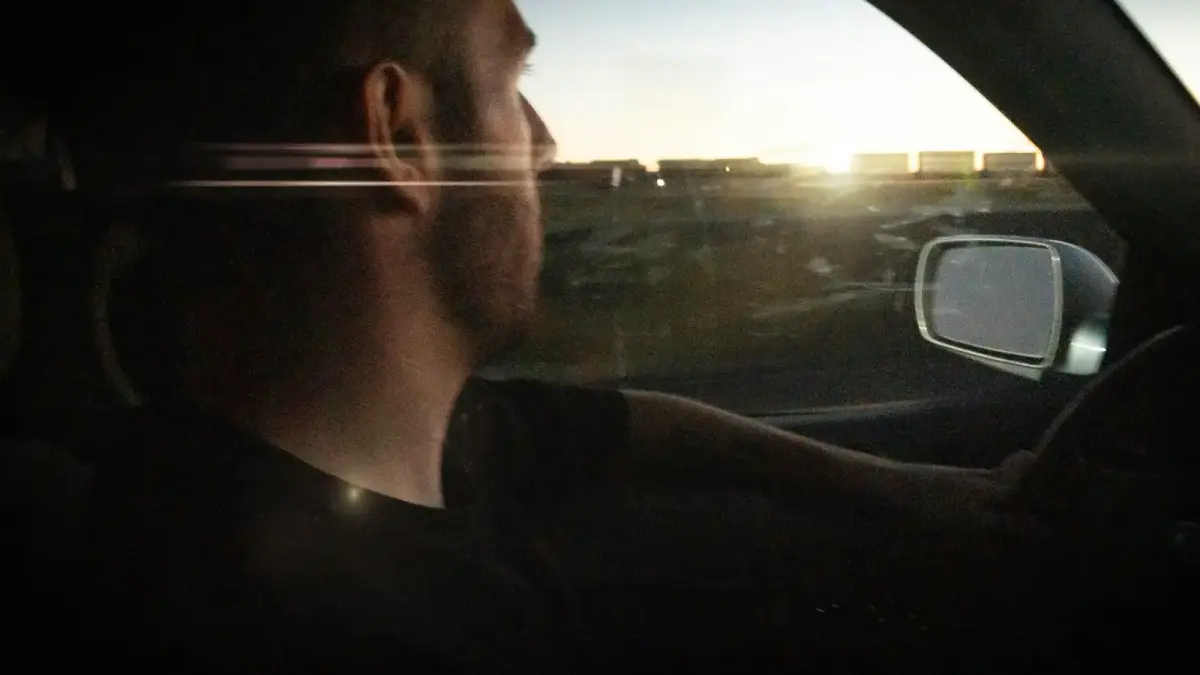
I caught myself doing it again last Tuesday. Sitting in the parking lot of a hardware store, engine still running, singing the last forty seconds of a song I would deny knowing if anyone asked.
Not quietly. Not humming. Full voice. Chest open. The kind of singing where your whole body participates and you forget, briefly, that you are a man who has spent most of his life monitoring his own volume.
The song ended. I turned the key. I walked inside and became the version of myself that the world has always expected - measured, contained, appropriate. But for two minutes and thirty-seven seconds in a parking lot off Route 9, I was someone else entirely. Someone I liked more.
I know I’m not alone in this. Not even close.
The volume knob between two selves
There’s a gesture that millions of men perform every single day, and nobody talks about it. You’re driving alone. The song comes on - the one you’d never queue up at a barbecue, the one you’d skip past if your buddy was in the passenger seat. And your hand moves to the volume knob.
You turn it up. Not a little. All the way up, or close to it.
Your voice joins in. You know every word. You’ve known every word for twenty years. You’ve never once sung this song in front of another human being.
Then, a block from your destination, the hand moves again. Volume down. Voice off. Face reset. You pull into the driveway or the office lot and you are, once again, the man people recognize.
That volume knob is doing something more than adjusting sound. It’s the dial between two versions of yourself - the private one who feels things at full intensity and the public one who learned, somewhere around age seven or eight, that intensity was a problem.
What the boys were told
I remember the exact moment. We were in the back of my father’s station wagon - me and my younger brother - and we were singing. Loud. Joyful. The way kids sing when they haven’t yet been taught that joy requires permission.
My father didn’t yell. He just said it flatly, the way men of his generation delivered corrections. “That’s enough noise.”
That was it. Three words. But I can still feel the silence that followed. The specific quality of learning, in real time, that the sound of your own happiness was an inconvenience to someone you loved.
I don’t think my father was cruel. I think he was repeating what had been said to him. A chain of men telling smaller men to be quieter, each one believing they were teaching something useful. Discipline. Composure. How to be a man.
A 2019 study published in the Journal of Personality and Social Psychology found that boys receive significantly more negative feedback for emotional expressiveness than girls, beginning as early as age four. The researchers called it “emotion coaching disparity” - girls are taught to name and express feelings, while boys are taught to regulate and suppress them.
The singing stopped in the back of that station wagon. It didn’t come back for decades. When it finally did, the only room it felt safe in had four doors, a windshield, and was moving at sixty miles per hour.
The room that moves too fast for witnesses
Think about why the car works, specifically, as the place where men let themselves be loud.
It’s not just privacy. A bathroom is private. A basement is private. You could sing in the shower - and some men do - but the car offers something those rooms don’t.
The car is moving. You are, quite literally, impossible to catch. No one can walk in on you. No one lingers outside the door. The witnesses are other drivers who pass in a blur, strangers sealed inside their own glass rooms, gone before they could register what they saw.
There is a psychological safety in motion that stillness doesn’t provide. When you’re parked and singing, some part of you watches the mirrors. But when you’re moving, when the road is pulling you forward and the song is pulling you somewhere else, the surveillance drops away.
The car becomes the only room in a man’s life where there is genuinely no audience. Not his wife. Not his kids. Not his coworkers. Not the version of his father that still lives somewhere in his posture.
A 2021 study in Frontiers in Psychology found that music listening during solitary driving activates emotional processing regions of the brain more strongly than music listening in social settings. The researchers suggested that the perception of complete privacy lowers what they called “display rule adherence” - the unconscious monitoring of how much emotion you’re showing.
In other words, the car doesn’t just allow you to sing. It allows you to feel what the song is actually about.
The songs they’d never play for anyone
Let me tell you about the songs. Not the ones men will admit to - the classic rock they’ll happily discuss, the guitar solos they’ll play air-instrument along with at a red light without shame.
I’m talking about the other songs. The ones on a playlist that has no name, or a name so generic it reveals nothing. The Celine Dion track. The Whitney Houston ballad. The Simon and Garfunkel song that makes your throat close because it sounds like something your mother used to hum while she ironed.
The love songs from decades ago that you first heard at fourteen and didn’t understand yet, but something in the melody told you that love was going to be the most complicated thing you’d ever do. And now, at fifty-five or sixty, you understand every word, and the understanding makes the song almost too much to bear.
These are the songs men carry secretly. Not because they’re embarrassed by the music itself, but because the music opens a door to a room full of feelings they were never given a framework for. Tenderness. Longing. The particular ache of remembering who you were before you learned to perform who you are.
You can’t play those songs when someone else is in the car. Not because they’d judge the music. Because they’d see what the music does to you. And you were taught - not in a single lesson, but across ten thousand small corrections - that being visibly moved by something beautiful was a form of weakness.
Thirty seconds in the parking lot
Every man who sings in the car alone knows this moment. You’ve arrived. You’re in the lot or the driveway. The song has maybe forty seconds left.
And you don’t turn the car off.
You sit there. Engine idling. Hands still on the wheel sometimes, sometimes dropped to your lap. And you let the song finish. Not because you need to hear the ending - you know the ending. But because stopping the song before it’s done would mean choosing the world over yourself, again, and you’ve been doing that your whole life.
Those thirty seconds in the parking lot are not trivial. They might be the most honest thirty seconds in a man’s entire day. The moment where he says, without words, “I’m not done feeling this yet, and I’m going to let myself finish.”
Then the song ends. He turns the key. He gets out. He walks toward whatever is waiting for him with his face arranged and his volume adjusted and his full self folded back into the compartment where it lives when other people are watching.
What they’re really protecting
I used to think this was about embarrassment. That men sang alone in cars because they couldn’t carry a tune, or because they thought it was silly, or because masculinity made them self-conscious about enjoying something soft.
I don’t think that anymore.
I think what’s happening in that car is something closer to sacred. These men aren’t hiding a guilty pleasure. They’re protecting the only version of themselves that was never edited by someone else’s expectations.
The singing self - the loud, full-throated, word-perfect, emotionally unguarded self - is not a lesser version. It might be the truest version. The one that existed before a boy was told to quiet down, before a teenager learned that caring too visibly about anything was social death, before a young man figured out that the safest way to move through the world was to keep the volume low.
A 2023 study in Psychological Science found that men who engage in regular private emotional expression - singing, journaling, crying alone - report higher levels of emotional clarity and relationship satisfaction than men who suppress across all contexts. The key word is private. These men hadn’t necessarily learned to be vulnerable in public. But they’d preserved a room, somewhere, where the full self was still allowed to exist.
The car is that room. Four doors, a decent sound system, and sixty miles of highway where no one can tell you to stop making noise.
The audience of no one
Here’s what I want you to know, if you’re the man in the car.
That thing you do - the volume up, the voice out, the thirty seconds in the parking lot before you rejoin the world - that’s not a small thing. That’s you keeping yourself alive in a way that matters more than you probably realize.
You are not hiding. You are not embarrassed. You are performing for the only audience that ever really deserved to hear you, which is yourself.
The boy who was told to be quiet found a room where quiet wasn’t required. The man who learned to fold himself into acceptable shapes found a space where he could unfold. That’s not weakness. That’s not silliness. That’s survival dressed up as a commute.
And if sometimes the song hits a certain line and your eyes sting and you’re glad the windows are up - that’s not something to be ashamed of either. That’s your full self, reminding you it’s still in there. Still knows every word. Still capable of the kind of unguarded feeling that the world spent decades teaching you to keep under the dashboard.
Turn it up. Sing the part you love. Let the song finish before you open the door.
The car was never just a car. It was the room you built for the version of yourself that deserved a stage - even if the stage was only ever sixty miles per hour and an audience of no one.