There are people who arrive everywhere ten minutes early and sit in the parking lot with the engine running, not because they are punctual but because the quiet between arriving and entering is the only part of the day that belongs entirely to them, and the person inside who thinks they are simply on time has no idea that someone just spent ten minutes breathing in a parked car before they could walk through the door
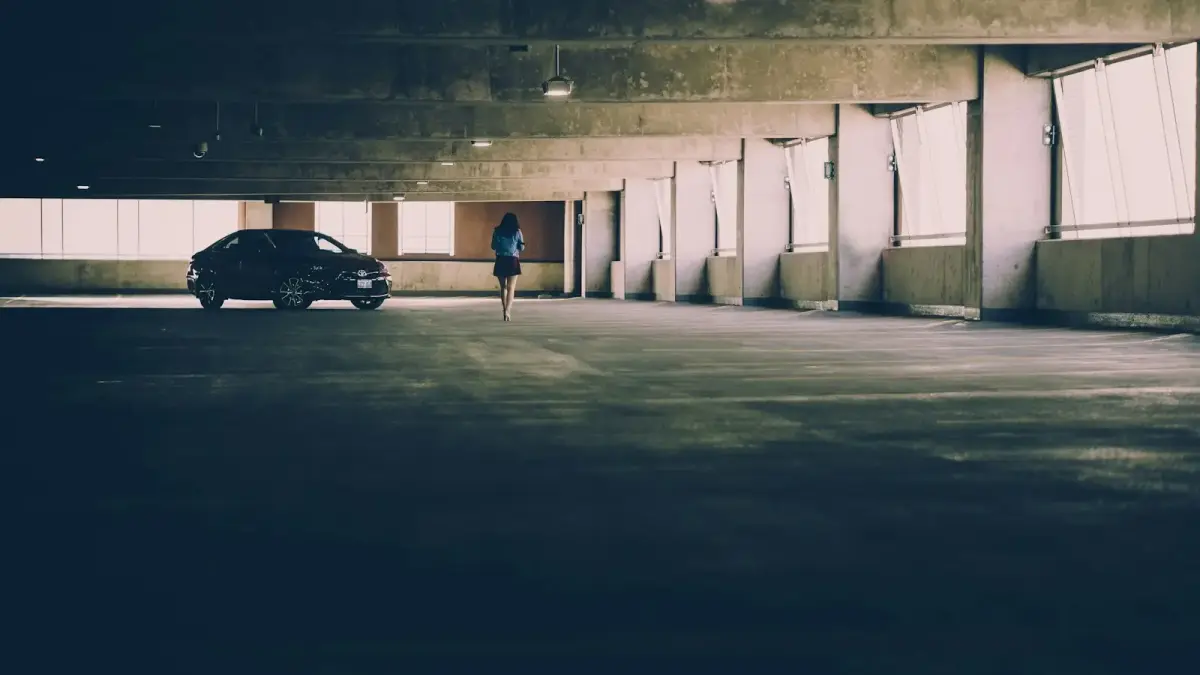
I got to the dinner party twelve minutes early and I did not go inside.
I turned the engine off, then turned it back on. I needed the hum. I needed the air conditioning pushing against the silence, some low mechanical presence that made the car feel like a room and not a coffin. I checked my phone - not for messages, but for something to look at while I wasn’t looking at the front door.
Then I did the thing I always do. I turned the rearview mirror toward my face, but not to check my hair. I was checking something else. I was looking for the version of me that could walk in there and be warm and present and light. I was looking for her in the mirror the way you’d scan a crowd for a friend you’re supposed to meet.
She showed up around minute eight. I turned the mirror back, exhaled, and opened the door.
Nobody inside knew any of that happened. They just thought I was on time.
The car is not transportation
There is a version of this that people call punctuality. The kind of person who is always five minutes early, always ready, always composed when they walk through the door. And sure, from the outside, it looks like good time management.
But if you’re the person sitting in the parking lot, you know the truth.
The car is not how you got there. The car is the last room that belongs to you before you enter a room that belongs to everyone. It is the decompression chamber between the private self and the performing self. The radio goes off. The hands settle in the lap. The breathing changes - not dramatically, not like meditation, but the way air moves through a body that knows it’s about to start working.
Because that’s what it is for some people. Being around others is not rest. It is beautiful, and it is wanted, and it is work.
Susan Cain wrote about this in Quiet - the idea that introversion is not about disliking people but about how the nervous system responds to stimulation. Introverts don’t recharge in groups. They spend in groups. And the car, those ten minutes in the parking lot, is the last deposit before the spending begins.
The door that was never just a door
I think this starts young. I think most people who sit in parked cars before entering buildings were once children who paused at front doors.
Not every front door. Their own front door.
Because in some houses, walking through the door required preparation. You had to listen before you entered. Was it quiet, the good kind of quiet, or the kind that meant someone had been crying? Were there voices, and if so, what pitch were they? Was the television on, and if it was, did that mean things were fine or did it mean someone was pretending things were fine?
The front door of those houses was never just a door. It was a threshold where you had to read the room before you stepped into it. You learned to stand on the porch and calibrate. You learned that entering without preparation was dangerous - not physically, necessarily, but emotionally. You could walk into the wrong mood. You could become the target of a frustration that had nothing to do with you. You could say the wrong thing in the first thirty seconds and spend the rest of the evening trying to undo it.
A 2014 study published in the Journal of Research in Personality found that children who grew up in emotionally unpredictable environments developed heightened sensitivity to social cues - not as a disorder, but as an adaptive strategy. Their nervous systems learned to scan before engaging. To arrive before entering.
That child grew up. And the porch became a parking lot. And the front door became every door.
What the body is actually doing
Here is what happens in those ten minutes, if you slow it down enough to notice.
The shoulders drop. Not because you tell them to, but because the body recognizes that for a brief window, nobody needs anything from it. The jaw unclenches. The hands, which have been gripping the steering wheel out of habit, open and rest on the thighs.
Sometimes there’s a specific exhale. Not a sigh - sighs are involuntary and tinged with frustration. This is different. This is a conscious release. A deliberate emptying of whatever the last environment left inside you.
Maybe you just came from work, where you spent eight hours modulating your voice and monitoring your facial expressions and making sure your reactions were appropriate and measured. Maybe you just came from home, where being a parent or a partner required a different kind of performance - the kind where you’re supposed to be relaxed but you’re actually orchestrating everything.
The car is where you put all of that down.
Elaine Aron’s research on highly sensitive people describes this as a neurological reality, not a personality quirk. Roughly fifteen to twenty percent of the population processes sensory and emotional information more deeply than the rest. For these people, transitions between social environments aren’t seamless. They’re costly. The nervous system needs a beat between contexts - a moment to discharge the residue of the last interaction before it can authentically engage with the next one.
The parked car provides that beat.
The performance of ease
Here is what makes this invisible. The people who sit in parking lots are usually the ones who seem the most natural when they walk through the door.
They’re warm. They’re present. They remember what you told them last time. They ask about your mother, your job, your kid’s soccer season. They laugh at the right moments and listen at the right moments and make you feel like they’re genuinely glad to be there.
And they are glad. That’s the part people misunderstand.
This is not avoidance. The person in the parking lot is not dreading what’s inside. They are preparing for it - the way a musician tunes an instrument before a concert, not because they resent the music but because they respect it. They know that walking in without preparation means walking in at half capacity. And they care too much about the people inside to give them a diluted version of themselves.
But the performance of ease costs something. A 2019 study in Frontiers in Psychology found that individuals high in introversion who regularly engaged in what the researchers called “surface acting” - presenting a social persona that differs from their internal state - experienced significantly higher emotional exhaustion than their extroverted counterparts performing the same social behaviors. The effort was invisible, but the fatigue was real.
The parking lot is where the effort begins. And nobody inside ever sees it.
The engine running
I want to talk about the engine for a moment. Because there is something specific about leaving it running.
Some people turn the car off and sit in the silence. But many leave the engine on. And I think that matters.
The engine running is the body’s way of keeping an exit available. Not because they plan to leave - they almost never do. But because the hum of the engine means the car is still alive, still ready, still a room they could retreat to if the evening becomes too much. It’s a safety net that never gets used, but its presence changes everything.
It is the same reason some people always sit near the door at restaurants. The same reason some people keep their coat on for the first twenty minutes of a party. The body has learned that feeling trapped makes everything harder, and the simplest way to not feel trapped is to keep one small exit visible.
This is not pathology. This is architecture. The nervous system building itself a room it can breathe in.
What it looks like from inside the car
If you’ve never done this, here is what it looks like from the inside.
You’re sitting in a parking lot and the light is doing that thing where it comes through the windshield at an angle that makes everything slightly golden. The car smells like your car - coffee, the faint sweetness of whatever lotion you put on that morning, the leather or fabric that holds the shape of your commute.
You can see the door you’re about to walk through. Maybe you can see people inside through the windows. They’re already talking, already laughing, already living in the evening you haven’t entered yet.
And for a few minutes, you exist in the space between. Not home and not there. Not alone and not with people. Suspended in the last privacy of the day.
You might check the mirror one more time. Not vanity - composure. You are assembling the self that walks through doors. The one who smiles first, who reaches for the hug, who says something generous before anyone has to wonder whether you’re happy to be there.
Then you turn the engine off. You open the door. The air hits different - cooler or warmer than the car, carrying the sound of the world.
And you walk in. And you’re wonderful. And nobody knows what it cost.
The reframe
I used to feel ashamed of the parking lot. I used to think it meant something was wrong with me - that normal people just walked inside, that the ten minutes of breathing was evidence of some deficiency I’d never outgrow.
But I’ve studied this long enough now to see it differently.
The parking lot is not avoidance. It is the opposite of avoidance. It is the proof that you care enough about being present that you prepare for it. It is the evidence that you take other people seriously - that you don’t want to walk in distracted or depleted or carrying the residue of whatever happened before.
The person who sits in the car for ten minutes before walking through the door is not fragile. They are someone who takes the world in at full volume. Every room, every conversation, every shift in someone’s tone - they catch all of it. And catching all of it is extraordinary, and it is exhausting, and the car is where they make space for both of those things to be true.
So if you’re reading this in a parked car right now, waiting for the version of yourself that can walk through the door - she’s coming. He’s coming. They always do.
And the people inside are lucky. Because they’re about to receive someone who didn’t just show up. They’re about to receive someone who prepared to be fully there.
The quiet in the car was never wasted time. It was the most generous thing you did all day.