There is a kind of love that only exists between two people who still point things out to each other - a hawk, a sunset, a license plate from far away - not because the thing itself matters but because the pointing is a way of saying I am here and I want you to see what I see and that is the oldest sentence love knows
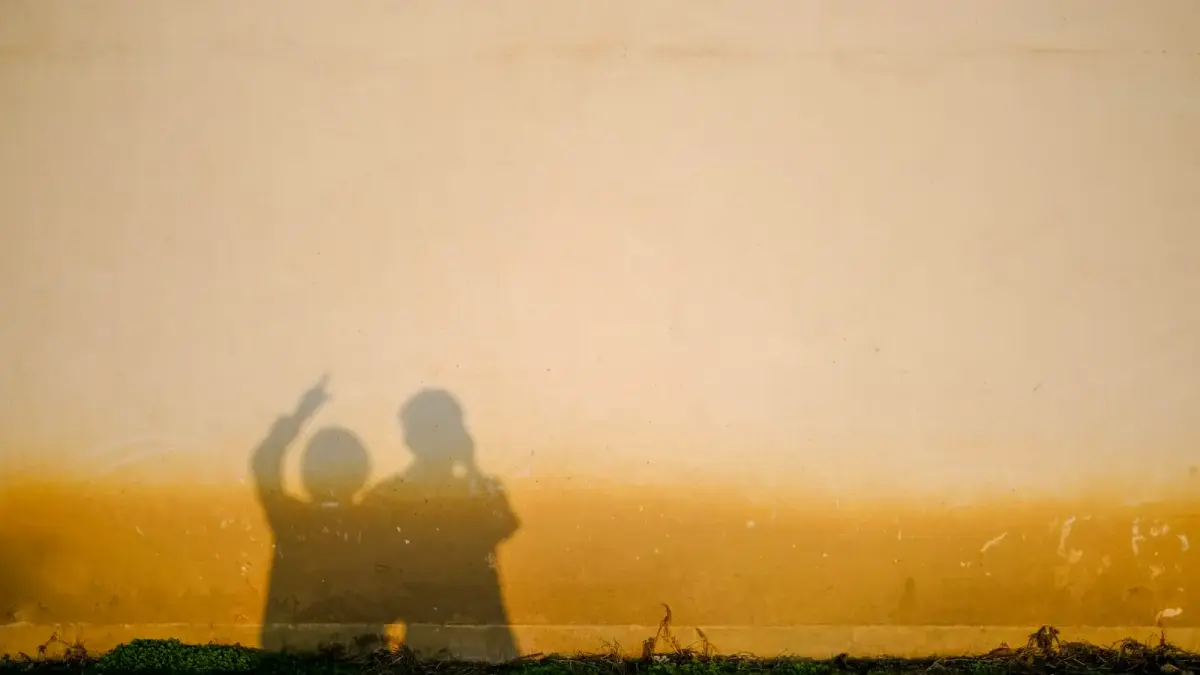
My father has a way of touching my arm when we walk together. Not a grab, not a pull. Just two fingers against my forearm, light as a question, and then the other hand rising to point at something I would have missed. A red-tailed hawk banking over the treeline. A cloud stretched long and thin enough to look like a river. A dog across the street wearing a plaid sweater and walking like it knows.
He does not say much when he does this. Sometimes it is just the word “look.” Sometimes not even that - just the touch and the lifted hand, and the expectation that I will follow his gaze and find whatever he found, and that finding it together will be enough.
I used to think this was a small thing. A habit. A way of filling quiet space on long walks. I do not think that anymore. I think he has been telling me something important every single time, and it has taken me most of my adult life to hear it.
The tap on the arm
There is a gesture that belongs almost exclusively to people over fifty, and it is this: the light touch on someone’s arm followed by a pointed finger and the words “would you look at that.”
It happens on porches and in parking lots. It happens on slow drives through the country when the passenger notices the light doing something particular to a wheat field. It happens at kitchen windows when a cardinal lands on the feeder, and one person calls to another in the next room, not because the cardinal is rare but because it is red and it is here and someone else should see it before it goes.
This is not idle conversation. This is not boredom filling silence.
This is a form of love so ordinary that most people never think to name it.
What the finger is really pointing at
Developmental psychologists have a term for this behavior. They call it joint attention - the act of directing another person’s focus toward a shared object or event. It is one of the earliest social behaviors humans develop. Babies do it before they can speak. They point at things, then look back at the adult to make sure the adult is seeing what they see.
A 2014 study published in Psychological Science found that shared experiences - even something as simple as tasting chocolate at the same time as another person - are rated as more intense and more pleasurable than the same experience had alone. The researchers called it co-witnessing, and they noted that the effect had nothing to do with conversation or commentary. Just knowing that another person was attending to the same thing, at the same moment, changed the quality of the experience itself.
The pointing finger at sixty is not about the hawk.
It is about the fact that two people are standing in the same place, at the same time, looking at the same piece of sky, and one of them thought the other one deserved to see it too.
That thought - you deserve to see this - is the sentence underneath the pointing. It is a sentence most people never say out loud because it sounds too simple to matter. But it is not simple. It is the foundation of almost everything.
A generation that learned to notice without narrating
There is something particular about people who grew up before screens. Not better. Not worse. Just particular.
They learned to be in a place without documenting it. They sat on porches without photographing the sunset. They drove through mountains without pulling over to get the shot. They ate meals without capturing the plate. Their experience of beauty was not mediated by a lens or a feed or the question of who else might see it later. It was immediate, and it was shared with whoever happened to be standing next to them.
The pointing behavior comes from this. From a time when the only way to share something beautiful was to physically turn toward another human being and say “look.”
Not “let me send you this.” Not “check my story.” Not a tag or a mention or a link.
Just a hand on an arm. A lifted finger. A voice that says “look at that” with enough quiet wonder to make it clear that the looking matters.
This is what presence used to feel like before we had a word for it. It was not a practice. It was not a discipline. It was just how people moved through the world when the world was the only thing in front of them.
The neuroscience of looking together
There is something happening in the brain when two people attend to the same thing at the same time. Neuroscientist Uri Hasson at Princeton has studied what he calls neural coupling - the phenomenon where the brain activity of a listener begins to mirror the brain activity of a speaker during engaged conversation. When two people are truly paying attention to the same experience, their neural patterns synchronize. They are, in a measurable and literal sense, on the same wavelength.
This is what the pointing creates. A moment of synchrony. Two nervous systems orienting toward the same stimulus, processing it in parallel, and in that brief alignment, something happens that feels like closeness but is actually something deeper. It is the experience of sharing a mind, just for a second, with someone you love.
Adam Grant has written about how the deepest bonds are formed not through grand gestures but through what he calls micro-moments of resonance - tiny instances of shared attention and emotional alignment that accumulate over decades into what we recognize as intimacy. The couple who points things out to each other has had ten thousand of these moments. They have been building something enormous out of hawks and sunsets and license plates from Alaska.
What we traded
I am not interested in romanticizing the past or demonizing phones. That is too easy and too dishonest.
But I will say this. There is a difference between sharing an experience and sharing a record of an experience. When my father touches my arm and points at the hawk, he is inviting me into a moment that exists only between us. It cannot be forwarded. It cannot be liked. It has no audience. It is happening right now, and in thirty seconds it will be gone, and the only proof it existed will be the fact that we both saw it and neither of us needed to prove that we did.
When I photograph a sunset and post it, I am doing something else entirely. I am asking strangers to witness what I witnessed, and in doing so I am turning the experience into content. The sunset becomes evidence of a life well-lived rather than the life itself.
I do not think this makes me a bad person. I think it makes me a person who grew up in a world that taught me every beautiful thing is wasted if no one else sees it. My father grew up in a world that taught him one person seeing it - the right person, the person standing next to you - was enough.
The quiet vocabulary of long love
If you have been with someone for twenty or thirty or forty years, you know that love stops announcing itself. It does not arrive with declarations. It does not perform. It becomes invisible in the way that breathing is invisible - so constant that you forget it is happening until it stops.
But the pointing. The pointing is love made visible again.
It is the moment when someone who has shared your bed and your kitchen and your silence for decades still thinks you need to see the way the light is hitting the barn. It is the insistence that your attention is worth redirecting. That the small beautiful thing in front of them is not complete until you are seeing it too.
A 2019 study in the Journal of Social and Personal Relationships found that couples who regularly engaged in shared novel experiences - even minor ones, like noticing something unexpected together - reported higher relationship satisfaction than couples who did not. The researchers emphasized that the novelty did not need to be dramatic. A strange cloud. An unfamiliar bird. A child doing something funny in a grocery store. What mattered was the act of turning toward each other and saying “did you see that?” What mattered was the turning.
This is what people over fifty have been doing for years without reading a single article about it. They have been turning toward each other. They have been pointing at the world and saying, wordlessly, “I am still here and I still want you to see what I see.”
That is not a small thing. That is the whole thing.
The oldest sentence
My father pointed out a license plate from Alaska last summer. We were in a grocery store parking lot in Virginia, and there it was, gold and blue, impossibly far from home. He touched my arm and said “now how do you suppose that got here” and we stood there for a moment, two people in a parking lot, wondering about a stranger’s long drive.
It was nothing. It was a license plate.
But standing there with him, following the line of his finger, imagining the miles between Alaska and this strip mall - I felt something I have spent years trying to find in meditation apps and therapy sessions and books about presence. I felt completely, entirely here. Not because I was trying. Because someone I love thought I should see something, and I did, and for a few seconds the whole world narrowed to the space between his hand and that plate and my eyes, and nothing else existed, and nothing else needed to.
If you are someone who still taps arms. If you still say “look at that” to whoever is standing next to you. If you still believe a hawk is worth interrupting silence for, and a sunset is worth pulling over for, and a dog in a sweater deserves a witness - you are practicing something that no app can teach and no screen can replace.
You are saying “I am here.” You are saying “you are here.” You are saying “this ordinary thing is beautiful and I need you to see it because seeing it alone is not enough.”
That is the oldest sentence love knows. And you have been saying it your whole life with nothing but a pointed finger and the trust that someone will look where you are looking.
They will. They always do.