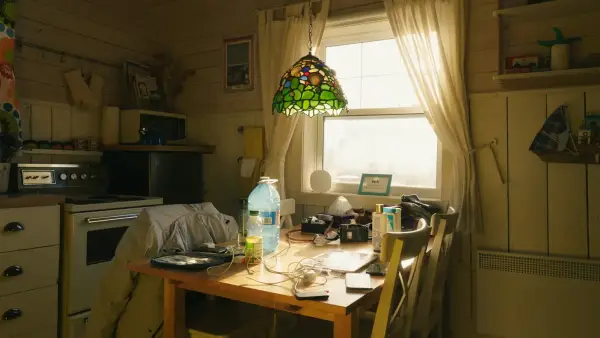
There is a kind of silence that entire families agree to without ever discussing it, where everyone at the dinner table knows something is wrong but the rules say you smile, pass the bread, and never name the thing sitting in the empty chair

I grew up in a house where the most important conversations happened in the spaces between words. My father would come home late, and my mother would set his plate in the microwave without looking up. My brother and I would exchange a glance across the table - quick, practiced, almost imperceptible - and then we’d talk about school.
Nobody told us to do that. Nobody sat us down and said, “When things feel heavy, you change the subject.” We just absorbed it the way children absorb everything - through watching, through sensing, through the slow education of what gets acknowledged and what gets swallowed.
If you grew up in a family like this, you already know the feeling I’m describing. That particular tension in your chest when something is clearly wrong and everyone around you is pretending it isn’t. You learned young that the most dangerous thing in your household wasn’t the problem itself. It was the possibility that someone might name it out loud.
The dinner table where everything was fine
Every family that practices this kind of silence has its own version of the dinner table. Maybe yours was the living room on holidays, everyone performing warmth while your uncle’s drinking sat in the middle of the room like furniture nobody mentioned. Maybe it was Sunday mornings, your parents moving around each other in the kitchen with a precision that looked like partnership but was actually choreographed avoidance.
The remarkable thing about family silence is how organized it is. It’s not chaos. It’s architecture. Everyone has a role. Someone tells the jokes. Someone asks about work. Someone clears the plates before the quiet stretches too long.
A 2012 study published in the Journal of Family Psychology found that children in families with high levels of emotional suppression develop what researchers call “emotional monitoring” - a hyperawareness of other people’s moods that operates constantly, automatically, and at significant cognitive cost. These children weren’t ignoring the tension. They were tracking it with extraordinary precision. They just learned never to report what they observed.
You might recognize this in yourself. The way you walk into a room and immediately scan for who’s upset. The way you can feel a shift in someone’s mood before they’ve said a single word. People have probably told you you’re perceptive, intuitive, empathetic. And you are. But that skill was forged in a kitchen where reading the room was a survival strategy.
What the silence was protecting
Here’s what I’ve come to understand after years of clinical work with adults who grew up in these families: the silence was never really about the secret. It was about the family’s identity.
Every family has a story it tells about itself. We’re close. We’re strong. We handle things privately. We don’t air our dirty laundry. The silence existed to protect that narrative. Because if someone named the drinking, the affair, the depression, the rage that lived behind closed bedroom doors - the story would collapse. And for many families, the story is all they have.
So the children learn something devastating. They learn that the family’s image matters more than their own experience. They learn that what they see with their own eyes is less real than what everyone has agreed to pretend.
This is where the damage lives. Not in the secret itself - though secrets carry their own weight - but in the message that your perception cannot be trusted. That what you feel is less valid than what everyone else has decided to perform.
Gabor Mate has written extensively about how children in emotionally suppressed families don’t just hide their feelings - they lose access to them entirely. The child doesn’t think, “I’m choosing not to mention Dad’s drinking.” The child thinks, “Everything is fine.” The suppression becomes so complete that the child genuinely cannot locate their own discomfort. It’s been packed away so efficiently that it feels like it was never there.
The adult who over-explains everything
If you grew up in this kind of family, there’s a good chance you do something in your adult relationships that confuses even you. You over-explain. You provide evidence for your own emotions. You say things like, “I’m not being crazy, but…” or “I know this might sound unreasonable, but I feel like…”
You build a legal case for your own experience before you share it with anyone.
This makes perfect sense when you trace it back. In your family, having a feeling wasn’t enough. Naming something you observed wasn’t safe. So you learned to preemptively defend your perceptions, to gather proof before you dared say what you noticed, because the cost of being wrong - of being the one who disrupted the agreement - was enormous.
A 2019 study in Psychological Science found that adults who grew up in families with unspoken emotional rules showed significantly higher rates of what researchers call “experiential avoidance” - the tendency to distrust, suppress, or argue against their own internal experience. They weren’t anxious about the world. They were anxious about themselves. About whether what they felt was real.
You might notice this showing up in specific ways. You feel hurt by something your partner says, and your first instinct isn’t to say so - it’s to talk yourself out of it. You think, “Am I being too sensitive? Is this actually a big deal? Maybe I’m reading into it.” You run your feelings through a committee in your head before you’ll let them reach your mouth.
That committee is your family’s dinner table. It’s still in session.
The loyalty that looks like love
One of the hardest things to untangle is this: in these families, silence felt like love. Keeping the secret, maintaining the performance, protecting the parent who was struggling - it all felt like loyalty. Like devotion. Like the deepest form of care you could offer.
And in a way, it was. You were a child doing the only thing you knew how to do to keep your family together. That instinct was generous and brave and real.
But it taught you a definition of love that will exhaust you if you carry it unchanged into adulthood. It taught you that love means absorbing someone else’s pain without mentioning it. That closeness means knowing everything and saying nothing. That the highest form of intimacy is the kind where two people agree to pretend.
Susan Cain has written about how introverts and sensitive people are disproportionately cast as the “keepers” in these family systems - the ones who feel the most, say the least, and carry the emotional weight of the entire household without anyone acknowledging the burden. If that was you, you may have spent decades believing that your role in relationships is to understand, to accommodate, to make things easier for everyone else at your own expense.
You probably didn’t call it self-sacrifice. You called it being a good daughter. A good brother. A good partner. A good friend.
When your body remembers what your mind agreed to forget
The silence doesn’t stay psychological. It settles into your body. I’ve worked with clients who carry chronic tension in their jaw, their shoulders, their stomach - and when we trace it back, it leads to a dinner table where they spent years clenching everything tight to keep from saying the wrong thing.
A 2021 study published in Frontiers in Psychology examined the relationship between childhood emotional suppression and adult somatic symptoms. The findings were striking: adults who reported growing up in families where emotions were systematically unexpressed showed significantly higher rates of chronic pain, digestive issues, and tension-related conditions. The body was holding what the voice was never allowed to release.
You might know this feeling. The tightness that arrives when you’re about to say something honest. The headache that shows up after a family phone call. The way your stomach drops when someone says, “We need to talk” - not because of what they might say, but because talking itself was the thing your nervous system learned to fear.
Your body kept the record. It was the only part of you that was allowed to.
Learning to name the thing in the chair
Breaking the silence doesn’t mean confronting your family at Thanksgiving. It doesn’t require a dramatic reckoning or a letter that burns bridges. Sometimes it doesn’t involve your family at all.
It starts with you. With the quiet, private act of letting yourself know what you know.
It sounds almost too simple. But for someone who spent their childhood learning to un-know things - to override their own perceptions, to smooth over their own instincts, to treat their feelings as problems to be managed rather than information to be trusted - this is radical work.
It looks like pausing when you catch yourself saying, “It’s fine,” and asking whether it actually is. It looks like letting a feeling exist for thirty seconds before you argue with it. It looks like telling one person - a therapist, a friend, a partner - something true that your family would never say out loud.
Daniel Goleman’s research on emotional intelligence has long emphasized that the foundation of every other interpersonal skill is self-awareness - the capacity to accurately identify what you’re feeling in real time. For people who grew up in silent families, this isn’t a skill they’re lacking. It’s a skill that was trained out of them. The awareness was always there. It just wasn’t safe to use.
The chair doesn’t have to stay empty
You didn’t choose the silence. You inherited it. You were handed a contract before you could read, and you signed it with your compliance because that was the only currency a child has.
But you’re not at that table anymore. You get to decide now what gets named and what gets left in the dark. You get to trust the part of yourself that always knew something was wrong, even when everyone around you was smiling.
That part of you wasn’t broken. It wasn’t dramatic or too sensitive or making things up. It was the most honest thing in the room.
And it’s been waiting - patiently, quietly, for years - for you to finally listen.