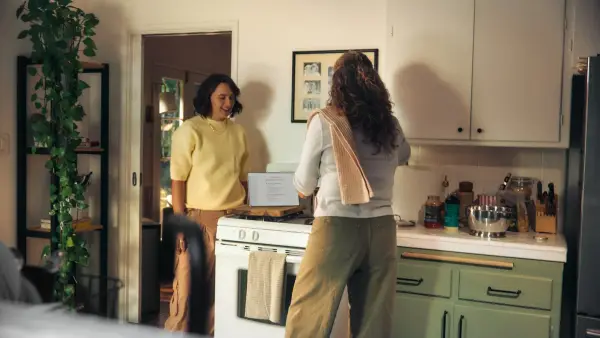
There is a moment in many long marriages when the conversations stop being about anything real and become entirely about logistics, and neither person notices the shift because a full calendar feels like closeness even though closeness left the room years ago

The Morning That Made Me Count
I was sitting across from my wife at the kitchen table on a Tuesday, and she was reading something off her phone about the water heater warranty. I was half-listening, half-scanning a calendar notification about our grandson’s soccer practice. And somewhere between the warranty expiration date and which parking lot to use at the sports complex, I realized we hadn’t said anything real to each other in weeks.
Not anything that mattered. Not anything that started with “I’ve been thinking” or “Can I tell you something?” or even “I had the strangest dream last night.”
We had talked constantly. Every single day. But it had all been about scheduling, logistics, the machinery of a shared life. Who was calling the plumber. Whether the pharmacy had the refill ready. What time her sister’s flight landed. I could not remember the last time either of us had said something that made the other person pause.
And the strange part - the part that unsettled me most - was that I hadn’t noticed. The calendar had been so full that it felt like we were deeply involved in each other’s lives. We were coordinating. We were collaborating. But we were not connecting. And I don’t think either of us could have told you when the shift happened.
When the Calendar Replaces the Conversation
This is something that happens so gradually in long marriages that it almost doesn’t register as a loss. You don’t wake up one morning and decide to stop sharing your inner life with the person beside you. You just get busy. And busy feels responsible. Busy feels like love, even.
There are prescriptions to pick up. Roof estimates to compare. Grandchildren who need collecting at very specific times from very specific places. The dog has a vet appointment. The taxes need a signature. Your mother’s assisted living facility called again.
Each of these things is real. Each of them matters. And each of them requires the kind of coordination that only two people who have built a life together can manage. So when you spend your evenings going over the week’s agenda, it genuinely feels like partnership. It feels like you are doing marriage well.
A 2014 study published in the Journal of Social and Personal Relationships found that couples who had been married for more than twenty years often reported high levels of satisfaction based on functional coordination - shared routines, efficient task management, mutual reliability. But the same study found that relational satisfaction and emotional intimacy were not the same thing, and that couples frequently confused one for the other.
They were proud of how well they ran the household. They just couldn’t remember the last time they’d been curious about each other.
The Specific Silence That Lives Between Busy People
There is a particular kind of quiet that settles into a home where two people are always doing something together but never being together. It’s not the silence of conflict. It’s not cold or punishing. It’s administrative.
You can hear it in the rhythm of the conversations. They begin with a question that has a factual answer. “Did you call the insurance company?” “What time is the thing on Saturday?” “Do we need milk?” And they end without anyone having been seen.
I started paying attention to it - not just in my own marriage, but in the marriages around me. Friends at dinner would spend the entire meal talking through their calendars in front of us. Couples at coffee shops would sit across from each other, exchanging logistics like coworkers at a Monday morning standup. Efficient. Cooperative. And somehow lonelier than being alone.
The poet David Whyte once wrote about the way relationships can become “a mutual agreement not to disturb each other.” I think about that often. Not because anyone made a conscious agreement. But because the logistics created a structure that made real conversation feel unnecessary - or worse, disruptive.
Why would you bring up the sadness you’ve been carrying when there are three things on tomorrow’s list that still need sorting? Why would you say “I miss how we used to talk” when you technically never stopped talking?
What Closeness Actually Requires
Here is what I had to learn the hard way: closeness is not proximity. It is not frequency of contact. It is not even shared purpose. Closeness is the willingness to be known in the places that have nothing to do with function.
It’s saying “I had a thought today that scared me a little” and having that be met with stillness instead of a solution. It’s asking “What are you actually feeling right now?” and being willing to sit with whatever the answer is. It’s the kind of conversation that cannot be scheduled between the dentist appointment and the grocery run, because it requires a different pace entirely.
Daniel Goleman, in his work on emotional intelligence, describes what he calls “full attention” - the act of being completely present with another person without an agenda. He argues that this kind of attention is the foundation of all genuine intimacy. Not the grand gestures. Not the vacations. The simple, unscripted moments where two people turn toward each other without a task to complete.
A 2021 study in Psychological Science found that couples who regularly engaged in what researchers called “substantive conversation” - talk about feelings, memories, values, fears, and wonder - reported significantly higher relationship satisfaction than couples whose communication was primarily instrumental. The effect held even when the instrumental communicators spent more total time talking to each other.
More talking. Less connection. That was the finding that caught in my chest, because I recognized it immediately.
The Grief That Doesn’t Announce Itself
One of the hardest things about this kind of drift is that it doesn’t feel like grief. It doesn’t arrive with a sharp edge or a dramatic confrontation. There is no slamming door. No tearful argument. No moment where someone says “We need to talk.”
Instead, it’s more like a room that gets slightly dimmer each year, so slowly that your eyes adjust. You stop noticing the dark because you’ve adapted to it. You can still see well enough to navigate. You can still function. You just can’t see each other’s faces clearly anymore.
I’ve talked to men in their sixties who describe this with a confusion that breaks my heart. “We get along fine,” they’ll say. “We don’t fight. We have a good routine.” And then, almost as an afterthought: “I just don’t think she knows me anymore. I’m not sure I know her either.”
They are not describing a bad marriage. They’re describing a marriage that quietly stopped doing the one thing marriages are supposed to do - make you feel less alone in the world. And they didn’t notice because they were too busy running it.
The Courage of the Unnecessary Conversation
Fixing this - if “fixing” is even the right word - does not require therapy or a retreat or some dramatic intervention. It requires something much smaller and, honestly, much harder. It requires starting a conversation that the calendar doesn’t need.
Saying something that has no practical function. “I’ve been thinking about my father a lot lately.” “I read something today that made me feel hopeful for the first time in a while.” “I want to tell you about a memory that came back to me this morning.”
These are unnecessary conversations. The household runs fine without them. The grandkids get picked up on time regardless. The roof estimate gets handled either way. But these are the conversations that keep two people real to each other - that keep a marriage from becoming a well-oiled machine that nobody actually lives inside.
Researcher John Gottman, whose decades of work on marital stability have become foundational, found that the single strongest predictor of long-term relationship health was not conflict resolution or sexual satisfaction. It was what he called “turning toward” - the small, daily moments where one person bids for the other’s attention and the other person responds. Not with a solution. Not with a calendar item. Just with presence.
A 2019 study in Frontiers in Psychology echoed this, finding that emotional responsiveness - the feeling that your partner truly “gets” what you’re experiencing - was the most reliable predictor of relationship longevity. More than compatibility. More than shared interests. More than how well you divided the household labor.
You can divide the labor perfectly and still lose each other.
What I Am Learning to Say Out Loud
I don’t want to pretend I’ve mastered this. I haven’t. I still catch myself defaulting to logistics because it’s easier. It’s safer. There’s a right answer to “Did the electrician call back?” There’s no right answer to “Do you ever feel like we’re disappearing into our routines?”
But I’m learning that the second question is the one that matters. Not because the first one doesn’t need asking - it does. The house has to run. The life has to be managed. But if management is all there is, then the marriage becomes a job that two people are very good at, and somewhere underneath that competence, two people are quietly starving for something they can’t quite name.
If you recognize this - if you’re reading this and feeling that dull ache of familiarity - I want you to know something. The fact that you recognize it means the closeness isn’t gone. It’s just been buried under a calendar. It’s been waiting under the prescription pickups and the roof estimates and the grandkid schedules, patient as it has always been.
You didn’t fail at marriage. You just got very good at running one. And now, maybe, you can get curious about living in one again.
It starts with one unnecessary sentence. One thing that has no place on the to-do list. One moment where you look at the person across the kitchen table and say something that isn’t about the water heater.
Something that’s just about them. Something that’s just about you. Something real.