There is a moment in your mid-forties when you hear your mother's exact voice come out of your own mouth - not her words but the tone, the specific rising note of worry she used when you were nine and running too close to the road - and it stops you cold because you spent thirty years becoming someone else and your body chose her anyway
I was standing at the kitchen counter last November, slicing apples for my daughter’s lunch, when she told me she was going to ride her bike to Celia’s house after school. And before I could think, before any conscious part of me had a say in it, my mouth opened and a voice came out that did not belong to me.
It was my mother’s voice.
Not a version of it. Not an echo. The exact voice. The specific rising note she used when I was small and doing something that scared her, the particular way she stretched the word “careful” into three syllables, the way her pitch climbed at the end of a sentence like it was reaching for something it couldn’t quite hold onto. I heard it leave my own throat and I stood there with the paring knife in my hand and the apple going brown on the cutting board, and I could not move for a full five seconds.
I am forty-six years old. I spent most of my twenties and thirties building a self that was deliberately, architecturally not her. And in a kitchen that smells like September, my body just handed me back.
The inventory you start keeping without meaning to
It begins with the voice. But once you hear it, you start noticing everything.
The way you fold a towel. Not in half and then in thirds, the way you learned in your own apartment at twenty-two, but in the specific, slightly inefficient way she folded them - lengthwise first, then into a tight square that doesn’t actually fit on the shelf but looks, somehow, like it belongs there. Your hands started doing it without asking you. You don’t know when the switch happened.
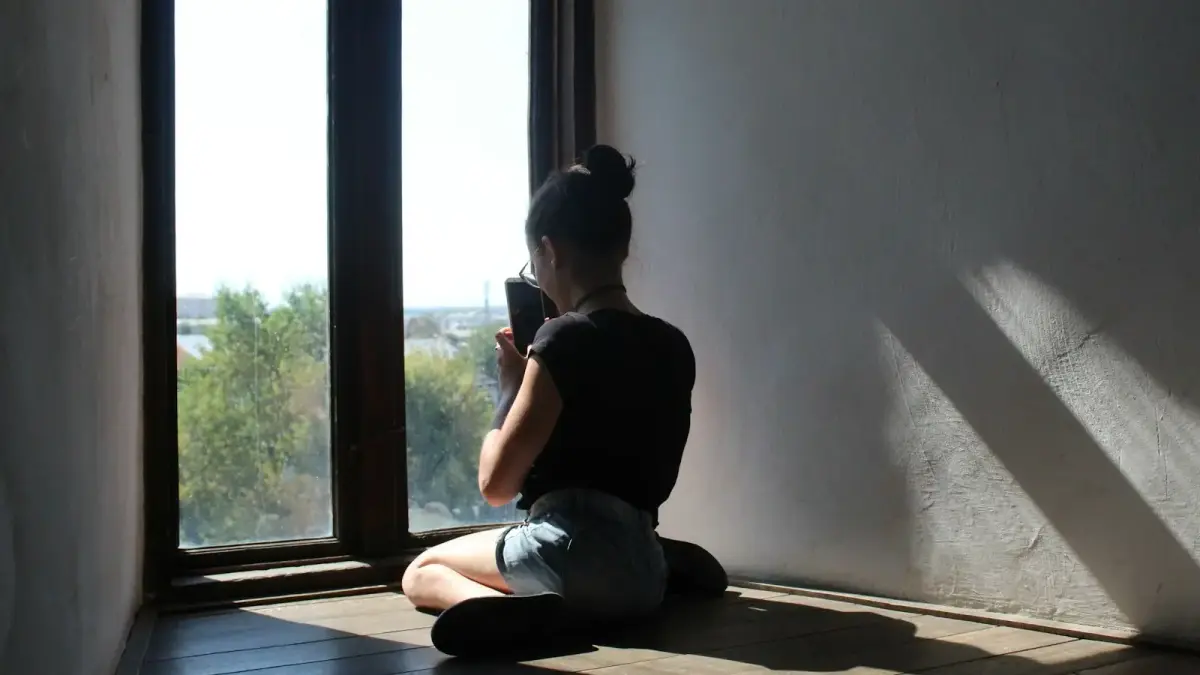
The way you stand at a window. Hips slightly forward, arms crossed low, one hand cupping the opposite elbow. You catch your reflection in a dark pane at night and the woman looking back is not forty-six. She is sixty-three and she is standing at the window in the house you grew up in, watching the driveway for headlights that haven’t come yet.
The phrases. That’s the part that really gets you. You swore, at fifteen, with the full righteous certainty of a teenager who has just discovered that her parents are flawed, that you would never say the things she said. And now they come out of you like water from a tap. “I’m not angry, I’m disappointed.” “Do what you want, but don’t come crying to me.” “I just worry.”
I just worry. Three words that contain an entire woman’s love and an entire woman’s fear and an entire woman’s inability to say what she actually means, which is: I cannot control what happens to you and this is unbearable to me and I have been unbearable since the day you were born.
You hear yourself say it and you think: oh. There you are.
The long project of not-her
Most of us don’t realize we’re doing it while we’re doing it. The project of becoming not-your-mother is so early and so total that it feels like personality rather than construction. But if you look closely, the blueprints are everywhere.
She was emotional, so you became measured. She deferred, so you became decisive. She gave herself away in pieces, so you held yourself in a tight fist. She stayed in a marriage that dimmed her, so you left one. She never said what she wanted, so you practiced saying it until it sounded natural, even when it didn’t feel natural, even now.
A 2018 study published in the Journal of Personality and Social Psychology found that adult children’s self-concepts were significantly shaped by perceived contrast with their parents, not just similarity. We don’t only become who our parents modeled. We become who we decided they should have been. The not-her is as much her creation as the her.
And the project works, for a while. Your twenties and thirties are a long successful performance of someone who has been built from scratch. You have different politics. A different relationship to money. A different way of sitting in a room. You have, you believe, escaped.
Then you turn forty-three, or forty-five, or forty-seven, and you call your kid in for dinner and the voice that comes out of your mouth has been waiting for you this whole time.
What lives in the body
Here is what I think is actually happening, and it is stranger and more tender than any psychology textbook makes it sound.
Your mother’s gestures live in your body the way a song lives in muscle memory. You learned them before you learned language. Before you had opinions or preferences or a self that could decide what to keep and what to throw away. You learned the way she held a steering wheel. The way she sighed when she sat down at the end of the day - not a dramatic sigh, just a small release, a sound so quiet you might not have noticed it if you hadn’t been listening for the weather of her your entire childhood.
You learned the angle of her head when she was listening. The particular motion of her hand when she waved someone off, the way her fingers spread and then came together, like she was releasing something small into the air.
These were not ideas. They were not beliefs you could evaluate and choose to adopt or reject. They were the raw material of your nervous system forming itself around the closest human body it had. Developmental psychologists call it embodied cognition - the way our earliest learning is stored not as memory but as movement, as reflex, as the particular rhythm of a body navigating the world.
A 2021 study in Frontiers in Psychology on intergenerational transmission of nonverbal behavior found that adults reproduced their primary caregiver’s gestures, vocal intonation patterns, and micro-expressions with remarkable accuracy, even when they had no conscious memory of those specific behaviors. The body keeps what the mind throws away. Your thirty-year renovation project changed the house, but it did not change the foundation.
And so one ordinary day in your forties, you tilt your head a certain way while listening to your daughter, and your husband looks at you and says, “You look exactly like your mom right now,” and something inside you cracks open that you did not know was sealed.
The part where the grief and the tenderness arrive at the same time
This is the part that catches people off guard. Because when you hear her voice come out of your own mouth, you expect to feel one thing. Resistance, maybe. Or amusement. Or the old familiar impulse to correct course, to steer back toward the self you built on purpose.
But what you actually feel, if you stay still long enough to feel it, is something much more complicated. It is grief and love arriving in the same breath. It is missing someone who is still alive, or mourning someone who is gone, and realizing simultaneously that you have been carrying them inside your body this whole time, like a letter you never opened.
You realize that the voice you spent thirty years trying not to have is the voice that sang to you when you couldn’t sleep. That the gestures you tried to train out of yourself are the same ones that comforted you when the world was too loud and too large and you were five years old and afraid of everything.
You realize that becoming her is not a failure of your project. It is your body’s way of keeping her close. An involuntary love letter written in the language of muscle and reflex and the specific way you hold a phone to your ear.
This does not mean everything she did was right. It doesn’t mean the things you built differently don’t matter. They do. You are not her. You are a woman who was shaped by her and then shaped yourself against her and then discovered, in the middle of an ordinary afternoon, that the two of you were never as separate as you thought.
The towels she will fold
My daughter is eleven. She watches me the way I watched my mother - constantly, silently, with the enormous unconscious attention that daughters pay to the bodies of the women who made them.
She sees me push my hair back from my face with both hands before I start cooking. She sees the way I stand at the window. She sees me fold the towels in that specific, slightly inefficient way, and she doesn’t know why I fold them like that, and I didn’t know either until I stood in my kitchen and heard my mother’s voice come out of my throat and realized that I had been carrying her in my body for forty-six years.
Someday - maybe at thirty-seven, maybe at forty-four, maybe in a kitchen of her own that smells like something she is making for someone she loves - my daughter will catch herself doing something small and unremarkable and deeply familiar. She will fold a towel the wrong way. She will sigh a small sigh when she sits down at the end of a long day. She will hear a note in her own voice that she doesn’t recognize, and then she will recognize it, and it will stop her where she stands.
And I hope, when that moment comes, she doesn’t fight it. I hope she lets it arrive. I hope she stands there in her kitchen with whatever she’s holding and lets the recognition wash through her like warm water, because this is what it actually is: not a haunting but a homecoming. Not a loss of self but the discovery that self was never built from scratch in the first place. That the woman you became was always a collaboration between the person you chose to be and the person whose body taught yours how to move through the world before you had any say in the matter.
Your body chose her. Not because you failed. Because she was your first language, and the body does not forget its first language, no matter how many new ones you learn to speak.
I fold the towels her way now. I don’t correct it. Some inheritances you fight, and some you just let in, and the difference, I think, is the difference between your twenties and your forties. Between thinking that becoming your mother is the thing that will undo you, and realizing, finally, that it might be the thing that brings you home.