There is a particular kind of couple who have been married for thirty years and still sit on the same side of the booth at a restaurant - not because they are performing closeness for anyone watching but because two people who survived raising teenagers and burying parents and refinancing a house during a recession have earned the right to want nothing more complicated than the warmth of a shoulder that has never once left
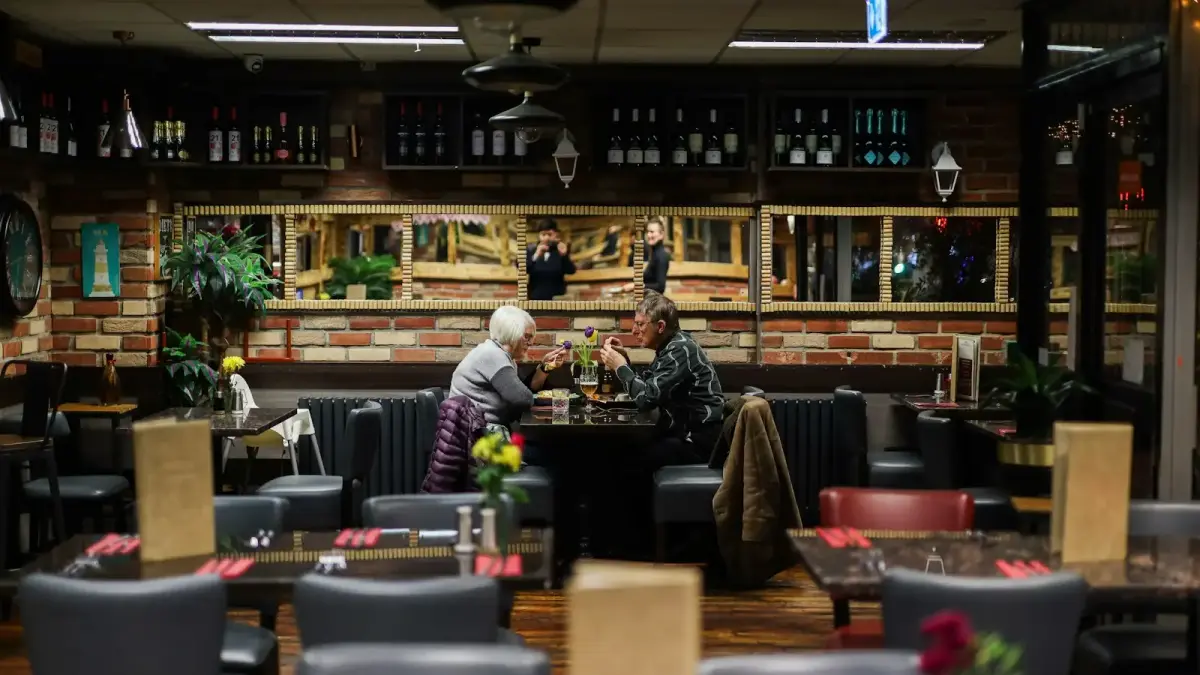
I saw them at a diner off Route 9 last October. A couple in their sixties, maybe early seventies, sitting on the same side of the booth. Not across from each other like most couples do. Side by side, like teenagers, except with reading glasses and a shared plate of onion rings between them.
She was reading something on her phone to him. He was leaning in, not because he couldn’t hear, but because he wanted to be closer to whatever she found interesting. Their shoulders were touching. Not dramatically. Not in a way anyone else in that diner would notice. But I noticed. And I sat there with my coffee going cold and felt something catch in my throat that I still can’t fully explain.
It wasn’t envy, exactly. It was recognition. The recognition that what I was looking at was not romance in the way we usually talk about romance. It was something older and quieter and infinitely more rare. It was the kind of love that has nothing left to prove.
What nobody tells you about thirty years
We talk about love like it’s a feeling. Like it arrives one day, electric and unmistakable, and if you’re lucky it stays. But anyone who has been married for decades knows that the feeling comes and goes like weather. There are years where you look at your partner and feel a rush of tenderness so large it could flatten you. And there are years where you sit across from them at dinner and think, I have no idea who you are anymore.
The couples who make it to thirty years are not the ones who avoided that second feeling. They’re the ones who sat inside it and didn’t run.
A 2012 study published in the Journal of Personality and Social Psychology found that relationship satisfaction follows a U-shaped curve over the course of a long marriage. Satisfaction dips significantly during the middle years - when children are demanding, careers are peaking, and the weight of life makes it nearly impossible to see your partner as anything other than a co-manager of logistics. But for couples who stay, satisfaction climbs again in later years, often surpassing where it began.
Not because the problems disappeared. But because the couple learned something the rest of us are still figuring out. That love is not the absence of difficulty. Love is what remains after difficulty has done its worst.
The Wednesday-evening kind of love
Nobody writes songs about Wednesday-evening love. Nobody makes movies about the couple who sat in the oncologist’s waiting room together, holding hands not because they had hope but because holding hands was the only thing left that made sense. Nobody photographs the moment she brought him a glass of water without being asked because she heard him cough from the other room and her body responded before her brain could.
That kind of love doesn’t perform well on camera. It doesn’t trend. It doesn’t go viral. But it is the foundation of almost everything good in the world.
I think about my parents sometimes when I think about this. They were not a demonstrative couple. They didn’t say “I love you” casually, the way my generation throws it around. But my father drove forty-five minutes in a snowstorm to bring my mother her reading glasses because she’d left them at my aunt’s house and couldn’t sleep without reading first. He didn’t announce it. He didn’t expect a medal. He just got in the car.
That is thirty-year love. It is the car in the snowstorm. It is knowing someone so completely that their comfort becomes indistinguishable from your own.
The myth of keeping the spark alive
There is an entire industry built around the idea that long-term couples need to “keep the spark alive.” Date nights. Lingerie. Surprising each other. Reinventing the relationship every few years so it doesn’t go stale. And some of that advice is fine, I suppose. But it misses the point so badly it almost makes me angry.
The couples sitting on the same side of the booth at sixty-five are not there because they kept the spark alive. They’re there because they let the spark become something else entirely. Something that doesn’t crackle and burn but instead gives off a low, steady warmth - the kind you don’t notice until you step outside and realize you’re freezing without it.
Psychologist Robert Waldinger, who directs the Harvard Study of Adult Development - one of the longest-running studies of human happiness ever conducted - has said that the single greatest predictor of health and well-being in old age is not wealth, not career success, not even physical fitness. It is the quality of your close relationships. Not the quantity. Not the excitement. The quality. The steadiness. The showing up.
The couples who sit side by side in booths are living proof of this research. They have built something that most people spend their whole lives chasing and never recognizing when it arrives - because it arrives quietly, without fanfare, on an ordinary Wednesday evening when nobody is watching.
What it costs to stay
I don’t want to romanticize long marriage without being honest about what it costs. Thirty years is not a fairy tale. Thirty years includes the fight in the parking lot of your daughter’s graduation. The silent car ride home from the fertility clinic. The season where one of you was drinking too much and the other didn’t know how to say it. The year where you slept in the same bed and felt lonelier than you ever did when you were single.
Staying costs something. It costs the version of yourself that believed love should always feel easy. It costs the fantasy that someone else might understand you better. It costs the pride of being right, over and over, in arguments that ultimately don’t matter.
A 2018 study in Frontiers in Psychology found that the couples who reported the highest levels of long-term satisfaction were not the ones with the fewest conflicts. They were the ones who had developed what researchers call “repair mechanisms” - the ability to reach back toward each other after a rupture. Not grand gestures. Small ones. A hand on a knee. A cup of coffee made the way they like it. A willingness to say, “I was wrong about that,” without being forced into it.
Repair is not glamorous. But it is everything.
The shoulder that never left
Here is what I keep coming back to. The couple in the diner. Her shoulder against his. The ease of it. The way their bodies had clearly been doing this for so long that sitting apart would have felt stranger than sitting together.
That kind of physical closeness after decades is not about attraction in the way we usually mean it. It’s about home. It’s about the body remembering, even when the mind is tired, that this is the person who stayed. This is the person who showed up to the hospital at 3 a.m. and held your hand while the doctor talked. This is the person who learned how to make your mother’s soup after she died because they knew you’d need it someday and couldn’t bring yourself to ask.
The warmth of a shoulder that never left. That sentence could be the whole article. That sentence could be the whole point of a life.
Brene Brown has written that true belonging doesn’t require us to change who we are. It requires us to be who we are. I think long love works the same way. The couples who make it to the same-side-of-the-booth years are the ones who stopped trying to be the perfect partner and instead became the honest one. The tired one. The flawed one who still shows up.
You already know this love if you’ve lived it
If you have been married a long time, you probably don’t need me to tell you any of this. You already know that love at year thirty feels nothing like love at year one, and that this is not a loss but a deepening. You know that the best moments of your marriage are not the ones in the photo album. They are the ones that happened in the kitchen at 11 p.m., or in the car on the way home from the hospital, or in the silence after a hard conversation when someone finally said, “I’m still here.”
And if you haven’t lived it yet - if you’re in the hard middle, in the U-shaped dip, in the years where your partner feels more like a roommate than a soulmate - I want you to know something. The dip is not the end of the story. The dip is where the real love is being built. Not in the sparks. In the staying.
The couple in the diner didn’t get to the same side of the booth by accident. They got there by surviving everything that tried to put a table between them and deciding, every single time, that they’d rather be close.
That is not the love that gets written about in songs. But it is the love that holds the whole world together. And if you are lucky enough to be building it right now, even if it doesn’t feel lucky, even if it feels like the hardest thing you’ve ever done - you are building something sacred.
A shoulder that never leaves. On an ordinary Wednesday. In an unremarkable diner. That is the whole beautiful point.