There is a thing that only happens at the edge of still water - a man in his sixties bends down, picks up a flat stone, weighs it in his palm, and throws it sidearm at exactly the angle his father showed him forty years ago, not because the stone or the counting matters but because the throw is the last unbroken conversation they are still having, and every skip across the surface is a word in a language that was never written down
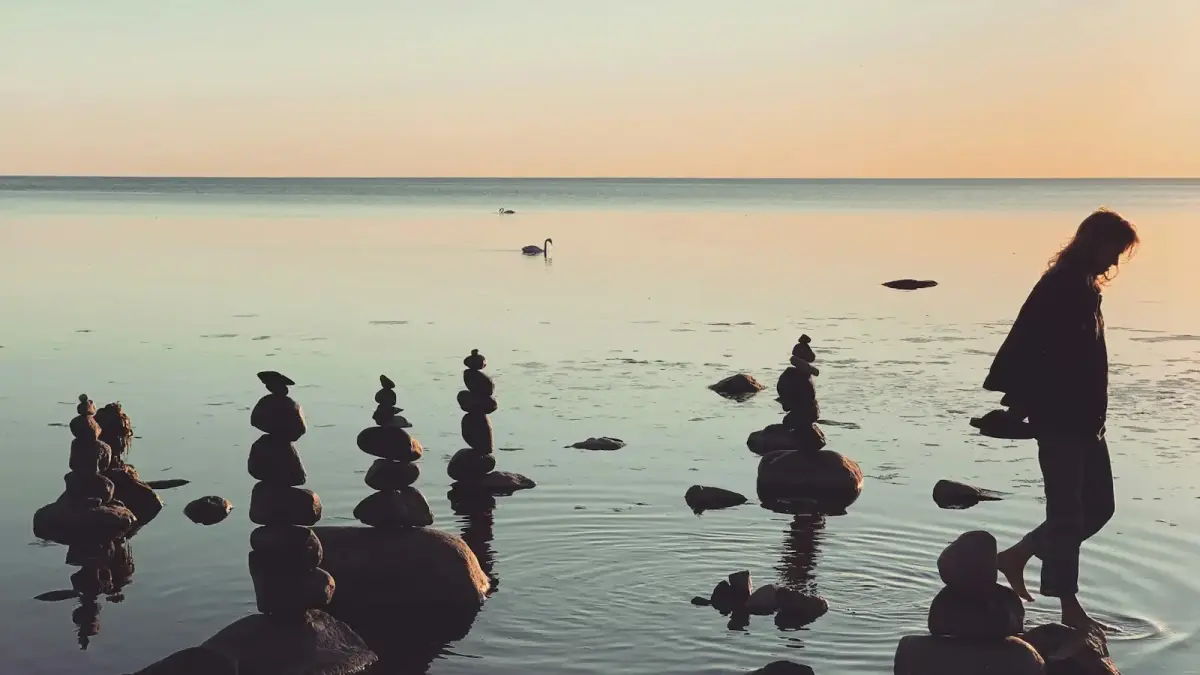
I watched a man skip stones last September at a lake in northern Minnesota. The water was so still it looked like it had forgotten it was allowed to move.
He was alone. Maybe sixty-five, maybe older. He bent at the shoreline the way you bend when your body knows exactly what it is doing and your mind has stepped politely aside.
His fingers moved across the gravel with a kind of practiced intelligence - rejecting round stones, weighing flat ones between thumb and forefinger, searching for the shape his hand already recognized. He found one. Stood.
He turned sideways and threw.
The stone hit the water and danced - one, two, three, four, five, six - and he counted each skip under his breath. Not loudly. Just enough to make each one real.
I knew, without knowing a single thing about this man, that someone had taught him how to do that. Not with a lecture. Not with a YouTube tutorial or a diagram of wrist mechanics.
Someone had stood beside him at another shoreline, decades ago, and placed a flat stone in his small hand and said something like “watch.”
And his arm had been remembering that moment ever since.
The classroom that never had walls
Nobody teaches stone-skipping from a textbook. There is no curriculum for it. No certification program, no online course, no chapter in any parenting guide that explains how this particular piece of knowledge travels from one generation to the next.
It travels hand to hand. That is the only way it knows.
You were probably eight or nine. Maybe younger. You were standing at the edge of a river or a pond or a lake on vacation, and someone older than you - your father, your grandfather, your uncle, the neighbor who always seemed to show up when your family went to the cabin - picked up a stone and showed you what water could do when you asked it the right question.
They did not explain the physics. They did not talk about angular momentum or the hydrodynamics of a spinning disc meeting a low-friction surface at an oblique angle. They threw, and the stone skipped, and your eyes went wide.
Then they handed you a stone and said “try.”
You threw it wrong at first. The stone plunked straight into the water and sank without ceremony. And the person beside you did not correct your technique with any kind of clinical precision.
They adjusted your wrist. They moved your elbow down. They said “flatter” or “lower” or just “like this” and threw again so you could watch the angle one more time.
That was the entire lesson. Watch me. Now you.
And somehow, despite the complete absence of formal instruction, despite the fact that no one drew a diagram or assigned homework or tested your comprehension afterward, the knowledge landed. It entered your body through your eyes and settled into your arm and stayed there for the next fifty years.
What the wrist remembers
There is a reason this kind of teaching works so well. Your body stores knowledge differently than your mind does.
A 2020 study published in Psychological Science examined how procedural memories - the kind stored in muscle and movement rather than in language - persist even when declarative memories deteriorate significantly. The researchers found that people with substantial memory loss could still perform complex motor tasks they had learned decades earlier, with remarkable accuracy. The body, it turns out, has its own filing system, and it does not care whether you remember the name of the person who taught you.
It remembers the lesson anyway.
This is why a man in his sixties can walk to the edge of a lake he has never visited before, bend down, find a flat stone, and throw it exactly the way he was shown at age nine. His conscious mind may not recall the specific afternoon. He may not remember what the weather was like or what his father was wearing or whether they drove home in silence afterward.
But his wrist remembers the angle. His shoulder remembers the rotation. His fingers remember how to release at the exact fraction of a second that turns a stone into something that refuses to sink.
This is not sentimentality. This is biomechanics. The throw lives in him the way a melody lives in someone who learned it before they learned to read - not as information, but as identity.
It is not a memory. It is a reflex that carries memory inside it.
The counting
And then there is the counting.
One. Two. Three. Four.
If you have ever skipped a stone, you know the counting is involuntary. You do not decide to count. You just do. Each skip pulls a number out of you the same way a bell pull draws a sound from a bell.
But here is what nobody talks about. The counting is not for you.
The counting is the conversation. It is the only language this act has ever needed.
When your father counted his skips aloud - “one, two, three, four, five, SIX” - with that little surge of triumph on the last number, he was not performing arithmetic. He was talking to you. He was saying look what I can do, and underneath that, he was saying this is ours.
And when you counted yours - “one, two, three” - and looked up to see if he noticed, that was you talking back. That was you saying I am learning. I am here. I want to be like you.
A 2019 study in the Journal of Research in Personality explored how shared nonverbal rituals between parents and children create what researchers call “embodied relational knowing” - a kind of understanding that exists beneath language. The study found that adults who reported strong nonverbal bonding experiences with their caregivers showed higher levels of secure attachment and emotional resilience decades later.
Nobody needed to explain what the counting meant. You both already knew. The numbers were the words, and the shoreline was the room where you spoke them.
The shoreline between two people
I think about how few settings in modern life allow two people to stand side by side, doing the same thing, saying almost nothing, and call it intimacy.
We have convinced ourselves that connection requires conversation. That closeness means eye contact and vulnerability and someone asking “how are you really doing.” And sometimes it does.
But sometimes the deepest connection looks like two people bent over the same patch of gravel, both searching for the flattest stone, not speaking because speaking would ruin it.
The shoreline is one of the last places where silence between a parent and child is not awkward. It is not avoidance. It is not emotional distance or the failure to communicate that therapists will later ask you to unpack.
It is two people engaged in the same ancient negotiation with physics, and the only words required are the ones that count the skips.
My father was not a man who talked about his feelings. I suspect yours was not either - not because he did not have them, but because his generation was handed a different set of instructions for what feelings were for. He could not tell you he was proud of you in so many words. He could not tell you that watching you grow up made him feel like he had done at least one thing right.
But he could find you a flat stone. He could adjust your grip without being asked. He could count your skips and let the last number hang in the air between you like a sentence that meant everything precisely because neither of you had to translate it.
If that is not love, I do not know what is.
The throw after they are gone
Here is the part nobody warns you about.
You will be sixty-three years old. You will be walking along some shoreline - maybe on vacation, maybe just killing time at a park with a pond you have driven past a hundred times - and your eyes will find a flat stone without your permission.
Your hand will reach for it. Your fingers will test its weight. Your thumb will find the smooth side and your body will turn sideways and your arm will move in that specific low sidearm arc, and the stone will skip across the water, and you will count.
And somewhere around the third skip, it will hit you.
This is his throw. This is the exact throw he showed you in the summer of 1974 at the cabin on Lake Whitefish when you were nine and the mosquitoes were terrible and he did not seem to mind. And he has been dead for eleven years.
The grief of this moment is almost unbearable. Not because you miss him - you always miss him - but because you realize that he is still teaching you. He is still in your wrist, still in your shoulder, still in the angle of your release. He is alive in the physics of this throw in a way that no photograph or voicemail or engraved headstone can replicate.
A 2022 study published in Frontiers in Psychology examined how bereaved adults experience what the researchers called “embodied continuing bonds” - physical sensations and motor patterns associated with deceased loved ones that persist long after the loss. They found that these body-level connections provided a form of comfort that cognitive memories alone could not offer. The body, they wrote, grieves differently than the mind. And it remembers differently too.
You are not skipping stones. You are finishing a conversation that started before you were old enough to understand it was happening.
And every skip is a word you are sending across the water to someone who can no longer count them back.
What still water holds
I watched a woman at that same Minnesota lake teach her daughter to skip stones the following morning. The girl was maybe seven. She threw rock after rock into the water with the determined futility of someone who has not yet figured out the wrist.
The mother did not lecture. She picked up a stone, turned her body, and threw. It skipped three times. The girl watched with her whole face.
The mother handed her another stone and said one word. “Flatter.”
That was the entire curriculum. That was everything.
And I thought about how this particular piece of knowledge has probably been passing between human hands for as long as there have been flat stones and still water. No one invented it. No one patented it. It does not belong to any culture or country or income bracket.
It belongs to every person who has ever stood at the edge of something calm and wanted to see how far a small, flat thing could travel before it finally surrendered to gravity.
Your father’s throw is in your arm right now. Your grandfather’s throw is in your father’s. The line reaches back further than anyone alive can trace - hand to hand, wrist to wrist, a chain of wordless teaching that has never once been written down because it was never meant to be.
Some things are too important for language. They can only be passed along in the space between “watch” and “try” - in the weight of a stone, the angle of an arm, and the counting that fills the silence where words would only get in the way.
If you ever find yourself at the edge of still water, bend down. Find a flat stone. Throw it the way you were shown.
And count.