There is a generation of women who learned to type on a typewriter, switched to a computer without anyone offering to teach them, mastered email and texting and video calls and cloud storage and passwords for forty different accounts - who adapted to every technological revolution of the last four decades without a single person in their family noticing or thanking them - because a girl who watched her mother learn to drive at thirty-seven understood that a woman's competence was expected to arrive silently and never be called brave
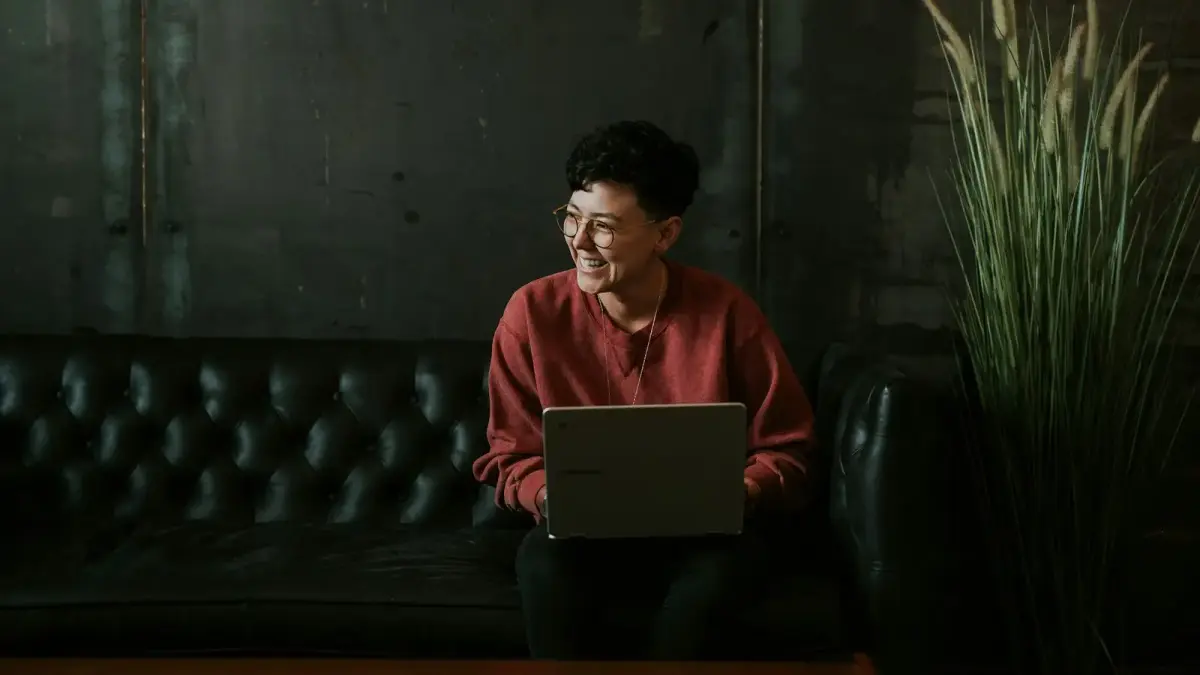
My mother sat down at the family computer in 2003 with a stack of index cards she had written for herself. Each card had one instruction in her careful, slanted handwriting. “Click the blue E.” “Type the address in the long white bar at the top.” “To send an email, click the envelope icon. Write the address of the person FIRST, before typing the message.”
She was fifty-nine years old. She had asked nobody for help. She had watched my brother use the computer for three evenings in a row, taking notes on a yellow legal pad she kept in her apron pocket, and then she had transferred those notes onto index cards because that was how she learned things - one instruction per card, one card at a time, the same method she had used to teach herself to balance a checkbook when my father decided that was her job now.
Nobody in our family commented on this. Not my father. Not my brother. Not me. My mother sat at that desk for two hours every evening for a week, working through her cards, until she could send an email and receive one and print a page and find the weather forecast. Then she moved the index cards to the kitchen drawer where she kept her recipe cards, filed between “casseroles” and “desserts,” as if the entire internet were just another recipe she had learned to follow.
I did not understand until decades later what I had watched her do. I did not have the word for it because nobody had ever used the word I needed. The word was brave.
The competence nobody named
My mother learned to drive at thirty-seven. This was 1981. She had three children, lived in a suburb with no bus line, and had spent fourteen years relying on my father’s schedule to get anywhere - the grocery store, the pediatrician, the school when one of us was sick and needed to be picked up.
She never talked about why she finally learned. She enrolled in a driving school, practiced in the church parking lot on Saturday mornings while we sat in the back seat eating cereal from plastic bags, and three months later she had her license. My father’s response was to hand her a set of keys and say, “About time.”
Nobody called it brave. Nobody said the word “resilient.” Nobody acknowledged that a woman who had structured her entire adult life around someone else’s willingness to drive had just reclaimed a fundamental form of independence at an age when most people have already settled into the shape of their lives.
She just drove. She drove to the store. She drove us to school. She drove herself to a part-time job she got three months later. And the driving became invisible within weeks, the way a woman’s competence always becomes invisible - not because people forget to notice but because they were never looking in the first place.
The long list of quiet revolutions
I am fifty-seven years old, and I have been watching women like my mother perform invisible technological adaptation my entire adult life.
They learned to type on typewriters in high school typing classes taught by women who had learned on typewriters before them. Then the typewriters disappeared and computers arrived and nobody offered a course or a manual or even a sympathetic pause. The women figured it out. They always figure it out.
A 2018 study published in Frontiers in Psychology examined what researchers called “invisible competence labor” - the phenomenon whereby certain groups, particularly women over fifty, are expected to acquire new skills without acknowledgment, training, or social reward. The study found that women in this demographic reported significantly less recognition for technology adoption than men of the same age, despite demonstrating equivalent or higher rates of successful adaptation. The researchers noted that the disparity was not about ability. It was about visibility. The women were learning. Nobody was watching.
I think about this study when I think about my mother and her index cards. I think about it when I watch my sixty-three-year-old neighbor set up a new phone by herself, transferring contacts and photos and passwords from the old one with a focus that would be called impressive if anyone in her family were paying attention. I think about it when I remember that my mother-in-law, who is seventy-one, taught herself to use video calling during the pandemic so she could see her grandchildren, and the first time she appeared on screen she smiled and said, “I think I’ve got it,” and everyone said, “Great,” and moved on.
Got it. She had taught herself to operate a piece of software that did not exist when she was raising her children, using a device that did not exist when she was raising her children, on an internet that did not exist when she was raising her children. She had taught herself. And the highest praise her family offered was, “Great.”
The password notebook in the kitchen drawer
Every woman of this generation has a notebook. You know the one. A small spiral-bound pad, usually kept in a kitchen drawer or a nightstand, filled with passwords written in pen. Capital letters carefully distinguished from lowercase. The Wi-Fi password for the house. The login for the bank. The email. The pharmacy portal. The streaming service. The video call app. The cloud storage. The insurance company website.
Forty different accounts. Forty different passwords. Forty small acts of adaptation that nobody ever acknowledged as what they actually are - which is a woman teaching herself an entirely new infrastructure for managing her life, one login at a time, with no training and no recognition and no ceremony.
A 2021 study published in the Journal of Research in Personality found that unacknowledged competence - the experience of mastering a skill without external validation - produces a specific psychological signature. People who routinely acquire new abilities without recognition develop what the researchers termed “private mastery orientation.” They continue learning. They continue adapting. But they stop expecting anyone to notice, and they stop calibrating their effort to external reward. The learning becomes internal, self-directed, and deeply lonely.
I read that phrase - “deeply lonely” - and I thought of my mother at the computer with her index cards. I thought of her driving home from the church parking lot for the twentieth time, quiet, confident, and entirely alone in the knowledge of what she had just done.
What a girl absorbs without instruction
I watched my mother learn every new thing that was asked of her for forty years. I watched her learn to program a VCR. I watched her learn to use a microwave when microwaves first appeared in our neighborhood. I watched her learn to operate an answering machine, a fax machine for the home business she started, a cell phone the size of a brick, a cell phone the size of a wallet, a smartphone with a screen she had to buy reading glasses to use.
I watched her learn all of it. And what I absorbed, without anyone teaching it to me, was a rule about what women’s learning is supposed to look like.
It is supposed to look effortless. It is supposed to happen in the margins. It is supposed to arrive without announcement, without complaint, without asking anyone to pause and recognize that something difficult has just been accomplished. A woman who learns to drive at thirty-seven is “about time.” A woman who teaches herself email at fifty-nine is “great.” A woman who masters video calling at seventy-one is simply doing what was expected.
The word nobody uses is brave. The word nobody uses is extraordinary. The word nobody uses is resilient.
And the reason nobody uses those words is not that the accomplishment is small. It is that the accomplishment is female, and female competence has been arriving silently for so long that the silence itself has become the expectation.
The woman at the desk with her index cards
My mother is eighty now. She uses a tablet. She orders groceries online. She sends photographs to her grandchildren through a messaging app she taught herself to use by watching a tutorial on a platform she also taught herself to use.
Nobody taught her any of this. Nobody sat beside her and walked her through it. Nobody said, “This is complicated and you are doing something remarkable.” She sat at the desk, or the kitchen table, or the armchair with the tablet balanced on a pillow, and she figured it out the way she has figured out every new thing the world has demanded of her for six decades - alone, carefully, one index card at a time.
I am fifty-seven and I have inherited this. The quiet adaptation. The private mastery. The assumption that learning is something you do in the margins without asking anyone to watch. I taught myself to use my first computer. I taught myself to build a website. I taught myself to file taxes electronically and navigate health insurance portals and set up two-factor authentication on accounts whose names did not exist five years ago.
And I did it all without using the word I should have used the first time I watched my mother work through her index cards at that desk in 2003. The word is brave.
She was brave. She was brave at thirty-seven in the church parking lot. She was brave at fifty-nine with her index cards. She is brave now, at eighty, ordering groceries on a screen.
And if you are a woman who has spent decades learning every new thing the world required of you without anyone noticing, without anyone thanking you, without anyone using the word that fits - then I want you to hear it now, clearly, from someone who watched her mother do exactly what you have done.
You were brave. Every time. And the fact that nobody said it does not mean it was not true. It means they were not looking. And a woman’s competence deserving recognition has never once depended on whether anyone in the room was paying attention.