There is a generation of women who learned to cook by standing next to their mothers and watching - no recipe written down, no measurement spoken aloud, just the way a hand moved through flour and the sound a pan made when the oil was ready - and now at sixty they are trying to teach their own daughters and realizing that what they actually inherited was not a recipe but proximity, and what they are grieving is not a dish but the fact that nobody stands that close to anyone in a kitchen anymore
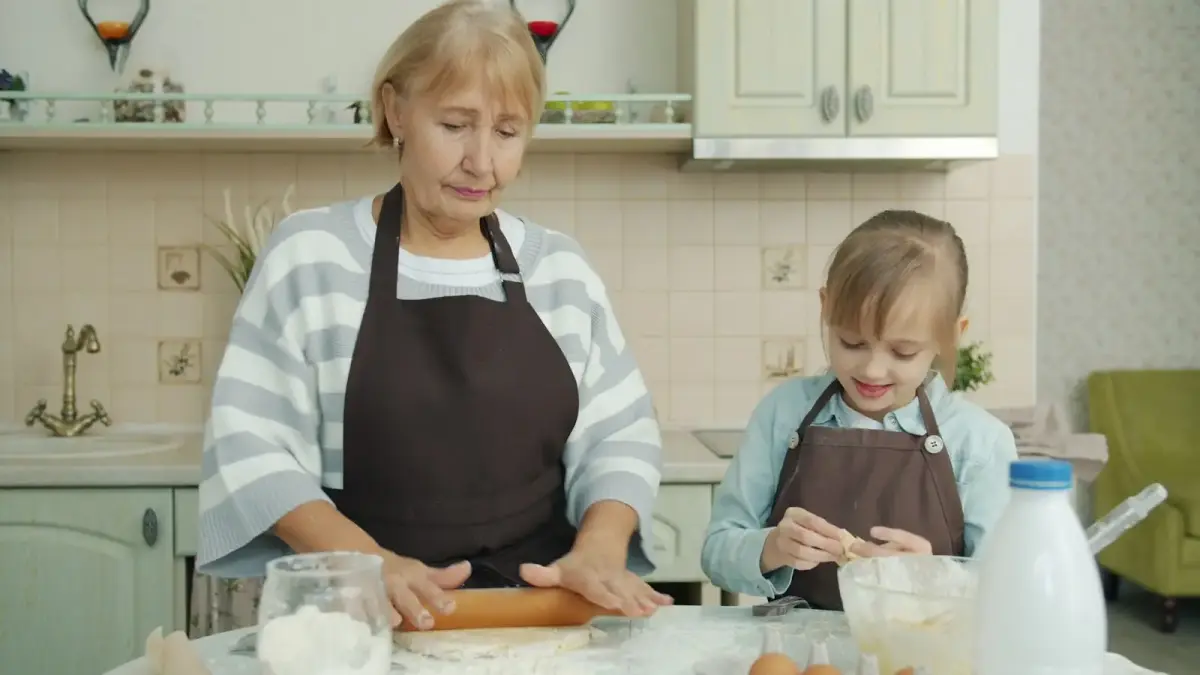
I can tell you the exact position I stood in. Left side, just behind my mother’s elbow, close enough that my shoulder sometimes pressed into her arm when she reached for the salt. I was maybe nine. She was making something with potatoes - I don’t remember what it was called or whether it had a name at all. What I remember is the heat from the stove hitting the right side of my face and the sound of oil doing something she understood and I didn’t yet.
She never told me what she was doing. Not really. She’d say “watch” sometimes, or “feel this” while pressing dough, but there were no quantities. No timers. No index cards tacked to the cabinet with her handwriting on them. The recipe was her body in motion. And my education was standing close enough to absorb it.
I didn’t know I was learning anything. I thought I was just keeping her company.
Now I’m sixty-one, and I’ve been trying to teach my daughter to make my mother’s bread, and I cannot write down what I know. Not because I’ve forgotten it. Because it was never language. It was proximity. And I am only now beginning to understand what that means - and what we’ve lost.
The kitchen was never about food
If you grew up in a certain kind of household - and if you’re reading this, I suspect you did - the kitchen was the room where closeness happened without anyone naming it. It wasn’t a workspace. It was a frequency.
Your mother stood at the counter and you stood next to her and something passed between you that neither of you would have called intimacy, but that’s exactly what it was. Shoulder to shoulder. The warmth of a body that was concentrating on something other than you, which paradoxically made the closeness feel safer.
A 2019 study published in the Journal of Family Psychology found that shared domestic routines - particularly cooking together - created what researchers called “embodied co-regulation,” a state where two nervous systems synchronize through physical proximity and rhythmic movement. The study noted that this form of bonding was especially powerful between mothers and daughters and was often more emotionally regulating than direct conversation.
Your mother wasn’t trying to co-regulate you. She was making dinner. But your body learned something in that kitchen that your mind has been trying to articulate for forty years.
She measured nothing and knew everything
Here is what I inherited from my mother’s kitchen: the knowledge that dough is ready when it stops sticking to your palm in a particular way. That onions need another minute when they still smell sharp. That a wooden spoon dragged across the bottom of a pot will tell you whether a sauce has thickened, and you’ll know the sound when you hear it, and no, I cannot describe that sound to you in words.
None of this was written anywhere. None of it was spoken in complete sentences.
My mother cooked the way a musician plays after fifty years - not from memory but from something deeper than memory. Her hands knew. And standing next to her, my hands began to know too. Not because she explained it. Because proximity is its own kind of teaching.
I think about this when I watch cooking videos online and see precise measurements for everything. Three-quarters of a teaspoon. Four hundred degrees for exactly twenty-two minutes. And I understand why people need that precision, I do. But something in me aches a little, because the women I grew up around never once consulted a measurement. They consulted their hands. Their noses. The way steam behaved. The sound of a lid rattling in a specific rhythm that told them it was time.
That kind of knowledge doesn’t survive transcription. You had to be there. You had to be standing that close.
What I am actually trying to pass down
My daughter is thirty-four. She lives two hours away and she’s a beautiful cook in her own right - she follows recipes from Instagram, she uses a kitchen scale, she times everything on her phone. Her food is good. Genuinely good.
But when she visits and I try to show her how to make my mother’s bread, something breaks down between us. Not emotionally - we love each other fiercely. What breaks down is the transmission.
I say, “You add flour until it feels right.” She says, “How much is that?” I say, “You’ll know when you touch it.” She laughs and gets out a measuring cup.
She isn’t wrong. I’m not wrong either. We’re just standing on opposite sides of a gap that opened so gradually neither of us saw it form.
What I’m trying to pass down isn’t bread. It’s the experience of standing close to someone who is concentrating and absorbing what their body knows through your own body. That’s what my mother gave me. Not the recipe. The standing next to.
And I don’t know how to give that to my daughter, because the world she lives in has made proximity optional. You can learn anything from a screen now. You don’t need to stand next to anyone.
The kitchen got quieter and lonelier at the same time
Research supports what many of us feel instinctively. A 2022 study in Frontiers in Psychology examined how digital technology has changed domestic learning and found that younger generations increasingly learn household skills through video tutorials rather than in-person demonstration. The researchers noted that while the technical outcomes were often equivalent, the relational and emotional dimensions of learning were significantly reduced.
In other words, the bread turns out fine. But something essential is missing from the process of making it.
I think about my mother’s kitchen - the radio on low, the window fogged from steam, the two of us moving around each other in a space that was maybe eight feet wide. There was no background noise from a screen. There was no recipe pulled up on a tablet propped against the backsplash. There was just her body and my body and the stove between us and the quiet.
That quiet wasn’t empty. It was full of a kind of attention that I don’t know how to describe except to say it felt like being held without being touched.
Now I watch my daughter cook with earbuds in, following a video, and she is completely competent and completely alone. And I don’t say anything because what would I say? “Take the earbuds out and stand closer to me?” She’d think I was being sentimental. Maybe I am. But I also think I’m grieving something real.
What we are actually grieving
This is not about cooking. I want to be clear about that. If it were about cooking, I’d write down the recipes and be done with it.
This is about a kind of closeness that was so ordinary we never gave it a name, and now that it’s gone we don’t even have the vocabulary to mourn it properly. It’s the closeness of standing hip to hip with someone in a warm room and doing something with your hands while the afternoon passes. No agenda. No lesson plan. Just being next to each other while something simmered.
Susan Cain, in her work on quiet intimacy, has written about how some of the deepest human connections happen not through conversation but through shared presence - the experience of simply being in the same physical space, oriented toward the same task, without the pressure to perform or explain. She calls it “side-by-side intimacy,” and she argues that our culture systematically undervalues it in favor of face-to-face emotional disclosure.
My mother and I never had deep conversations in that kitchen. We didn’t process our feelings or share our vulnerabilities. We stood next to each other and made food and sometimes she’d hum and sometimes I’d lean into her arm and that was enough. That was everything, actually.
The distance isn’t physical
My daughter and I are close. We talk every few days. She tells me things my mother never would have told hers. We are emotionally open with each other in ways that the previous generation couldn’t have imagined.
And yet.
There is a kind of closeness that has nothing to do with emotional openness. It’s physical. It’s spatial. It’s the distance between your shoulder and someone else’s shoulder while you both look at the same pot. It’s the warmth of another body three inches from yours while your hands move through flour.
That closeness is disappearing. Not because anyone chose to end it, but because the architecture of daily life no longer requires it. We don’t need to stand next to anyone to learn. We don’t need to share a small kitchen. We don’t need to be in the same room, the same city, the same time zone.
We gained something in all that freedom. I won’t pretend we didn’t. My daughter has a life my mother couldn’t have dreamed of.
But we lost the standing next to. And I feel it most in the kitchen, because that’s where it lived.
A warmth that doesn’t transfer through language
I tried once to write down my mother’s bread recipe. I sat at the table with a notebook and measured everything as I went - the flour, the water, the salt. I timed the kneading. I wrote down the oven temperature. I produced a complete, accurate recipe that anyone could follow.
My daughter made it. It was good bread.
But it wasn’t my mother’s bread. Because my mother’s bread included the part where she pressed her thumb into the dough and said “not yet” and I learned to feel what “not yet” meant through the pad of my own thumb. It included the part where she opened the oven and didn’t check a timer - she checked the smell. It included the part where I stood so close to her that I could feel her breathing change when she was satisfied.
A recipe can tell you what to combine. It cannot tell you what it feels like to stand next to your mother in a kitchen when you’re nine years old and the light is coming in gold through the window and she is making something with her hands and she doesn’t know she’s teaching you anything at all.
That’s what I inherited. Not instructions. Presence.
And presence, it turns out, is the one thing you cannot write down, send in a text, or learn from a video. You had to be there. You had to be standing that close.
I still cook my mother’s bread every Sunday. I do it alone now. But I stand in the same spot - left side of the counter, just behind where her elbow used to be. And sometimes, if the kitchen is warm enough and the light comes in at the right angle, I can almost feel her there.
Not a ghost. Not a memory, exactly. More like the warmth that a body leaves in a room after it’s gone. Faint. Fading. But still, somehow, enough to bake by.