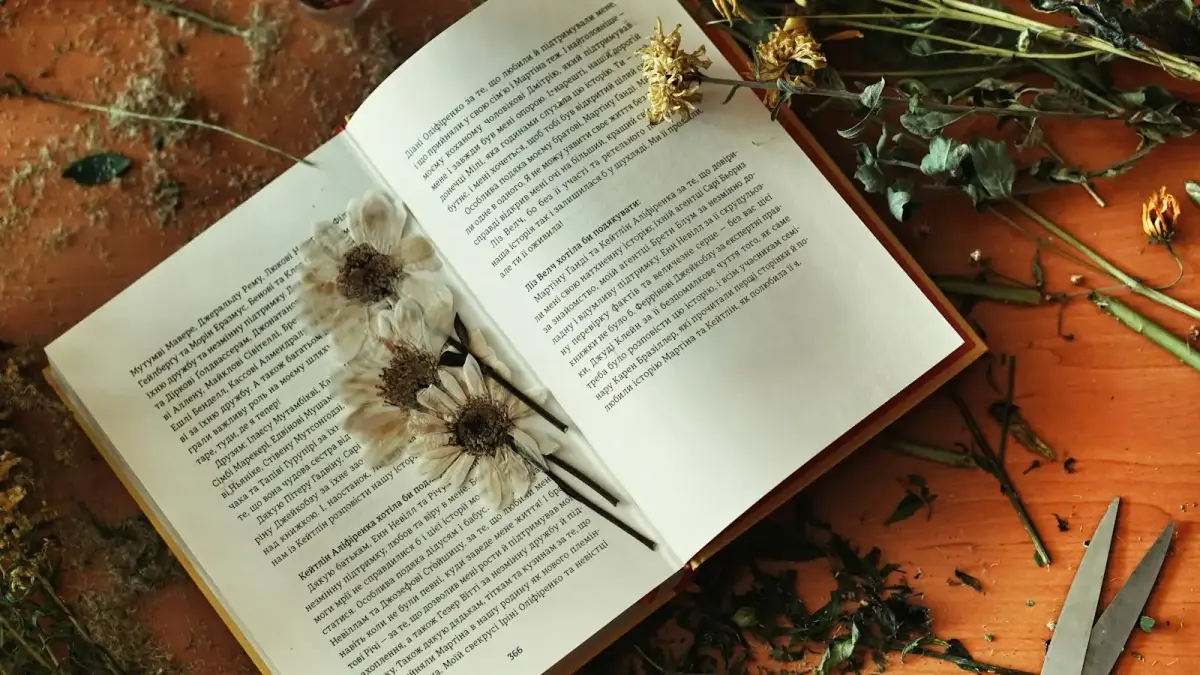
There are women who still press flowers between the pages of books they will never finish reading - who lay a pansy flat against a paragraph at the end of summer and close the cover like a prayer, who find dried petals falling from a novel twenty years later and can tell you exactly which garden they came from and which season was ending when they picked them - not because they are sentimental but because a daughter who watched her grandmother flatten a rose beneath the weight of a dictionary understood that the only way to keep something beautiful was to stop it in time and trust the pages to hold what the season would not
The Pansy That Fell Out of My Grandmother’s Copy of Wuthering Heights
I was cleaning out my grandmother’s house the September after she died, sorting her books into boxes for donation, when a pansy fell out of a paperback and landed on my knee.
It was paper-thin and rust-colored, its original purple bled into something closer to dusk. The edges were translucent. The stem had fused to the page it had been resting against for what must have been decades, leaving a faint botanical shadow on a paragraph I never got around to reading.
I sat on the floor of her living room with that pansy in my palm and I cried in a way I hadn’t been able to at the funeral. Because the pansy was not just a flower. It was proof that my grandmother had once stood in her garden on a particular afternoon, noticed something beautiful, and decided it mattered enough to save.
She didn’t photograph it. She didn’t post it anywhere. She placed it between pages 114 and 115 of a novel she may or may not have finished, and she trusted the book to hold what the season would not.
If you have ever found a pressed flower inside a book that belonged to someone you loved, you already know what I am about to say. The flower is not the thing she was keeping. It was the moment she was refusing to let go of.
A Ritual Older Than Any of Us
Women have been pressing flowers for centuries. Long before there were photo albums or cloud storage or any way to freeze a Tuesday afternoon in late July, women were laying petals flat between heavy pages and waiting for time to do its work.
Your grandmother may have done it with wildflowers picked from the side of a road on the way home from church. Your mother may have done it with roses from a wedding or a birthday or a garden she planted the year she finally had a yard of her own.
The method is always roughly the same. You find the flower at its peak - not yet wilting, not yet past - and you press it flat inside something with weight. A dictionary. A Bible. An encyclopedia no one opens anymore. You close the cover and you walk away, trusting that the pressure and the darkness and the patience of paper will preserve what sunlight and air would destroy.
There is something almost liturgical about it. The careful selection. The placement. The closing of the book like a small act of faith.
A 2015 study in the journal Memory found that physical objects serve as powerful anchors for autobiographical memory - more reliably than photographs, and far more reliably than digital records. The researchers called these objects “mnemonic anchors,” and they found that holding or encountering them could trigger vivid, emotionally rich recollections of specific moments in time.
A pressed flower is exactly that. A mnemonic anchor disguised as decoration.
What She Was Really Preserving
If you asked most women why they press flowers, they would probably shrug and say something about it being pretty. About liking the way a dried violet looks tucked inside a birthday card.
But that is not really what is happening.
What is happening is time preservation. The pressed flower is a woman’s way of saying: this moment was real. This garden existed. This light fell at this angle on this particular afternoon, and I was alive to see it.
There is a quiet defiance in that. Because the world moves fast, and seasons end, and gardens get dug up when houses are sold. The woman who presses a flower is the woman who refuses to accept that beauty is disposable just because it is temporary.
Psychologist Dennis Klass, whose work on continuing bonds theory reshaped how we understand grief, found that people maintain relationships with the dead not by letting go but by holding on - through objects, through rituals, through the physical traces a person leaves behind. The pressed flower fits this framework almost too perfectly. It is the trace of a moment that has died, kept alive through physical form.
Your grandmother was not being sentimental when she pressed that rose. She was doing something far more radical. She was insisting that a Tuesday in June deserved to be remembered.
The Daughter Who Watched and Learned
Here is the part that gets me.
The pressing of flowers is almost never taught. It is absorbed. A daughter watches her mother open a heavy book in autumn, lay something small and bright against the page, and close the cover carefully. No one explains why. No one gives instructions. The daughter simply understands that this is what women do with beauty - they stop it in time.
I watched my grandmother do it every September. She would walk through the garden in the last warm days, selecting the flowers that had held on the longest, the ones that still had color when everything around them was turning brown. She would bring them inside cupped in her palm like something fragile and sacred.
Then she would open whatever book was on the kitchen table - a novel, a cookbook, once an old phone directory - and she would lay each flower flat against the page with the kind of attention most people reserve for handling something irreplaceable.
I never asked her why. I think I already knew.
When I started pressing flowers myself in my twenties, it was not a conscious decision. I was walking home one evening in October, and I saw a cluster of wild asters growing through a crack in the sidewalk. I picked one. I brought it home. I opened the nearest book - a used copy of Beloved I had been meaning to finish - and I placed the aster between the pages before I could think about what I was doing.
It was only later that I realized I had inherited something. Not a skill, exactly. A posture. A way of moving through the world that says: beauty deserves to be witnessed, and witnessing is not enough. You have to hold it.
Grief, Gardens, and the Last Flowers
There is a particular kind of flower pressing that has nothing to do with craft or aesthetics. It is the pressing that happens when you are about to lose something.
The last flowers from a garden you are moving away from. The roses from a funeral that you cannot bear to throw in the trash. The wildflowers from a walk you took the week before a diagnosis changed everything.
This kind of pressing is not decorative. It is desperate. It is a woman’s hands saying what her mouth cannot: I am not ready for this to be over.
A 2019 study published in the Journal of Environmental Psychology examined why people keep physical remnants from places and experiences they have left behind - pressed leaves, stones, shells, dried flowers. The researchers found that these objects function as “place anchors,” helping individuals maintain a sense of continuity when their physical environment changes. The objects did not just remind people of where they had been. They helped people remember who they had been in that place.
I think about my mother pressing the last roses from the garden of the house where she raised us. She knew the new owners would probably tear the garden out. She knew those particular roses - the pale pink ones she had planted the year my brother was born - would not survive the transition.
She pressed three of them inside her copy of a Julia Child cookbook. I found them years later, papery and colorless but still holding their shape. Still holding their memory.
She was not keeping flowers. She was keeping the version of herself who had knelt in that soil and believed that planting something beautiful was a reasonable thing to do with an afternoon.
The Difference Between a Photograph and a Pressed Flower
We live in a world that has given us infinite ways to preserve a moment. You can photograph a garden in forty-seven different filters. You can record a sunset in slow motion. You can store ten thousand images on a device that fits in your pocket.
And still, some women press flowers.
I have thought about why, and I think it comes down to this: a photograph captures what something looked like. A pressed flower captures what something was.
When you hold a pressed pansy that fell out of your grandmother’s book, you are not looking at a representation. You are holding the actual thing. The actual cells, the actual pigment, the actual matter that was alive on a specific day in a specific garden in a specific lifetime. It is not a copy. It is a relic.
There is a weight to that. Literally and otherwise. Digital preservation is effortless, infinite, and ultimately weightless. You can store a million photos and never feel the mass of a single one. But a pressed flower has texture. It has fragility. You can tear it if you are not careful. You can lose it if you are not paying attention.
That vulnerability is the point. The pressed flower asks something of you. It asks you to be gentle. To pay attention. To treat a small, dried, imperfect thing as if it matters.
And the women who press flowers understand that this is not a small request. It is the whole philosophy.
What Falls Out of the Books We Inherit
If you are the kind of person who has inherited books from a mother or a grandmother, you know the particular jolt of opening a cover and finding something she left behind. A pressed leaf. A dried sprig of lavender. A pansy flattened so thoroughly it has become part of the page itself.
These discoveries are never expected, and they are never casual. They land in your hands like small messages from the dead, written in a language you did not know you spoke.
You pick up the dried flower and you hold it the way she must have held it the day she picked it. And for a moment, you are standing in her garden, in her season, in her particular quality of light. You are borrowing her eyes. You are seeing what she thought was beautiful enough to save.
This is the inheritance that no one talks about. Not the house, not the jewelry, not the money. The way a woman teaches her daughter to notice beauty - and to refuse to let it pass without acknowledgment.
If you press flowers, you are not being quaint. You are not clinging to some outdated domestic art. You are practicing a form of attention that the modern world has almost entirely abandoned. You are saying that a single bloom, on a single afternoon, in a single unremarkable season of your life, was worth stopping for.
And the book you tuck it into will hold that truth longer than your memory will. Longer than your body will. Longer than the garden where the flower grew.
The pages will hold what the season would not. They always have. The women who came before you knew that. And now, so do you.