There are women who still wrap every gift by hand - who keep rolls of wrapping paper in a hall closet organized by season, who measure twice before cutting, who fold corners with a precision that makes the seams disappear - not because they do not know gift bags exist but because a girl who watched her mother transform a plain box with paper and scissors and a ribbon curled against a blade learned that the wrapping was never about the paper, it was the first sentence of a love letter the box itself could never deliver
She Had a Closet That Smelled Like Christmas in July
My mother kept her wrapping paper in the hallway closet behind the winter coats. If you opened that door in the middle of August, the smell hit you first - something between pine and department store tissue paper and the faintly sweet scent of adhesive ribbon.
She had a system. Birthday paper on the left, separated by color. Holiday rolls in the center, standing upright in a tall basket she had repurposed from a set of fireplace tools. Baby shower paper on the right, next to a drawer of curling ribbon organized by width.
I didn’t understand it when I was young. I thought it was just something she did, like wiping down the counters after everyone had already gone to bed or putting on lipstick before answering the front door. It was part of her operating system, the way she moved through the world, and I assumed every mother had a wrapping paper closet the way every mother had a junk drawer.
It wasn’t until I was in my thirties, standing in a drugstore holding a glossy gift bag with tissue paper stuffed inside like an afterthought, that I felt something shift in my chest. The bag was fine. It was efficient. It would do the job.
But it would not do what my mother’s wrapping did.
The Forty-Five Minutes Nobody Sees
There is a woman - maybe you know her, maybe you are her - who spends forty-five minutes wrapping a birthday gift that the recipient will tear open in three seconds.
She clears the dining room table. She unrolls the paper and lays the box on top, turning it once, then again, estimating how much she needs with the practiced eye of a woman who has done this hundreds of times. She cuts with long, decisive strokes. She folds the first edge over and tapes it flush against the box with a single strip placed exactly parallel to the seam.
Then the corners. This is where it matters. She tucks the paper in like she is folding a fitted sheet with military precision - triangle, fold, crease, press. She runs her thumbnail along the edge until the paper surrenders, lying flat against the cardboard with the obedience of something that has been told exactly where to go.
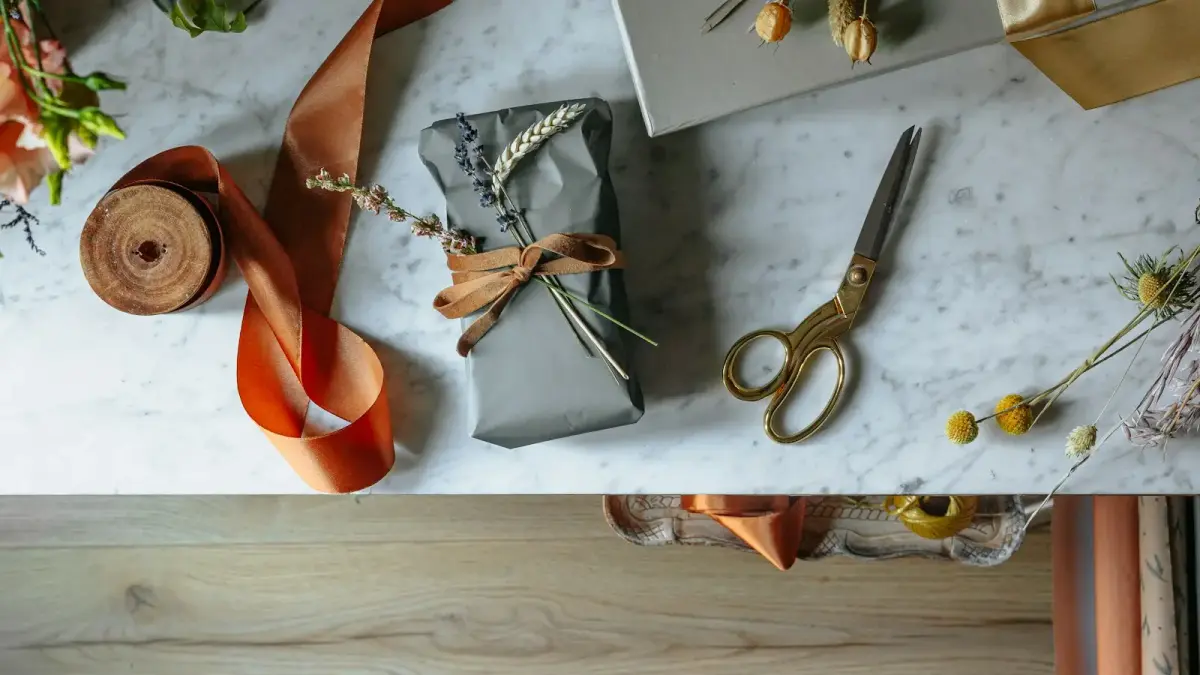
And the ribbon. She pulls it from the spool with the confidence of a woman measuring by feel, not by inches. She ties it, curls it against the blade of the scissors - that gesture, that specific wrist motion, passed down through kitchens and living room floors on Christmas Eve for decades - and the ribbon spirals into something almost alive.
Nobody will see this process. Nobody will know she recut the paper because the pattern was off-center. Nobody will notice that the tape is invisible, that the folds are symmetrical, that the ribbon sits perfectly centered on top.
She knows this. She does it anyway.
What She Was Really Teaching You
A 2019 study published in the Journal of Consumer Psychology found that gift wrapping significantly influences the recipient’s expectations and emotional response to the gift inside. The researchers discovered something that every woman with a wrapping paper closet already knew - the presentation is not decoration. It is communication.
But the study could not measure what happens in the space between a mother’s hands and her daughter’s eyes.
Because here is what was actually being transmitted on those living room floors, the ones covered in scraps of paper and tape stuck to the carpet and ribbon curls that the cat batted under the couch. Your mother was not teaching you how to wrap a gift. She was teaching you that love has a physical form.
That caring about someone means spending time they will never know about. That the evidence of your attention is something you offer freely, without expectation of acknowledgment, without keeping score.
She was teaching you that the wrapping is the first thing they see. Before they know what you bought, before they read the card, before they understand the thought behind the choice - they see the paper. They see the ribbon. They see the care.
And the care is the message.
The gift inside is what they asked for. The wrapping is what they didn’t ask for but needed - proof that someone spent time on them specifically, not generically, not efficiently, but with the slow and deliberate attention that says you were worth the extra forty-five minutes.
The Ritual Nobody Asked Her to Keep
Gift bags arrived in the 1990s and solved a problem that most people were happy to have solved. They were fast. They were reusable. They eliminated the need for scissors, tape, measuring, folding, and that particular frustration of wrapping an oddly shaped bottle in paper that refuses to cooperate.
Most of the world moved on. The women I am describing did not.
Not because they are stubborn. Not because they are old-fashioned. Not because they failed to notice the innovation. They noticed. They simply chose to keep doing something harder because the difficulty was the point.
Dr. Brene Brown has written about how vulnerability is the birthplace of connection - that allowing ourselves to be seen in our effort, in our care, in our imperfect trying, is what creates belonging. The woman who wraps by hand is doing something vulnerable every single time. She is saying, with paper and scissors and a ribbon she curled with her own hands, I did this for you. Not a store. Not a machine. Me.
A 2021 study in Frontiers in Psychology on ritualized behaviors found that the perceived effort behind an action directly increases its emotional significance to the observer. The more labor-intensive the ritual, the more meaning it carries - not because the outcome is better, but because the effort itself becomes the message.
The woman wrapping a gift at her dining room table at eleven o’clock at night before a birthday party knows this in her body, even if she has never read the research.
A Crease Is a Kind of Sentence
I started wrapping gifts by hand in my late thirties. Not because I decided to. Because my hands decided for me.
I was at the dining room table with a roll of paper I had bought without thinking about it - blue with small white stars, the kind of pattern my mother would have chosen - and I laid the box down and reached for the scissors and something in my muscle memory clicked on like a light in a room I had forgotten existed.
I measured the way she measured. I cut the way she cut. I folded the corners with her geometry, her patience, her insistence on getting the crease sharp enough to feel with your fingernail.
I didn’t cry. But I understood something I hadn’t understood before.
Every crease is a kind of sentence. Every fold is a completed thought. The finished package - paper smooth, edges clean, ribbon curled and centered - is a paragraph written in a language that has no words, only gestures.
My mother could not always say what she felt. Her generation often couldn’t. They were raised by women who showed love through labor - through meals cooked from scratch and clothes ironed on Sunday night and yes, through gifts wrapped with the kind of attention that made you feel, before you ever opened the box, that someone had been thinking about you.
The Three Seconds That Contain Everything
Here is the part that breaks my heart a little, every time.
She spends forty-five minutes wrapping it. She positions the ribbon. She writes the tag in her best handwriting. She places the gift on the table or under the tree or beside the plate, and she watches.
She watches the recipient pick it up. She watches their hands find the seam, the edge, the place where the tape gives way. She watches them tear through the paper in three seconds - sometimes less - crumple it into a ball, and reach for what is inside.
And she is not disappointed. She does not say, “I spent forty-five minutes on that.” She does not ask them to notice the corners or the invisible tape or the way the pattern lined up across the fold.
Because the wrapping was never for the opening. The wrapping was for the moment before the opening - that one second when the recipient holds the package and sees, without knowing they are seeing it, that someone cared enough to make the outside beautiful.
A 2023 study in the Journal of Personality and Social Psychology found that people consistently underestimate how much others value the effort behind a gesture. We assume that results are what matter. But the people who receive our care often remember the process more than the product - the fact that we tried, that we bothered, that we chose the harder path when an easier one was right there.
The woman who wraps every gift by hand is not performing for an audience. She is completing a conversation that started when she was small enough to sit on the floor beside her mother and watch a plain cardboard box become something worth giving.
The Closet You Will Inherit
If you are the daughter of a woman who wrapped every gift by hand, there is a version of you that already knows how to do this. It lives in your hands. It lives in the way you instinctively reach for scissors instead of a bag, in the way you run your thumb along a crease without being taught, in the way you hold a ribbon against a blade and pull.
You might not do it for every gift. You might reserve it for the ones that matter most - the birthday of someone you love deeply, the baby shower of your closest friend, the Christmas gift for the person who is hardest to buy for because what you really want to give them cannot fit inside a box.
But when you do it, you will feel her. Not as a memory, exactly, but as a presence in your hands. The way they move without instruction. The way they know, without measuring, how much paper you need.
Someday someone will open your closet and find the wrapping paper. They will see the rolls organized by occasion, the drawer of ribbon, the scissors you keep just for this purpose. They might wonder why you bother.
You will not be able to explain it in words. You will not need to.
The wrapping was never about the paper. It was always the first sentence of something you learned to say before you had language for it - a love letter written in creases and folds and ribbon curled against a blade, delivered in the three seconds before the tearing begins, singed into the memory of everyone who ever held a gift you wrapped and thought, without quite knowing why, that they mattered to someone.
That is what your mother gave you. Not a skill. A language.
And every time you clear the dining room table and unroll the paper and reach for the scissors, you are speaking it.