There are women who go to the movies alone on a Tuesday afternoon - not because they have no one to go with but because a girl who learned at fourteen that her emotional life was only fully honest when nobody was watching discovered that the dark theater was the one room where she could cry at the beautiful thing without someone turning to ask if she was okay
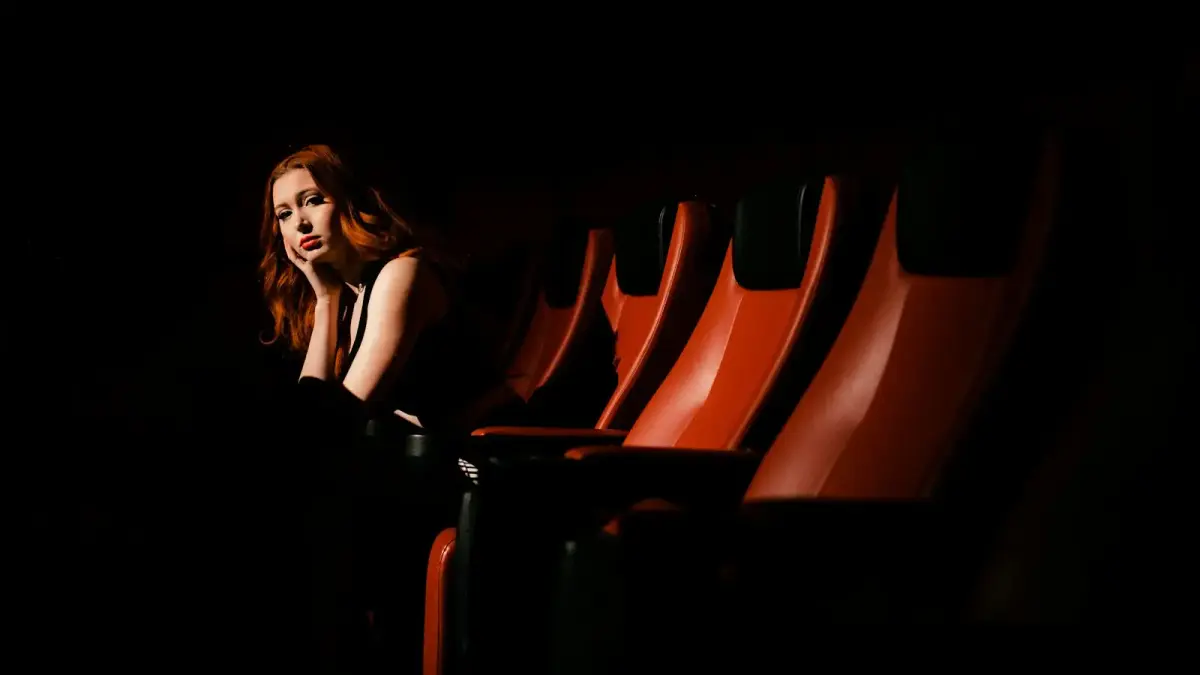
I buy one ticket. Always the 2:15 showing. Always a Tuesday.
The kid behind the counter doesn’t look up anymore. He knows me, or at least he knows the shape of me - the woman who comes alone on the slow afternoons, who picks the seat in the center of row seven where the sound hits cleanest, who doesn’t buy popcorn because eating would give her hands something to do and the whole point is having nothing to do except feel.
I am not lonely. I want you to know that before we go any further.
I have people. I have a husband who would happily come with me. I have friends who text asking what I’m doing this week. I have a full, peopled, noisy life.
And I love it. But the theater on a Tuesday afternoon is not part of that life. It belongs to a different country inside me - one where the passport is silence and the currency is the full, unwitnessed weight of what moves me.
The girl who held her breath
I was fourteen the first time I noticed it.
My best friend and I went to see a movie neither of us remembers now. Something with a father saying goodbye. Something with a hand letting go. I felt the tears start - that specific heat behind your eyes that announces itself before you’re ready - and I looked sideways.
She was watching too. And in that split second, my body made a decision my mind hadn’t approved. I swallowed. Blinked hard. Rearranged my face into something neutral.
Not because she would have judged me. She was kind. She probably would have cried too.
But I had already learned - from years of being told I was “too sensitive,” from a mother who said “oh, honey, it’s just a movie,” from the low-grade humiliation of feeling more than a room seemed to want me to feel - that my truest emotional responses only survived when nobody was measuring them.
The tears I swallowed at fourteen didn’t disappear. They just went underground. And they stayed underground for decades, surfacing only in the rare moments when I found myself genuinely, completely alone.
The architecture of honest feeling
There’s a word I keep coming back to: architecture.
We build structures for everything. We build kitchens for cooking and bedrooms for sleeping and offices for working. But where is the room we’ve built for feeling the thing we actually feel, at the volume we actually feel it, without performing that feeling for someone else’s comfort or interpretation?
For me, the answer turned out to be row seven, seat twelve, on a Tuesday at 2:15.
Susan Cain wrote in her landmark work on introversion that introverts don’t feel less than extroverts - they often feel more, and that intensity is precisely why they need solitude to process. The inner world of a deeply introverted person is not empty. It is so full that adding another person to the room changes the pressure.
I think about that word. Pressure. Because that’s exactly what another person’s presence creates in my emotional life - not burden, not annoyance, but a subtle atmospheric shift. Like opening a window in a room where you were trying to hear something quiet. The breeze isn’t bad. But the thing you were listening for is gone.
A 2019 study published in the Journal of Research in Personality found that people who regularly seek solitary aesthetic experiences - going to museums alone, watching films alone, sitting with music alone - reported deeper emotional processing and greater clarity about their internal states than those who primarily consumed art in social settings.
Not better people. Not healthier people. Just people whose emotional honesty required a room with one chair.
The lie I tell on Tuesdays
Here is the small, harmless lie I tell my husband.
“I had lunch with Karen.”
He nods. Asks how she’s doing. I say fine. And I feel a flicker of something - not guilt exactly, but the awareness that I am protecting something so private that even naming it would change its shape.
Because if I said “I went to the movies alone,” he would say that’s fine. He would mean it. But next time he might say, “Want me to come?” And I would have to explain that no, the whole point is the aloneness, and then it becomes a conversation about us instead of a conversation about me and the dark and the thing on the screen that made me feel like I was fifteen again, watching the world be beautiful and not having to explain to anyone why my face was wet.
The protection isn’t about him. It’s about the space.
Some rooms lose their magic when you describe them. Some rooms only work because nobody knows you’re in them.
What the darkness gives you
I’ve thought a lot about why it has to be the movies and not, say, a walk in the park or a quiet hour with a book.
The darkness matters.
In a movie theater, you disappear. Your body stops being a thing that other people read. Your face - that instrument you’ve spent a lifetime tuning for other people’s comfort - finally goes off duty. You can let it do whatever it wants. Crumple. Smile too wide. Go slack with wonder.
A 2021 study in Psychological Science distinguished between “chosen solitude” and “imposed isolation,” finding that people who voluntarily seek alone time show increased emotional regulation, greater self-awareness, and lower rates of anxiety. The key variable wasn’t being alone - it was choosing to be alone. The agency made the difference.
That word again. Choosing.
Every Tuesday at 2:15, I choose myself. Not in the self-care, bubble-bath, hashtag way. In the most literal way possible. I choose the version of me that exists when no one is adjusting her volume, redirecting her attention, or asking her to narrate what she’s experiencing while she’s still experiencing it.
The dark theater is the one room where my feelings don’t need a translator.
The weight that needs a room
My mother used to say, about my tears, “You feel things so big.”
She meant it as a gentle warning. A weather report for a storm she wished I could learn to control. And I did learn to control it - in public, at family dinners, in the passenger seat of every car, in every room where someone else’s presence meant my feelings needed to shrink to fit the available social space.
But feelings that get compressed don’t get smaller. They get denser.
And dense feelings need architecture. They need a room with the right dimensions, the right acoustics, the right darkness. They need a two-hour window where nobody will knock. They need credits rolling while you sit in your seat and let the last wave pass through you without standing up before it’s done.
I read once that Brene Brown talks about how vulnerability requires safety. And I think what I’ve learned, in my quiet, specific, Tuesday-afternoon way, is that for some of us, the safest place to be vulnerable is a room where no one can see our face.
That’s not a wound. That’s a preference so deep it has become a practice.
The single ticket at fifty-seven
I am fifty-seven years old, and I have been going to the movies alone for over twenty years.
I have cried at animated films about fish. I have laughed so loudly at a nearly empty 2:15 showing that I startled myself. I have sat through credits listening to a song I wanted to live inside of. I have walked out into the Tuesday afternoon sunlight feeling like I’d been scrubbed clean from the inside.
Not once, in all those years, have I felt lonely in that seat.
Loneliness is wanting someone and having no one. What I feel on Tuesday afternoons is the opposite of loneliness. It is the rare, precious experience of having access to my own full emotional range without a single filter between me and it.
Daniel Goleman’s work on emotional intelligence suggests that self-awareness - the ability to recognize and sit with your own emotional states - is the foundation of every other emotional skill. And I think some of us can only practice that awareness in private. Not because we’re broken. Because we’re built with instruments so sensitive that they only play true in a quiet room.
What I want you to know
If you are reading this and you recognize yourself - the woman who cries harder when she’s alone, who saves her biggest feelings for the drive home, who sometimes needs to excuse herself not because she’s upset but because she’s feeling something so real that she can’t hold it and hold a conversation at the same time - I want you to know something.
You are not broken. You are not cold. You are not “too much” or “too sensitive” or unable to connect.
You have simply learned that your emotional life has a volume that requires a specific room. And you’ve gone looking for that room, and you’ve found it, and you keep going back. That is not weakness. That is the kind of self-knowledge most people never develop.
The single ticket is not a symbol of what you lack. It is proof that you know exactly what you need.
And the girl at fourteen - the one who swallowed the tears because someone was watching - she grew up. She found her room. She gave herself permission to feel the whole thing.
Every Tuesday at 2:15, she still does.