7 things people who still count the items in their shopping cart before entering the express lane - who would rather put something back than risk being the person holding up the line, who feel a flush of shame at the thought of someone behind them counting and finding them over the limit - reveal about their childhood, according to psychology
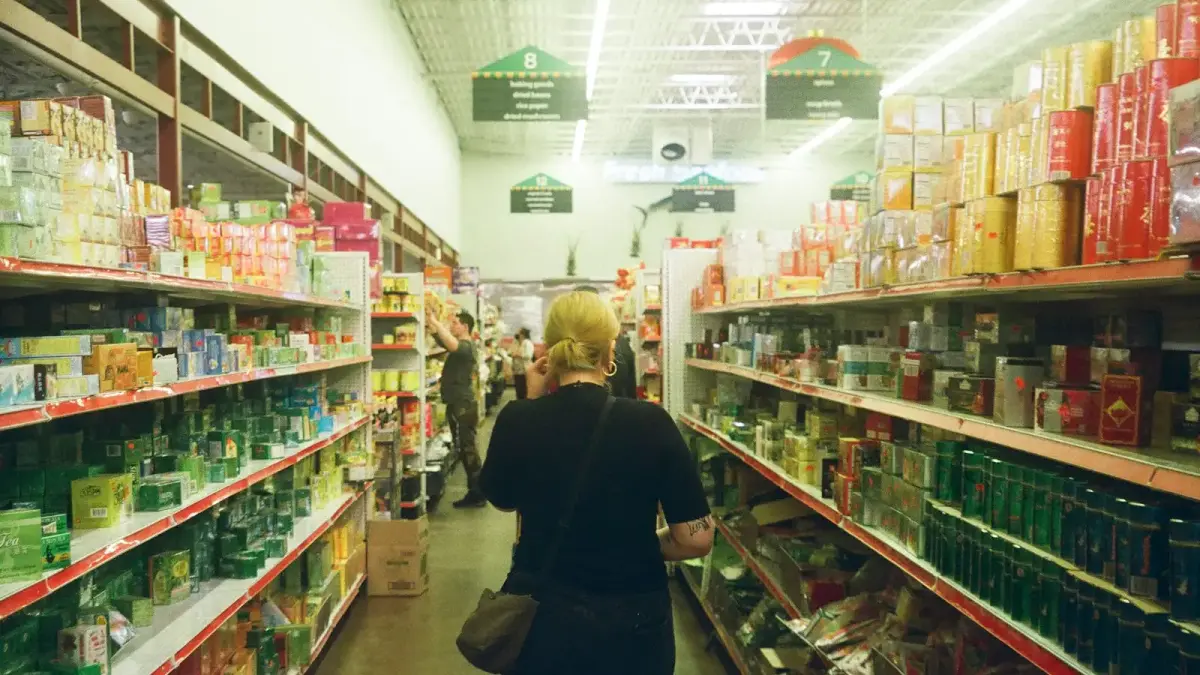
I watched a woman in front of me at the grocery store last Tuesday do something I have done a thousand times. She stood at the edge of the express lane, cart angled slightly away from the register, and counted. Her lips moved. She touched each item with one finger. Then she counted again.
She had eleven items. The sign said fifteen or fewer.
She entered the lane like someone walking into a room she wasn’t sure she’d been invited to.
I recognized her immediately. Not her face. Her math. That particular arithmetic where you count twice, consider putting the yogurt back, and only commit to the lane when you are certain - absolutely certain - that no one behind you could accuse you of taking more than your share.
I know this math because I have been doing it since I was nine years old. And it was never about groceries.
A 2019 study in the Journal of Personality and Social Psychology found that adults who grew up in households with rigid or unpredictable boundaries around resources tend to develop what researchers call “limit hypervigilance” - a persistent need to monitor and stay within perceived limits, even when the stakes are negligible. The express lane is low stakes. But the feeling underneath it is not.
If you are someone who counts, here is what that counting reveals about where you came from.
1. You learned that exceeding a limit - any limit - had consequences
You did not grow up in a house where going over meant a gentle correction. Going over meant something shifted. A mood changed. A door closed harder than it needed to. Someone’s voice dropped into that particular register that meant you had used something up - patience, money, goodwill - and now the atmosphere would be different for the rest of the evening.
So you learned to stay under. Not just under the limit, but well under it. You built in margins. If the rule was ten, you aimed for seven. If dinner was supposed to last twenty minutes, you finished in twelve.
The express lane sign says fifteen items. You bring eleven. That four-item buffer is not politeness. It is the distance you learned to keep between yourself and a consequence you could not predict.
2. Taking more than your share meant someone else got less
This one runs deep if you grew up in a household where resources were finite in a way that was visible. Not necessarily poverty - though sometimes that too. Sometimes it was emotional. Sometimes attention was the scarce thing, and you could feel it redistribute when you asked for too much of it.
You learned a particular equation: what you take is subtracted from someone else. A second helping meant someone might not get enough. An extra minute of a parent’s attention meant your sibling got one fewer. The math was always zero-sum.
A 2021 study published in Psychological Science found that children raised in scarcity environments - whether material or emotional - develop heightened sensitivity to resource distribution that persists well into adulthood. They become adults who portion everything. Time. Space. Even how long they talk in a conversation before yielding the floor.
The express lane is just one more place where you refuse to take more than you have calculated as your fair share.
3. You cannot stand being perceived as someone who breaks rules, even tiny ones
Here is the thing about the express lane. Nobody is actually counting your items. The cashier does not care. The person behind you is looking at their phone. There is no enforcement mechanism for the fifteen-item limit at a suburban grocery store on a Wednesday afternoon.
You know this. Intellectually, you know this.
But the feeling is not intellectual. The feeling is that someone might notice. Someone might see you with sixteen items and think something about you - that you are careless, entitled, inconsiderate. That you are the kind of person who believes rules are for other people.
That perception would be unbearable. Because you grew up in a home where being perceived as a rule-breaker was not a small thing. It was an identity. It meant you were difficult, selfish, too much. And once that label landed on you, it did not come off easily.
So you follow every rule. Even the ones printed on laminated signs above grocery store registers. Especially those.
4. The shame of being noticed doing something wrong is physically overwhelming
I want to be specific about this, because people who did not grow up this way often underestimate what this feels like. It is not embarrassment. Embarrassment is a blush that fades.
This is a full-body event. Your face goes hot. Your chest tightens. There is a ringing quality to the silence after someone points out that you have done something wrong - even something trivially, meaninglessly wrong - that feels like the air has been sucked out of the room.
You learned this response young. A parent’s correction that came with a look - the one that said you should have known better, you should have been more careful, you should have counted. That look taught your nervous system that being caught exceeding a limit is not a minor social friction. It is a threat.
Research on childhood shame responses, published in Frontiers in Psychology in 2020, found that children who experience disproportionate correction for minor infractions develop what clinicians call “shame flooding” - an autonomic response where the body reacts to small social errors as though they are emergencies. The woman putting back a can of soup to drop from twelve items to eleven is not being quirky. Her body is protecting her from a feeling it learned to treat as dangerous.
5. You advocate for other people’s rule-breaking but cannot forgive your own
This is the paradox that nobody talks about. If the person in front of you has seventeen items in the express lane, you feel nothing. Maybe a flicker of admiration, even. How easy it seems for them. How unbothered.
If your friend takes the last piece of bread at dinner, you smile and tell them to enjoy it. If your coworker shows up five minutes late, you wave it off. You are generous with other people’s transgressions because you understand, on some level, that those transgressions are minor. That the rules are flexible. That nobody is actually keeping score.
But the generosity stops at your own skin. You hold yourself to the original, unedited version of every rule you ever learned. The one where there is no grace period. No rounding up. No benefit of the doubt.
You can forgive everyone except the child who once took too much and learned what it cost.
6. You calculate everything - time, space, food portions, conversation length - to stay under the line
The express lane is just the most visible version of a calculation you run constantly. You do it at restaurants, eating slightly less than your share so no one can say you took too much. You do it in conversations, monitoring how long you have been talking and cutting yourself off before you suspect you have exceeded your allotment of someone’s attention.
You do it with physical space. You sit in the smallest chair. You press yourself against the car door in the back seat. You take up less room than your body requires because your body learned young that it was always slightly too large for the space it had been given.
This is not modesty. It is not consideration. It is a survival calculation that became so automatic you forgot it was running. You learned to measure yourself against an invisible line, and you have spent decades making sure you never cross it. Not because the consequences are real anymore. But because the part of you that learned to count has never been told it can stop.
7. The express lane is not about groceries - it is about deserving to take up space
Here is what it all comes down to. The woman who counts her items and puts one back - she is not performing a social courtesy. She is answering a question that was posed to her in childhood, a question she has been answering every day since: Are you allowed to have this much?
The express lane is a small, contained theater where the drama of her entire childhood plays out in thirty seconds. The counting. The recounting. The decision to remove something rather than risk being seen as someone who took too much. The relief of entering the lane with a number safely below the limit.
She is not afraid of the cashier. She is not afraid of the person behind her. She is afraid of the feeling - that old, body-deep feeling - of being someone who exceeded what she was allowed.
And the quiet tragedy of it is this: the limit was never about items. It was about her. She learned, very young, that there was a limit to how much space, how much food, how much attention, how much of anything a person like her was permitted to occupy. And she has been staying under that limit ever since. Carefully. Precisely. Without anyone ever noticing the math she is doing just to stand in a grocery store line.
If you recognized yourself in this, I want you to sit with something for a moment. The fact that you count is not a flaw. It is evidence of a child who paid very close attention to the rules of her world, because she had to. That attentiveness kept you safe once.
But you are not in that kitchen anymore. You are not at that table. The person behind you in line is not counting your items, and even if they were, you are allowed to have thirteen things. You are allowed to have twenty. You are allowed to take up the exact amount of space your life requires.
You always were. Nobody told you.