8 things men who always add a firm back-pat to every hug reveal about their childhood, according to psychology - and the one therapists notice first is that the three sharp pats on the shoulder at fifty-two are not affection but a timer the body invented to tell a boy when he was allowed to let go, because holding on a beat longer once brought something to his father's face that he learned never to cause again
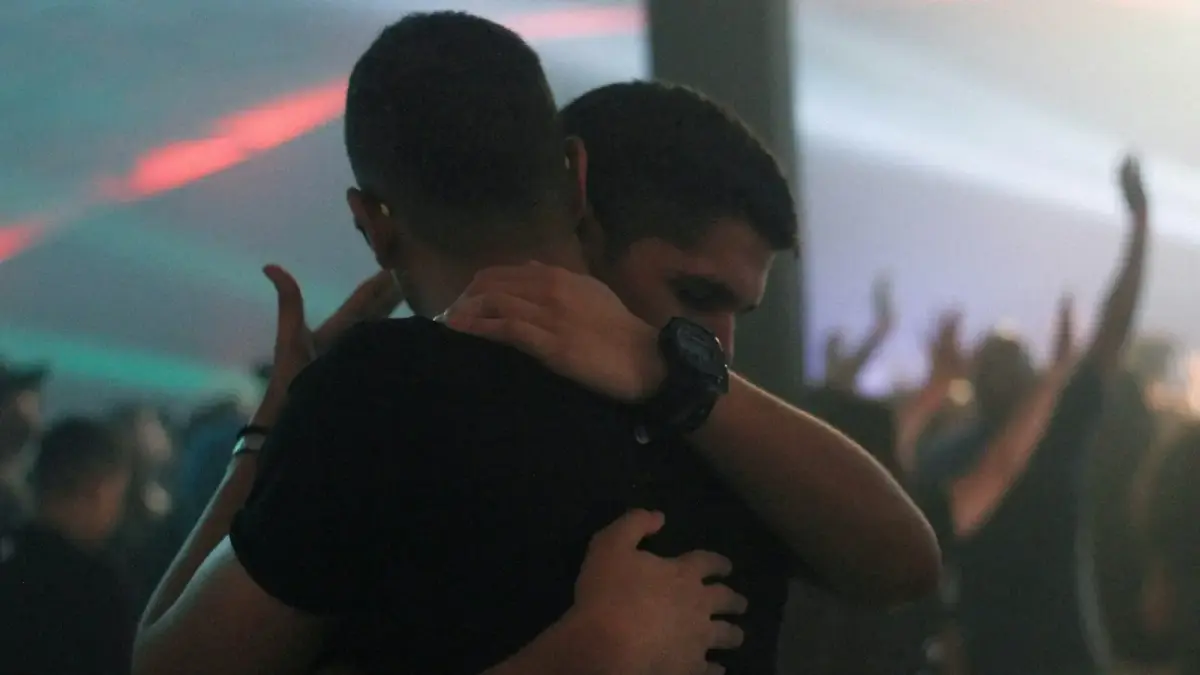
I watched my uncle greet my father at a funeral last year. They hadn’t seen each other in almost three years. They stepped forward, wrapped their arms around one another, and within a second and a half - pat, pat, pat - it was over.
Three firm taps on the back. A slight lean away. Then a handshake to close the deal, as if the hug itself had been an accident that needed correcting.
I’ve been that man. You probably have too. The one who reaches for someone he loves and immediately starts counting down. Not because the embrace doesn’t feel good - but because somewhere, decades ago, you learned that tenderness requires a time limit.
That rhythmic back-pat isn’t aggression. It isn’t awkwardness, not exactly. It’s something more specific and more heartbreaking than either. It’s a clock your body built when you were very young - a way to give physical closeness an exit strategy so that nobody, least of all you, had to sit inside the discomfort of being held for one second longer than felt safe.
Psychology has a lot to say about what that gesture actually reveals. Here are eight things it tells us about the boy who’s still running the show inside the man.
1. He learned that affection had a threshold - and crossing it had consequences
The back-pat is a boundary dressed up as warmth. Therapists who specialize in male attachment say this is the gesture they notice first, because it reveals the exact moment a man’s nervous system decides he’s had enough vulnerability for one interaction.
A 2019 study published in the Journal of Nonverbal Behavior found that men who use repetitive tactile signals during embraces - patting, tapping, rubbing - tend to have significantly higher scores on avoidant attachment scales. The pat isn’t random. It’s a learned motor pattern, and it almost always traces back to a household where physical affection was either rationed or came with an unspoken expiration date.
If you grew up watching your father stiffen after two seconds of contact, you didn’t need anyone to tell you the rule. Your body memorized it.
2. His nervous system treats stillness as danger
Here’s the part that breaks my heart every time I think about it. The back-pat exists because standing still inside a hug - just holding someone, just breathing - feels genuinely unsafe to his body.
Not unsafe like a threat. Unsafe like exposure. The nervous system of a boy who grew up in a home where softness was met with discomfort learns to associate stillness with vulnerability and vulnerability with risk. So the body invents motion. The pat is the motion. It gives the muscles something to do besides surrender.
Dr. Stephen Porges’ polyvagal theory explains this beautifully. When a person’s neuroception - the unconscious surveillance system that scans for safety - registers closeness as ambiguous rather than safe, the body defaults to mobilization. Movement. Action. Something. Anything except standing completely still in someone’s arms, because stillness means you’ve stopped protecting yourself.
3. He was taught that comfort is something you give, never something you receive
Watch closely the next time a back-patter hugs someone who is crying. He’ll pull them in - genuinely, warmly - and then immediately start patting. He’s doing something. He’s active. He’s the strong one, the steady hand, the anchor.
What he’s not doing is receiving anything.
A 2015 study in Psychological Science found that men who scored high on traditional masculinity norms were significantly less likely to report feeling comforted by physical touch, even when physiological measures showed their cortisol levels dropping during contact. Their bodies were being soothed. Their conscious minds refused to register it.
The back-pat keeps him in the role of giver. He’s comforting you. He’s never in the position of needing to be comforted himself. That arrangement was decided a very long time ago, probably before he had the words to negotiate it.
4. The rhythm of the pat matches a script he memorized from his father
This is the detail that stops people in their tracks when I mention it. Count the pats. Seriously - next time, count them.
Most men pat two to four times. The rhythm is almost always the same: firm, evenly spaced, with a slight increase in pressure on the last one. That final pat is the announcement. It says “we’re done here.”
That rhythm didn’t come from nowhere. Research on haptic communication patterns within families, including a 2020 paper in Frontiers in Psychology, shows that touch behaviors are transmitted intergenerationally with remarkable fidelity. The way your father ended a hug is almost certainly the way you end a hug. You didn’t choose the pattern. You inherited it the way you inherited his jaw or his posture or the way he cleared his throat before saying something difficult.
Your body is performing his choreography. Every single time.
5. He confuses duration with intensity - and both feel dangerous
For the back-patter, a long hug doesn’t feel like more love. It feels like more exposure. There’s a critical distinction there that most people miss.
He’s not afraid of affection. He’s afraid of what happens when affection lingers. When it sits there, unhurried, without a clear ending. Because in his childhood, the things that lingered - tension, silence, a look on his mother’s face, the aftermath of a fight - were never good. Duration became a threat signal.
So he invented the pat. A metronome for closeness. Three beats, maybe four, and then release. Not because he doesn’t love you. Because love without a clear exit feels like the moments in his childhood that didn’t have one either.
6. He has a different nervous system response to being held than to holding
Ask a back-patter to hold a child and watch what happens. His arms soften. His breathing slows. He might rock gently, unconsciously. No patting. No timer.
Now hug him. Watch the pat return instantly.
The difference is about who’s vulnerable. When he’s the protector, the holder, the big spoon - his nervous system reads the situation as safe because he’s in control. When he’s the one being held, even briefly, even casually, the roles reverse. He’s the one being taken care of. He’s the one who might need something.
Daniel Goleman’s work on emotional intelligence touches on this asymmetry. Men socialized in environments where emotional need was treated as weakness often develop what Goleman calls a “competence mask” - the ability to provide emotional labor for others while remaining functionally unable to receive it. The back-pat is the competence mask made physical. It turns every hug into a performance of strength.
7. He’s performing a goodbye even in moments of greeting
This might be the saddest one on the list. The back-pat doesn’t just end hugs. It signals departure in the middle of arrival. He’s already leaving while he’s still saying hello.
Watch a group of men greet each other at a reunion, a wedding, a holiday. The embrace happens, and the pat begins before the arms have fully closed. He’s communicating that this will be brief. That he’s already on his way out of the moment. That you don’t need to worry - he won’t ask you to stay in this space with him for long.
A 2018 study in the Journal of Personality and Social Psychology found that individuals with dismissive-avoidant attachment styles initiate separation behaviors an average of 40% faster than securely attached individuals in physical greeting contexts. The back-pat is one of those separation behaviors. It’s a preemptive goodbye embedded in every hello.
He learned this because, at some point, staying too long in a tender moment meant watching someone he loved become uncomfortable. So he started leaving first.
8. The pat is not the absence of love - it’s the architecture love was forced to build around itself
This is where I need you to hear me clearly, because this is the thing that changes everything once you understand it.
The man who pats your back during a hug is not withholding affection. He is giving you every ounce of affection his system will allow him to deliver without triggering the alarm that was installed when he was seven, or nine, or twelve.
The pat is the scaffolding. It’s the structure his love had to build in order to exist at all in a body that learned early that softness was a luxury he couldn’t afford. Every pat is his heart saying “I’m here, I’m here, I’m here” while his nervous system says “and now we need to go.”
Brene Brown has written extensively about how vulnerability is not weakness but rather our most accurate measure of courage. The back-patter knows this intuitively - not because he’s read the research, but because every hug is a small act of courage for him. He shows up. He reaches out. He wraps his arms around you. That’s the brave part. The pat is just the price his body charges for the bravery.
If you recognized yourself in any of this, I want you to sit with something for a moment.
The next time you hug someone and feel your hand start its familiar rhythm against their back - don’t stop it. Don’t force yourself to be still. That pat kept you safe once. It was a brilliant adaptation by a boy who needed one.
But maybe, just once, let the last pat land a little softer. Hold it there for half a second longer than usual. Not to fix anything. Not to prove anything. Just to let your body know that the thing your father’s face did all those years ago - whatever it was - isn’t coming this time.
You learned to put an expiration date on tenderness because tenderness once cost you something. That’s not a flaw. That’s a survival story written in the language of muscle and bone. And the fact that you still reach out at all, still open your arms, still show up to the embrace even knowing your body will rush you through it - that tells me the boy inside the man never stopped wanting to hold on.
He just needs to know it’s safe to.