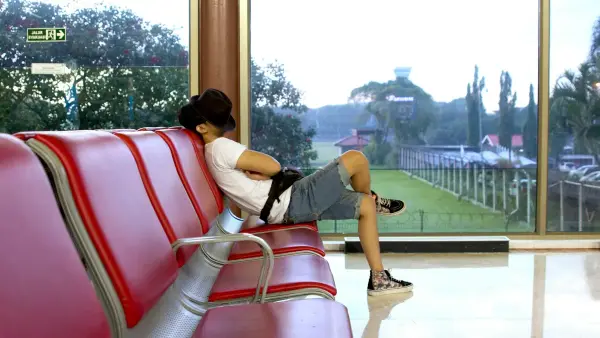
Psychology says people who sit perfectly straight in waiting rooms when nobody is watching - who press their knees together, keep their hands in their lap, and hold their spine like vigilance instead of comfort - are not disciplined or well-mannered. They are people whose body was taught to present itself before it was ever taught to be comfortable.
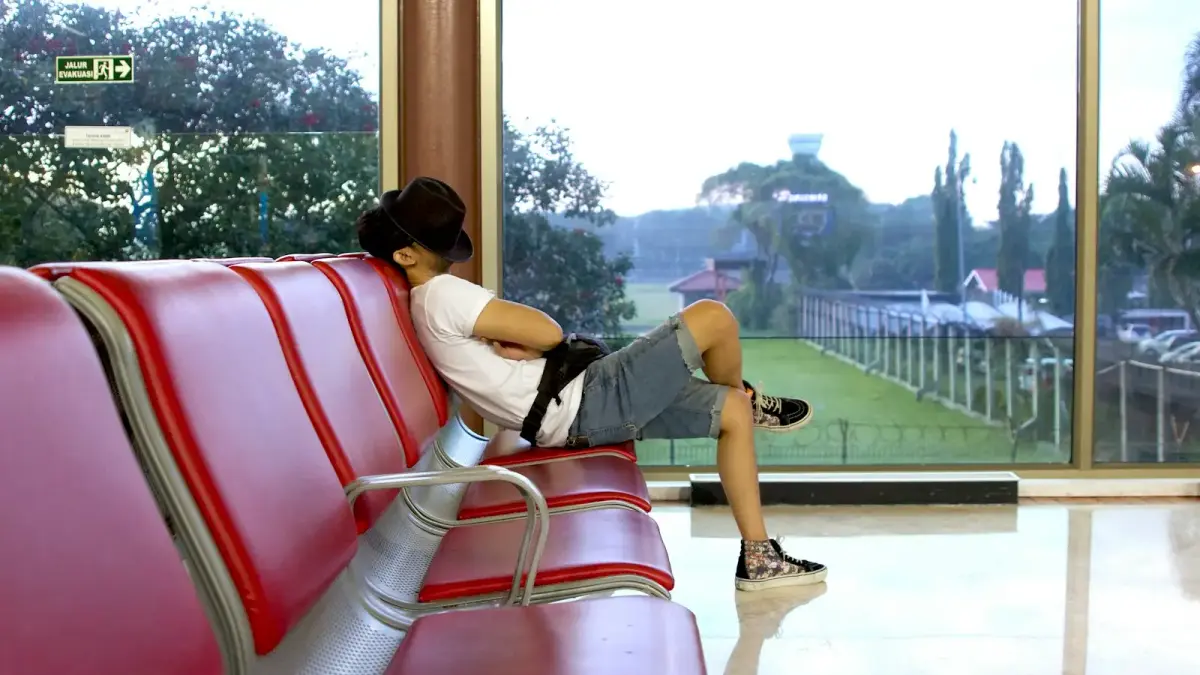
I caught myself doing it again last Tuesday. Sitting in my dentist’s waiting room - completely empty, not another person in sight, the receptionist around the corner - and my knees were pressed together, my hands folded in my lap, my back a ruler line against the chair.
Nobody was watching. Nobody was going to walk in and grade me on how I occupied a plastic seat. And still, my body was auditioning.
I tried to lean back. I consciously told my shoulders to drop, my spine to curve into something resembling comfort. It lasted about eleven seconds. Then something older than my conscious mind pulled me upright again, pressed my knees back together, and returned my hands to their approved resting position.
That is when I understood that this posture has never been about discipline. It has never been about health, or good manners, or the kind of effortless poise that belongs to people who grew up with nothing to prove. This is something else entirely. This is a body that learned, long before it could name what it was learning, that the way it appeared to the outside world was the only currency it had.
The Spine That Never Learned to Slouch
There is a particular kind of posture that looks like confidence from the outside but feels like a held breath from the inside.
You know it if you have it. The straight back at restaurants where you are not entirely sure you belong. The squared shoulders in job interviews. The way you sit in a doctor’s office like you are being evaluated - not medically, but morally.
This is not the posture of someone who took a yoga class and liked what it did for their alignment. This is the posture of someone who was corrected.
“Sit up straight.” “Don’t slouch - what will people think?” “At least look like you belong here.”
Those phrases did not come from etiquette books. They came from mothers and grandmothers who understood something about the world that they could not articulate in academic language but felt in their bones. They understood that when you come from a family without money, without connections, without the invisible ease that wealth installs in a person’s body like factory software - the way you hold yourself is the first thing people use to decide whether you deserve to be in the room.
What Bourdieu Called the Class-Conditioned Body
The French sociologist Pierre Bourdieu spent decades studying something he called habitus - the idea that social class does not just shape what you think or what you buy. It shapes how you move. How you hold a fork. How much space you allow yourself to take up in a chair.
Bourdieu observed that people from working-class and lower-middle-class backgrounds carry their class in their posture, their gestures, their physical relationship to space. Not because they are less comfortable in their bodies, but because their bodies were trained, from childhood, to perform a version of respectability that their address and their income could not perform for them.
A 2019 study published in the Journal of Personality and Social Psychology confirmed this pattern. Researchers found that people from lower socioeconomic backgrounds displayed more constrained body language in social settings - less physical expansiveness, more postural rigidity, more self-monitoring of how their body appeared to others. The researchers noted this was not a deficit. It was an adaptation. These were bodies that had learned, accurately, that they would be judged more harshly for how they presented themselves.
Your mother was not wrong when she told you to sit up straight. She was reading the room correctly. She just could not tell you the full truth of what she was saying, which was something closer to: “The world will not give you the benefit of the doubt. Your body has to earn it before your mouth ever opens.”
The Performance That Outlives Its Audience
Here is what nobody tells you about posture learned this way. It does not expire.
The girl who was told to press her knees together at church at seven years old is still pressing them together at fifty-two. Not because she thinks anyone cares. Not because she is anxious in some diagnosable way. But because her body automated a response so early and so completely that it became indistinguishable from identity.
You sit up straight at your own kitchen table. You hold your spine rigid in the car at a stoplight. You catch yourself performing composure in rooms where you are the only person present, and you do not even register it as performance anymore. It just feels like you.
A 2017 study from the University of Toronto, published in Psychological Science, found that body postures adopted in childhood as social strategies become neurologically embedded over time. The researchers described this as “embodied social cognition” - the body does not just reflect social learning, it stores it. Your muscles remember what your conscious mind has long forgotten.
This means that the straight spine you carry into every waiting room, every restaurant, every office where you sit down and instinctively arrange yourself into the most presentable version of a human being - that is not a choice you are making. That is a choice that was made for you, decades ago, by someone who loved you enough to believe that the angle of your shoulders could protect you from a world that was not going to be kind.
The Body That Cannot Afford to Be Casual
Watch someone who grew up with money sit in a chair. Really watch them.
They sprawl. They drape one leg over the armrest. They lean back until the chair protests. They take up space the way a person takes up space in a house they own - without apology, without calculation, without the faintest awareness that the way they are sitting is communicating anything at all.
Now watch yourself.
You sit forward. You keep your limbs within the boundaries of your own seat. You do not touch the armrests in certain settings because some part of you was taught that taking up too much space is a kind of greed - that comfort is something you earn, not something you assume.
This extends far beyond waiting rooms. It is the way you hold your body at work meetings, never leaning back in your chair because leaning back looks too casual, too entitled, too much like someone who thinks they deserve to be comfortable here. It is the way you sit in restaurants with your back away from the backrest, your posture a quiet announcement that you are not the kind of person who forgets herself. It is the way you stand in grocery store lines - shoulders back, chin level, your body an unbroken performance of somebody who has it together.
A 2021 study in the journal Body Image found that adults who grew up in families with high appearance-monitoring - where physical presentation was explicitly linked to social worthiness - showed persistent patterns of postural self-surveillance well into midlife. These were not people with body dysmorphia or clinical anxiety. They were people whose relationship to their own body was fundamentally shaped by the message that how you look to others is how you survive.
The Love Letter Written in Vertebrae
I want to say something carefully here, because this is not a story about blame.
Your mother, your grandmother, whoever first pressed your shoulders back and told you to sit like you meant it - they were not wrong. They were strategic. They were handing you the only armor they could afford, and it was forged from the understanding that a working-class body that looks polished will be treated differently than a working-class body that looks relaxed.
They knew this because they had lived it. They had watched doors open for women who carried themselves a certain way and close for women who did not. They could not give you a trust fund or a last name that opened rooms by itself. But they could give you a spine that said “I belong here” before anyone had the chance to suggest you did not.
Your posture is not a flaw. It is not something to fix in therapy or unlearn in a mindfulness class. It is devotion - encoded in muscle and bone - to a woman who believed, with everything she had, that the way you held your body could carry you into rooms your address never would.
The straight spine you bring to every empty waiting room is not a habit. It is a love letter to someone who did not have much to give you except the instruction to sit up, look sharp, and never let them see where you came from.
What Your Body Is Ready to Hear
You are allowed to lean back now.
I know that sounds simple, and I know your body will resist it. That is not weakness - that is loyalty. Your nervous system is still honoring an agreement it made with someone who needed you to be safe, and “safe” meant “presentable,” and “presentable” meant “spine straight, knees together, hands where people can see them.”
But you are fifty-two now. Or forty-seven. Or sixty-one. And the audience your body has been performing for - the neighbors, the teachers, the strangers in waiting rooms who might have looked at a slouching child and drawn conclusions about her family - that audience left the room a long time ago.
You do not have to stop sitting up straight. That posture is yours. It was given to you by someone who loved you in the most practical way she knew how, and it carried you further than she probably dared to hope.
But maybe, in the quiet moments - the empty waiting rooms, the parked car, the kitchen table where nobody is watching - you could let your shoulders drop. Not because the performance was wrong. But because the girl who learned it has already proven everything she needed to prove.
Your body was taught to present itself before it was taught to be comfortable. That is not a flaw in who you are. That is the story of where you came from, written in every vertebra, and it is worthy of more tenderness than you have ever thought to give it.