There is a reason certain men only say honest things while driving - not on a couch, not across a dinner table, not in bed at midnight when the room is dark enough to try, but behind a steering wheel with both of you facing the same direction and the windshield between him and whatever he is about to admit - and the boy who learned that eye contact during vulnerability was the thing that made the other person's face change understands, without ever having been told, that the car is not where he avoids intimacy but the only architecture his body ever trusted to hold it
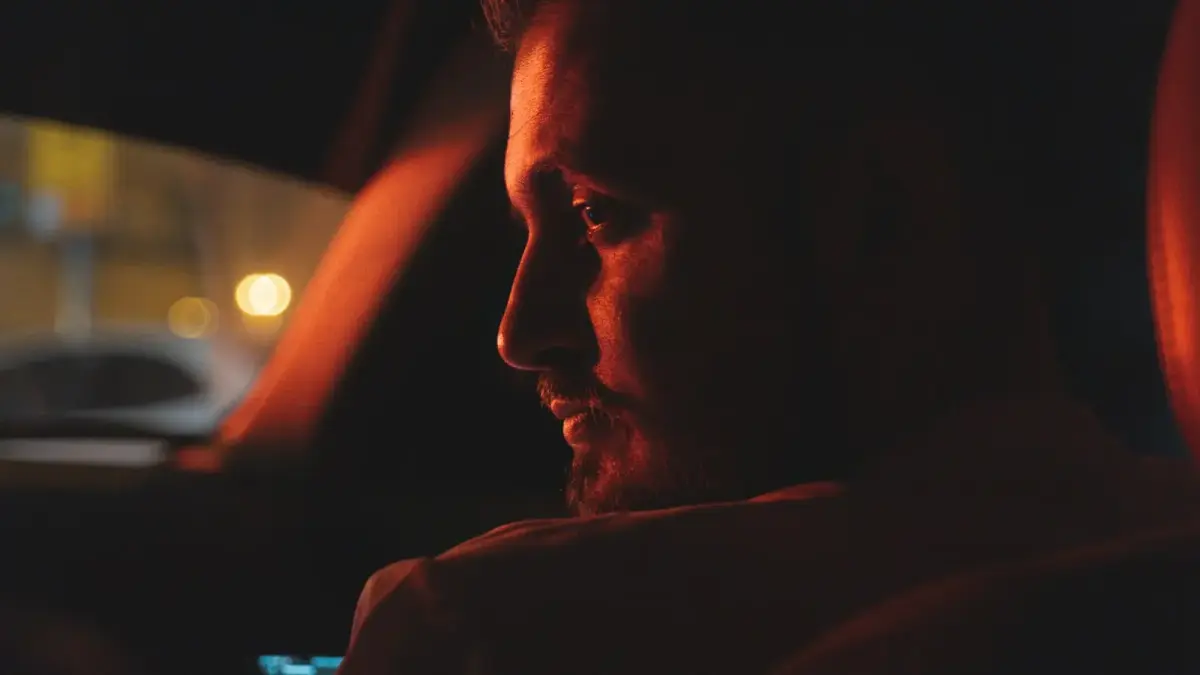
I told my wife the truest thing I’d said in six months somewhere between Exit 14 and Exit 17 on the Garden State Parkway.
I don’t remember which lane I was in. I remember the dashboard was glowing that soft blue-green, the kind that makes everyone’s hands look like they belong to someone calmer. I remember the turn signal was clicking because I was about to merge, and the rhythm of it - that patient, mechanical ticking - gave me something to breathe alongside.
She was in the passenger seat. We were both facing the same stretch of highway. And I said something I’d been carrying for weeks, maybe longer. Something about being afraid. Not of anything dramatic. Just afraid in that low, steady way that sits in your chest like furniture you forgot you moved in.
I couldn’t have said it across a dinner table. I know that the way you know your own handwriting. I couldn’t have said it on the couch with her looking at me, or in our bedroom with the lamp on, or in a therapist’s office with someone holding a clipboard and waiting. But in the car, with the road pulling us forward and neither of us having to look at the other, it came out like it had been waiting for exactly this geometry.
If you’ve ever loved a man who only tells you real things while driving, this is for you.
The Architecture of the Front Seat
There is a specific physical arrangement that happens in a car that doesn’t happen anywhere else in adult life.
You sit side by side. You face the same direction. Your eyes are pointed at the same vanishing point on the road ahead. There is glass between you and the world, and there is motion - constant, gentle, forward motion - that makes every silence feel like it’s going somewhere instead of just sitting there.
This is not a small thing. This is everything.
In almost every other setting where two people talk about something that matters, the architecture is confrontational. A dinner table puts you across from each other. A couch angles you toward each other. A therapist’s office arranges chairs so that eye contact is not just possible but expected. Even a bed, even in the dark, carries the weight of proximity and the knowledge that the other person could turn to look at you at any moment.
The car removes all of that. It replaces the geometry of confrontation with the geometry of companionship. Two people facing the same direction, watching the same road, held inside the same machine that is carrying both of them somewhere.
And for certain men - men whose bodies learned something very specific about what happens when you’re honest while someone is looking at your face - that geometry is the difference between silence and speech.
The Face That Changed
Here is what I think happened, for a lot of us.
You were young. Maybe eight, maybe twelve, maybe fifteen. And you said something honest. Not rebellious, not defiant. Just honest. You said you were scared of something, or confused by something, or sad about something that you didn’t fully understand yet.
And the person you said it to - a parent, usually - their face did something.
It wasn’t violence. It wasn’t even cruelty. It was something much more subtle than that. A flicker. A tightening around the mouth. Eyebrows that moved a quarter of an inch in the wrong direction. A look that wasn’t anger but was maybe disappointment, or discomfort, or that particular expression adults get when a child has said something that makes them feel helpless.
You saw that face, and something in you - something preverbal and precise - made a note. Vulnerability plus eye contact equals that. Whatever that was. The shift. The way the room changed temperature.
Gabor Mate writes about this - the way the body stores emotional experiences not as memories but as patterns. Your thinking brain might not remember the specific Tuesday when you told your father you were afraid of something and watched his jaw tighten. But your nervous system filed it. Your body kept the receipt.
And what your body learned was not “don’t be honest.” That would have been simpler. What your body learned was “don’t be honest while someone can see your face doing it.”
The Parallel Arrangement
Linguist Deborah Tannen spent years studying the differences in how men and women communicate, and one of her most striking observations was about physical orientation.
Women, she found, tend to build intimacy face to face. They sit across from each other. They make eye contact. They treat the direct gaze as a form of connection, a way of saying I am here with you.
Men tend to build intimacy side by side. They sit next to each other at a bar. They walk together. They watch a game together. They fish. They drive. They stand next to each other looking at an engine or a sunset or a problem, and the conversation happens laterally, almost as a byproduct of shared attention on something else.
This is not a failure of male intimacy. This is male intimacy. It just has a different architecture.
Research published in the British Journal of Developmental Psychology found that adolescent boys disclosed more personal information during activities where they were side by side - walking, driving, working on a task together - than in face-to-face arrangements. The removal of direct eye contact didn’t reduce the depth of conversation. It increased it.
The car is the purest version of this architecture. It is the most perfectly designed parallel-processing emotional space that modern life accidentally created. You are contained. You are moving. You are both looking at the same thing. And the engine noise gives you a floor of ambient sound so that silence doesn’t feel like a verdict.
The Man Who Proposes While Walking
Once you see the pattern, it’s everywhere.
The man who proposes while walking along a beach - both of them facing the same direction, the ocean doing the work of being something to look at while he says the most vulnerable sentence of his life.
The man who apologizes while doing dishes - standing at the sink, hands busy, eyes on the water, his wife next to him drying. Side by side. No one having to look at anyone.
The man who confesses that he’s been struggling at work, but only while mowing the lawn with his partner sitting on the porch, close enough to hear but not close enough to study his expression.
The man who tells his son he’s proud of him, but only while they’re both under the hood of a car, looking at the engine, and the words come out aimed at the carburetor.
This is not cowardice. I want to be very clear about that. This is not a man running from intimacy. This is a man who found the one geometry - the one specific physical configuration - where his body releases the lock on honesty.
A study in Psychological Science found that reducing direct eye contact during emotional disclosure didn’t correlate with emotional avoidance. In many cases, it correlated with deeper disclosure. The subjects weren’t hiding. They were creating the conditions their nervous system needed to feel safe enough to speak.
The Woman Who Says “Let’s Go for a Drive”
There is a particular kind of knowing that some women carry about the men they love.
She stopped saying “we need to talk.” She stopped sitting across from him at the kitchen table with her hands folded and her eyes searching his face for the thing he wasn’t saying. Not because she gave up. Because she figured it out.
She says “let’s go for a drive” now.
She says it casually, like it’s about the drive. Maybe she mentions wanting to check out a new restaurant two towns over, or needing to pick something up at the store that’s twenty minutes away. She manufactures the distance. She creates the architecture.
And somewhere on that drive - usually on the way back, when the errand is done and the car feels lighter - he starts talking.
She learned that his honesty lives in a specific room, and the room has a steering wheel and a windshield and no eye contact. So she stopped trying to drag him into her room and started meeting him in his.
That is not settling. That is not accommodating dysfunction. That is love doing the patient, granular work of learning someone’s actual language instead of insisting they speak yours.
The Car Is Not Where He Avoids Intimacy
I used to feel ashamed of this about myself. That the car was where I could be honest. That I needed the road and the motion and the mutual forward gaze. That I couldn’t just sit across from someone and say the thing.
I thought it meant I was broken in some fundamental way. That real emotional maturity looked like the therapy office version - two people facing each other, making eye contact, speaking clearly about feelings with no props, no movement, no escape route.
But I don’t think that anymore.
The car is not where I avoid intimacy. The car is the only architecture my body ever trusted to hold it. And there is a difference between those two things that is the size of a life.
The boy who watched a face change when he was honest didn’t stop wanting to be honest. He just spent years - decades, sometimes - searching for the one arrangement where honesty didn’t come with the cost of watching what it did to someone’s expression. And when he found it, when he slid behind the wheel and felt the engine turn over and aimed himself at a highway with someone he loved sitting next to him, his body finally said yes.
That is not avoidance. That is the nervous system solving a problem that the conscious mind didn’t even know how to name.
So if you love someone who gets quiet at dinner but opens up at sixty miles an hour, know this: you are not getting the lesser version of him in every other room. You are getting the only version of him that the car makes possible. And the fact that he found his way there - that he didn’t just go silent forever - is not a limitation.
It is one of the bravest things his body ever learned to do.