8 things people who always choose the seat facing the door reveal about their childhood, according to psychology - and the one that surprises therapists most is that the person scanning every exit in a restaurant is not expecting danger, they are a child who never stopped monitoring which direction the next disruption would come from
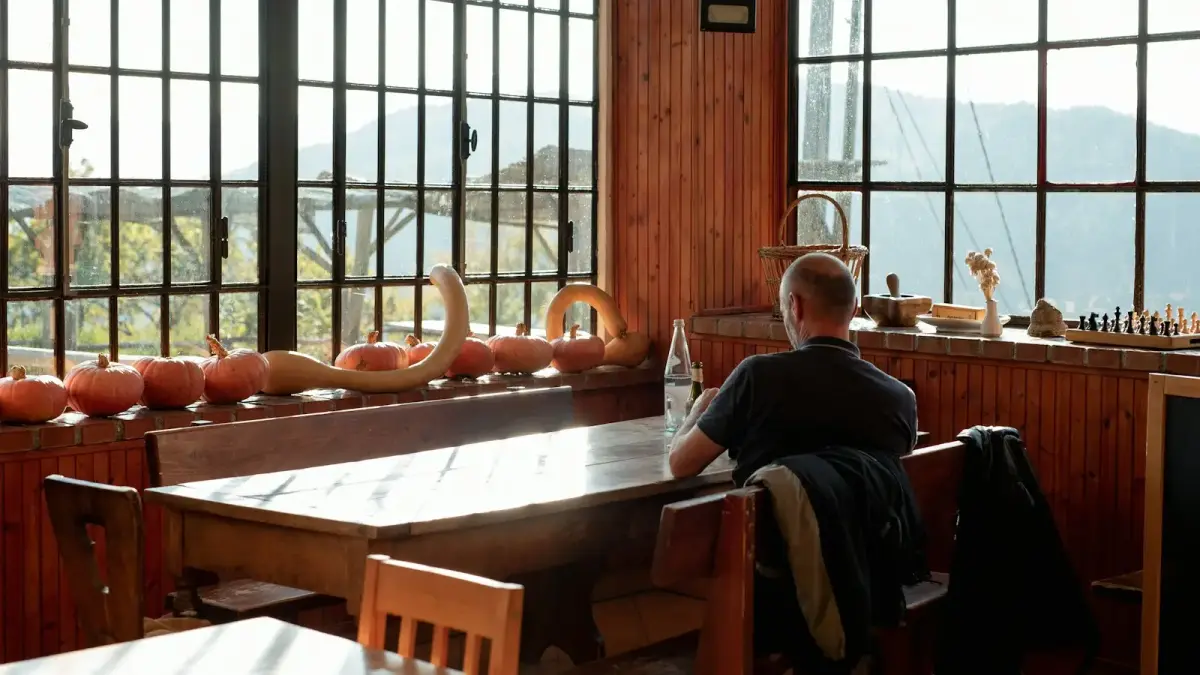
I was at dinner with three friends last month - a place we go every few weeks, nothing fancy, just good pasta and loud conversation. We hadn’t even ordered drinks yet when one of them laughed and said, “Sarah, you always take that chair.”
She was right. I had already claimed the seat facing the entrance before anyone set their bag down. I’d done it without thinking. The way you reach for a seatbelt or check your phone screen when it buzzes - automatic, below decision-making.
My friend thought I liked the view of the street. I smiled and said something about the light. But sitting there, watching the door while my friends settled in around me, I knew the light had nothing to do with it.
That seat is the one where I can see who’s coming.
Not because I’m expecting anyone. Not because I feel unsafe. But because somewhere deep in my body, in a place that existed long before I had language for it, I learned that the direction a disruption enters from matters. And that the person who sees it first has a half-second advantage that once felt like everything.
I’ve spent years studying developmental psychology. I know exactly what that chair means. And I still choose it every single time.
If you do too, here are eight things that choice might be quietly revealing about where you’ve been.
1. You always face the door - because you learned early which direction disruption enters from
This is the most recognizable one, and the one most people dismiss as a personality quirk. You prefer to see the entrance. You angle your body toward the door in waiting rooms, coffee shops, living rooms. If someone takes that seat before you, there’s a flicker of something - not panic, but discomfort. A low hum you can’t quite name.
What’s underneath it is rarely about the present moment. It’s about a childhood where things changed without warning - a parent’s mood, a door slamming, an argument erupting from nothing. You learned to watch the threshold because that’s where the shift always started.
Stephen Porges’ polyvagal theory calls this neuroception - your nervous system scanning the environment for cues of safety or threat before your conscious mind even registers what’s happening. A 2019 study published in Psychological Science found that adults who experienced unpredictable childhood environments show heightened spatial monitoring, particularly toward entry points. They’re not watching for danger. They’re watching for change.
2. Your back goes to the wall - because as a child, the vulnerable side was the one you couldn’t protect
There’s a reason this instinct shows up in combat veterans and survivors of childhood chaos alike. The wall at your back eliminates one entire direction of approach. It narrows the field. It means nothing can come from behind.
For children who grew up in homes where emotional weather shifted without warning, the back was the exposed side. The side where a voice could appear suddenly. Where a hand could land on a shoulder and the tone of the next sentence was unknowable.
You may not remember specific incidents. But your body remembers the architecture of vigilance. Bessel van der Kolk writes extensively about this in The Body Keeps the Score - the way trauma and chronic stress encode themselves not as memories but as spatial reflexes. Your back finds the wall the way a compass finds north. It’s not a choice. It’s a calibration your nervous system made decades ago and never updated.
3. You scan the exits within seconds of entering any room
You walk into a new space and before you’ve processed the decor, the music, or the people - your eyes have already found the exits. The front door. The hallway. The back entrance. The windows that open.
Most people never notice themselves doing this. It’s fast, peripheral, almost invisible. But if someone asked you right now to draw the exits of the last room you entered, you could probably do it from memory.
This is not the same thing as anxiety, though the two often travel together. This is a mapping behavior. It’s what a child does when they learn that staying requires knowing how to leave. Not because they plan to leave. But because the knowledge that they could is the only thing that makes staying tolerable.
A 2021 study in Frontiers in Psychology examined environmental scanning behaviors in adults and found that those reporting high levels of childhood unpredictability showed faster and more accurate exit identification - even in unfamiliar settings. The researchers described it as a “safety architecture” built in childhood and carried forward without conscious maintenance.
4. You choose the aisle seat - on planes, in theaters, in lecture halls - because the escape route matters more than the view
You’ve turned down better seats because they were in the middle. You’ve chosen the end of a row in a theater even when the center had better sightlines. On airplanes, the window might be more beautiful, but the aisle lets you stand up without asking anyone to move.
This isn’t claustrophobia, though it can look like it. It’s a need for autonomous movement. The ability to get up and go - not because you will, but because you can.
Children who grew up in environments where they felt trapped - emotionally, physically, relationally - often become adults who organize their physical world around exit access. It’s not about the plane or the theater. It’s about the deep, preverbal knowledge that being boxed in means being at someone else’s mercy. And your body decided a long time ago that it would never let that happen again.
5. You sit near the edge of groups, never in the center
At parties, you migrate toward the perimeter. In meetings, you choose the chair closest to the door or the end of the table. In group photos, you drift to the side.
This isn’t introversion, though you may have been told it is. This is a positioning strategy. The center of a group means being surrounded. It means every direction is a direction someone could approach from. It means you can’t leave without being noticed.
The edge is different. The edge gives you observation without exposure. You can see the whole room without the room seeing all of you. And for a child who learned that visibility sometimes brought unwanted attention - that being noticed meant being selected for something unpleasant - the edge isn’t shyness. It’s survival geometry.
Adam Grant has written about how many people who appear introverted are actually hypervigilant extroverts - people who genuinely enjoy connection but manage it from a position of spatial control because their early experiences taught them that openness without oversight is risky.
6. You position yourself near windows - because seeing outside was the first form of safety you understood
Not every hypervigilant child watched the door. Some watched the window. The window was where the outside world existed - the world that didn’t argue, didn’t go quiet in that heavy way, didn’t make your stomach tighten before dinner.
If you gravitate toward windows in restaurants, offices, and living rooms, part of it might be about light or scenery. But part of it might be about a child’s earliest understanding that “out there” felt safer than “in here.” The window was the proof that the room you were in wasn’t the whole world.
As an adult, the pull toward windows often shows up as a need for openness - physically and psychologically. You don’t like closed doors. You keep curtains open. You feel something settle in your chest when you can see the sky.
That settling is your nervous system receiving a signal it learned to trust before you could spell your own name: there is more world than this room.
7. You can’t relax when someone is standing or sitting behind you
This one catches people off guard because it feels so physical. Someone walks behind you in a coffee shop and your shoulders climb toward your ears. A colleague stands behind your desk and you can’t focus until they move. At the hairdresser, the person working behind your head produces a low-grade tension you manage by watching them in the mirror.
The unseen direction is the uncontrolled direction. For a child whose environment included sudden mood shifts, unexpected physical contact, or the sound of footsteps that could mean anything - the space behind the body became the space of maximum uncertainty.
Bessel van der Kolk’s research on how trauma lives in the body describes this as a somatic memory - the body holding a pattern of tension that corresponds not to a specific event but to a chronic environmental condition. You may have no conscious memory of what made “behind” feel dangerous. But your trapezius muscles remember. Your neck remembers. The subtle forward hunch you carry into every room remembers.
8. You choose the same seat every time - because predictability is the closest thing to safety a child had
This is the one that surprises therapists most. Because it seems like such a small thing. You sit in the same spot at the kitchen table. The same pew, the same park bench, the same corner of the couch. When your seat is taken, you feel a disproportionate flicker of distress - not anger exactly, but a loss of footing.
Predictability isn’t a preference for people who grew up without it. It’s a life raft. When your childhood environment was chaotic - when rules changed depending on moods, when the emotional temperature of a room was different every time you entered it - the things you could control became sacred. Your seat. Your route home. The order you did things before bed.
A 2020 study published in the Journal of Personality and Social Psychology found that adults who reported high childhood unpredictability showed significantly stronger preferences for environmental consistency - same seats, same routes, same routines - and that these preferences correlated not with rigidity but with a deep need for environmental anchoring. The researchers noted that this wasn’t obsessive behavior. It was adaptive. These were people whose nervous systems had learned to create the stability they were never given.
Your same seat isn’t a habit. It’s a monument to a child who found one reliable thing in an unreliable world and held onto it.
What this really means
If you read this list and recognized yourself in most of it, I want you to hear something clearly: there is nothing wrong with you.
You are not paranoid. You are not controlling. You are not “too much” or “too vigilant” or any of the other labels that get applied to people whose bodies carry the evidence of difficult early environments.
You are someone whose nervous system learned to build safety from the raw materials available - spatial awareness, positioning, environmental scanning. These aren’t symptoms. They’re achievements. They’re proof that a very young version of you figured out how to navigate an unpredictable world, and they did it so well that the strategies still run decades later.
The seat facing the door isn’t about expecting danger. It never was. It’s about a child who learned to watch, who learned to map, who learned to position themselves where they could see what was coming - and an adult whose body still performs that vigil, even on quiet Tuesday evenings over pasta with friends.
You were not broken by what you experienced. You were shaped by it. And the shape you took - alert, perceptive, spatially intelligent, deeply attuned to the emotional weather of any room you enter - is not a wound.
It’s the architecture a child built to survive.
And the adult who still chooses that seat, who still scans the exits, who still feels their shoulders drop only when the wall is at their back - that adult is not stuck in the past. They are someone whose body learned to keep watch before their mind learned to name what it was watching for.
You can soften those reflexes over time, if you want to. You can teach your nervous system that the room is safe now, that the disruption isn’t coming, that the door is just a door.
But you don’t have to be ashamed of any of it. Not the scanning. Not the positioning. Not the seat.
Especially not the seat.