8 things that quietly happen to people who cannot fall asleep until the kitchen is clean - who stand at the sink at eleven o'clock scrubbing a pan that could wait until morning - not because they are neat but because a child who grew up where disorder preceded chaos learned that the only safe way to close a day was to make every surface prove nothing was coming undone, according to psychology
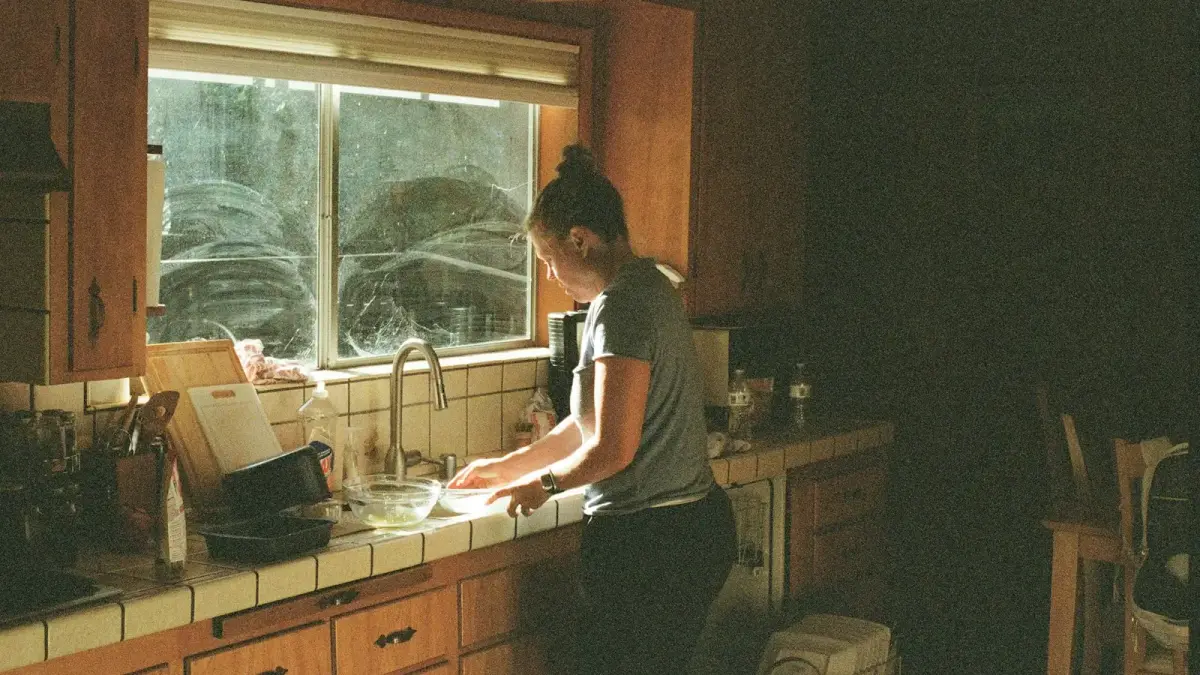
I was standing at the sink at quarter past eleven on a Tuesday, scrubbing a cast iron pan I’d already cleaned once after dinner.
My husband had gone to bed an hour earlier. The house was quiet. The kids were asleep. Nothing was wrong. But the pan had a film of oil on it - barely visible, the kind most people wouldn’t notice - and my hands wouldn’t stop. I scrubbed and rinsed, scrubbed and rinsed, and somewhere between the second and third rinse I caught my reflection in the dark window above the sink and thought: what am I actually doing right now?
I wasn’t cleaning a pan. I was closing a loop. I was performing the same ritual I’d been performing since I was nine years old, standing in my mother’s kitchen wiping counters while she slept, making sure the morning wouldn’t arrive with evidence that the previous day had been messy. Because in my house growing up, mess was never just mess. It was a fuse.
If you’re reading this at eleven at night with dish soap on your hands, you probably already know that this isn’t about neatness. It never was.
1. You don’t clean the kitchen - you neutralize it
Other people tidy up after dinner. You do something different. You don’t just put dishes away - you return the kitchen to a state of zero. No crumbs on the counter. No water spots near the faucet. No dish towel slightly crooked on the oven handle. The kitchen must look as though no one used it today. As though nothing happened here.
A 2017 study published in Personality and Social Psychology Bulletin found that people who grew up in unpredictable home environments developed heightened sensitivity to environmental cues - they scanned rooms for signs of disorder the way other people check their phones. Not because they cared about cleanliness, but because their nervous systems had learned to associate visual disorder with impending emotional upheaval.
You’re not cleaning the kitchen. You’re disarming it. You’re making it prove, surface by surface, that everything is fine. That nothing is about to erupt. That the day can end safely.
2. You wipe counters that are already clean
You know they’re clean. You cleaned them twenty minutes ago. But your hand reaches for the sponge anyway, and you make one more pass across the counter by the stove - the same spot, the same motion, the same slow exhale when you’re finished.
This is not obsessive-compulsive behavior, though it might look like it from the outside. It’s a repetitive soothing behavior - a way your body learned to discharge anxiety when your mind can’t name what it’s anxious about. Dr. Bessel van der Kolk describes this kind of pattern in his work on the body’s response to chronic stress. The body stores what the mind tries to forget, and it replays its survival routines long after the threat has passed.
You’re not wiping the counter because it’s dirty. You’re wiping it because the motion itself - the contact, the pressure, the visual result of a clean surface appearing under your hand - tells your nervous system that you still have control. That you can still make things right.
3. You empty the dishwasher before bed even when no one asked you to
The dishwasher finished its cycle at nine. It could sit there until morning. Everyone in the house would survive. But you can’t leave it. The thought of those clean dishes sitting behind a closed door, waiting to be put away, follows you into the bedroom and sits on your chest.
So you get up. You open it. You put each glass in its place, each plate in the stack, each fork in its slot. And only then does something in your body release.
This isn’t conscientiousness. It’s completion compulsion - the need to close every open task before your body will agree to rest. Children who grew up in environments where unfinished tasks were met with anger or escalation - where a parent might open that dishwasher in the morning and let it become the spark for a terrible day - learned that leaving anything undone was leaving a loaded weapon in the house.
You’re not putting dishes away. You’re removing every possible trigger from the next twelve hours.
4. You straighten the towels before you leave the room
The hand towel is hanging crooked. Not very crooked - a few degrees off, maybe. But you reach for it. You fold it. You hang it so it’s even on both sides, the seam facing the wall. And you stand there for half a second, looking at it, making sure it’s right.
A 2020 study in the Journal of Research in Personality found that adults who scored high on childhood environmental sensitivity - defined as heightened awareness of subtle changes in their surroundings - were significantly more likely to engage in evening ordering behaviors. They didn’t just clean before bed. They arranged. They aligned. They made things symmetrical.
The researchers noted that these behaviors were not correlated with perfectionism as a personality trait. They were correlated with childhood exposure to households where small signs of disorder - a towel out of place, a shoe left in the hallway - were read by caregivers as evidence of disrespect, laziness, or moral failure.
You straighten the towel because, in the house where you grew up, a crooked towel was never just a crooked towel.
5. You check the locks and the stove and the lights in a specific order
You don’t just glance at the front door. You touch it. You turn the deadbolt even if it’s already locked, just to feel it click. Then the stove. You look at the knobs. You might touch those too. Then the back door. Then the lights - living room, hallway, kitchen, in that order, always that order.
This sequence isn’t a quirk. It’s a closing ceremony. It’s the ritual your nervous system designed to prove that the perimeter is secure, that every entry point is sealed, that no threat can arrive without warning.
Dr. Stephen Porges, whose polyvagal theory maps the nervous system’s response to safety and danger, describes how children raised in unpredictable environments develop what he calls “faulty neuroception” - their threat-detection systems remain activated even in objectively safe spaces. The body can’t distinguish between the home you grew up in and the home you built for yourself. So it runs the same closing protocol every night, checking every door, making sure this house won’t betray you the way the last one did.
You’re not checking the locks because you’re worried about intruders. You’re checking them because your body still believes that safety has to be earned every single night.
6. You cannot leave a sink with dishes in it overnight
Some people leave a pot soaking overnight and think nothing of it. For you, it’s a physical impossibility. Not a preference. Not a choice. A wall. Something in your body simply will not allow you to walk away from a sink that has dishes in it.
This one traces back to the most direct and painful root. In many homes where chaos was the norm, the kitchen was the stage. The kitchen was where the fights happened, where the frustration landed, where a parent’s mood turned on a dime because the house wasn’t the way they wanted it. Dishes in the sink were not dishes in the sink. They were proof of someone’s failure. They were evidence someone would be held accountable for.
A 2018 study in Mindfulness found that participants with high adverse childhood experience scores reported significantly greater distress when confronted with environmental disorder - not because the mess itself bothered them, but because it activated what the researchers called “anticipatory threat responses.” The mess didn’t feel messy. It felt dangerous.
You wash those dishes at eleven at night because the child in you still believes that someone is going to walk into this kitchen in the morning and make everyone pay for what they see.
7. You feel a specific kind of calm when every surface is clear
It’s not satisfaction. It’s not pride. It’s something deeper and quieter than either of those words can hold. When the counters are clean, the dishes put away, the towels straight, the stove wiped, the floor swept - when every surface in the kitchen reflects nothing but its own emptiness - you feel a wave of calm move through your body like a long exhale after holding your breath underwater.
That calm is not the pleasure of a job well done. It is the absence of threat. It is your nervous system finally receiving the signal it’s been scanning for all evening: the environment is controlled. Nothing is out of place. No one will be angry. No one will escalate. The day is sealed.
Gabor Mate writes about how the body keeps its own scorecard - independent of what the conscious mind believes. You can know, intellectually, that a few dishes in the sink are meaningless. But your body has forty years of data that says otherwise. And until every surface is clear, your body refuses to agree that the day is over.
That calm you feel isn’t peace. It’s the cessation of vigilance. And for someone who grew up where you grew up, that might be the closest thing to peace you’ve ever known.
8. You do all of this quietly, without asking anyone to notice
You don’t announce it. You don’t complain about it. You don’t post about your midnight cleaning sessions or make jokes about being a neat freak. You just do it. Silently. Alone. While everyone else in the house is already asleep.
Because the child who cleaned the kitchen at night wasn’t doing it for praise. They were doing it to prevent something. To protect everyone from a version of the morning that they’d already lived through too many times. And that child learned something that no one should have to learn so young: the work that keeps everything from falling apart is work that no one is supposed to see.
A 2022 study published in the Journal of Personality and Social Psychology found that adults who identified as “invisible caretakers” in their families of origin - the ones who managed the household’s emotional temperature through environmental control rather than direct confrontation - were significantly more likely to perform maintenance behaviors in solitude. They didn’t want credit. Credit would mean someone noticed. And being noticed, in their childhood, usually meant something had gone wrong.
You clean at night because that’s when the cleaning was always done. Quietly. Alone. While the house held its breath and you held yours.
If you’re the person who can’t sleep until the kitchen is clean, I want you to know something that might take a long time to believe.
You are not rigid. You are not controlling. You are not the punchline of a joke about neat freaks or Type A personalities.
You are a person whose body learned, very early, that the only reliable way to create safety was to control the environment. And you’ve been doing it so faithfully, for so many years, that it feels less like a choice and more like breathing.
The kitchen doesn’t need to be perfect for the morning to be okay. But your body doesn’t know that yet. It’s still running the protocol it built when you were eight, standing on a step stool to reach the faucet, making sure the morning would arrive clean and quiet and free of evidence that anyone could use against you.
That’s not a flaw. That’s a child who loved their family enough to try to save it with a sponge and a dish towel, every single night.
And you’re still that child. Standing at the sink. Making sure everything is going to be okay.