8 things people who always walk one step behind the person they are with - who let others enter the room first, who drift to the edge of every group photo, who hold the door and then somehow end up behind everyone - do without realizing it, according to psychology, because the way you position your body in a room tells the whole story of where you learned you belonged
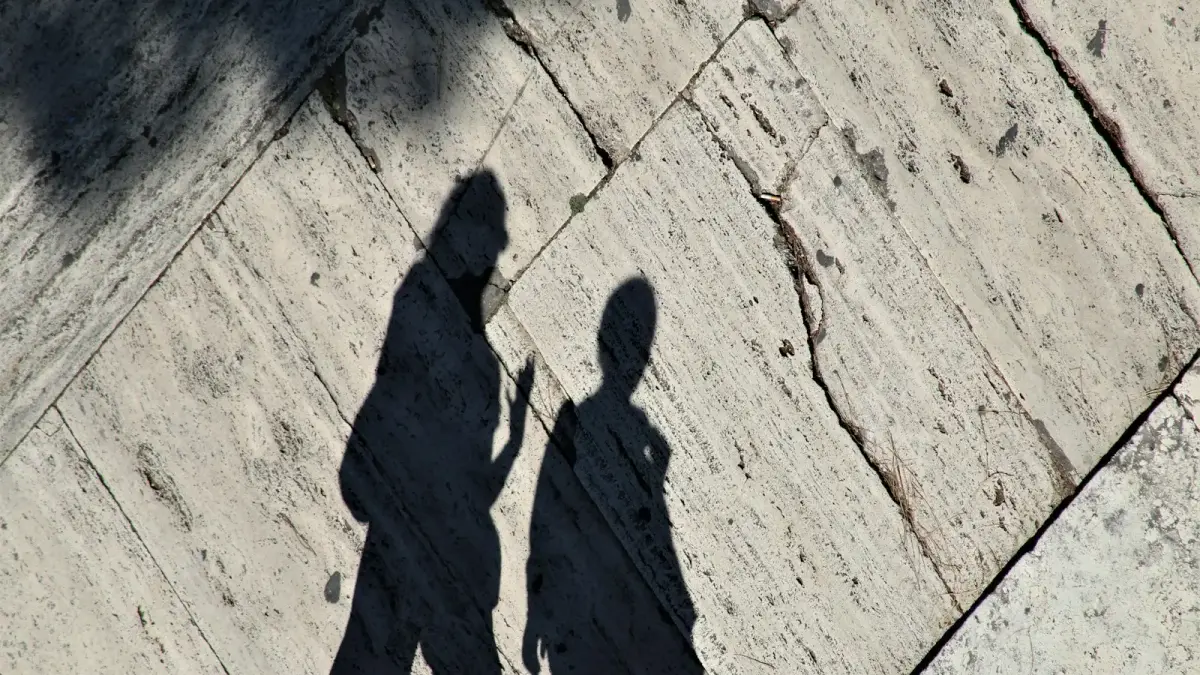
I noticed it on a Saturday afternoon, walking through a farmer’s market with a friend I have known for twenty years. We were side by side for about three steps. Then he drifted back. Not dramatically. Not like he stopped walking. Just a half-step, maybe less, and suddenly I was leading and he was following.
I slowed down. He slowed down too. I stopped at a booth. He stopped slightly behind me, slightly to my left, like a person who had rehearsed the geometry of making room for someone else without ever being asked to.
I have watched him do this his entire life. In parking lots. In hallways. Walking into restaurants. He is never the one who reaches the door first. He is never the one who steps into the room and takes up the center. He occupies the margins - not because he lacks confidence in the way most people understand confidence, but because his body learned a long time ago that the correct position was slightly behind, slightly yielded, slightly smaller than the space he was allowed.
If you recognize yourself in that description, what follows is going to feel uncomfortably specific. Because walking one step behind is not a habit. It is a language. And your body has been speaking it for decades.
1. They let others walk through doorways first - every single time
This is the one that looks like politeness. And sometimes it is politeness. But there is a difference between choosing to hold a door open and feeling physically incapable of walking through one first.
People who default to the trailing position do not just hold doors. They yield the threshold entirely. They step aside, gesture the other person forward, and then enter the room after the space has already been claimed by someone else.
A 2019 study published in the Journal of Nonverbal Behavior found that individuals with lower self-perceived social status consistently yielded spatial priority to others - entering rooms last, choosing peripheral seating, and positioning themselves in ways that minimized their physical presence in shared environments. The researchers called it “spatial deference,” and it had almost nothing to do with manners. It had everything to do with how those individuals understood their own place in the social order.
The door is not really the point. The point is that walking through it first would mean arriving somewhere before the other person. And arriving first means taking up space before you have been given permission to.
2. They adjust their walking pace to match whoever they are with but never set the pace themselves
Watch closely next time you are walking with someone who does this. They are not walking at their natural speed. They are walking at yours.
If you speed up, they speed up - but just enough to stay one step behind. If you slow down, they slow down. If you stop, they stop. Their entire locomotion is calibrated to a rhythm someone else is setting, and they have no idea they are doing it.
This is not laziness or inattention. This is hypervigilance dressed up as ease. Their body is constantly scanning for the other person’s pace, direction, and intention, adjusting in real time so that no moment of walking together ever requires the other person to accommodate them.
They learned this early. The child who had to match a parent’s mood before they could feel safe. The kid who figured out that the best way to avoid friction was to never be the one creating the tempo. That child grew up and now walks through the world at everyone else’s speed.
3. They drift to the edges of group photos
You have seen this in every family portrait, every vacation snapshot, every casual group shot taken on someone’s phone. There is always one person who ends up at the far end of the row. Not because they arrived late. Not because someone nudged them there. Because their body navigated toward the margin the way water navigates toward the lowest point.
They do not fight for the center. They do not position themselves near the person taking the photo. They find the edge - the spot where, if you cropped the image by a few inches, they would disappear entirely.
A 2021 study in Frontiers in Psychology examined how spatial positioning in group contexts correlates with self-concept. Participants who scored lower on measures of self-importance and personal agency consistently chose peripheral positions in group arrangements, even when explicitly told that placement did not matter. The researchers noted that this was not conscious decision-making. It was an automatic spatial behavior - a body that had internalized the message that the center was for other people.
4. They hold doors open and then somehow end up behind everyone
This is the magic trick that nobody notices except the person performing it. They hold the door. One person walks through. Then another. Then another. And somehow, by the time the last person has passed, the door-holder is at the back of the group with no memory of how they got there.
It starts as a single generous gesture and becomes an entire positional reset. One moment they were walking alongside everyone. The next they are trailing behind a group that has already moved on, and the gap between them and the rest feels both accidental and entirely inevitable.
This is the choreography of a person who learned that service was the price of belonging. That you earn your place in the group not by being in it but by making it more comfortable for everyone else. The door is just the mechanism. The real act is the disappearance - the quiet renegotiation of where they stand relative to the people they love.
5. They choose the chair closest to the wall or the exit
At a dinner table, they sit at the end. In a meeting room, they take the seat nearest the door. At a party, they find the corner of the couch or the stool by the kitchen entrance - the spot that says “I am here, but I can leave without disrupting anything.”
This is not social anxiety in the clinical sense, though it can look like it from the outside. This is spatial self-minimization. They choose the seat that requires the least rearrangement from anyone else. The seat no one else wanted. The seat that says “I did not take this from you.”
Research on proxemics - the study of how humans use physical space - has consistently shown that individuals with insecure attachment styles tend to manage physical distance differently than those with secure attachment. A 2017 study in the Journal of Personality and Social Psychology found that people with anxious attachment maintained greater physical distance from close others in public settings, not because they wanted distance but because they were preemptively managing the possibility of being too close, too present, too much.
The chair by the wall is not a preference. It is a negotiation with an old fear that taking the better seat would mean taking something from someone who deserved it more.
6. They speak quieter in group settings and wait for a gap that often never comes
The spatial pattern does not stop at walking. It extends to how they use their voice in a room full of people.
They do not interrupt. They wait. They listen for a pause, a breath, a natural opening in the conversation, and by the time they find one, the topic has moved on. So they stay quiet. Not because they had nothing to say but because the gap never arrived, and they would rather say nothing than take space that was not offered.
This is the vocal equivalent of walking one step behind. It is yielding the conversational floor the same way they yield the sidewalk - automatically, reflexively, without anyone asking them to.
And the painful part is that no one notices. The group keeps talking. The conversation keeps moving. And the person sitting slightly outside the circle, slightly back from the table, slightly quieter than everyone else, absorbs the silence as confirmation of what they already believed: that the room was not waiting for them to speak.
7. They apologize for physical space they have every right to occupy
“Sorry - am I in your way?” They say this in grocery store aisles. In elevators. In their own kitchen. They apologize for standing where they are standing, as though their physical body is an inconvenience that other people are graciously tolerating.
This is not mere politeness or social reflex. This is a person whose internal map of the world includes a persistent belief that they are slightly in the wrong place at all times. That their presence requires justification. That the default state of any room would be better if they were not occupying space in it.
Listen for it. You will hear it dozens of times a day from someone who walks one step behind. “Sorry, go ahead.” “Sorry, I did not see you there.” “Sorry, I will move.” The word carries no actual apology. It carries a relational confession: I know I am here, and I know that is an imposition.
A 2020 study published in Psychological Science examined what researchers called “chronic self-diminishment” - a pattern in which individuals habitually minimize their presence, contributions, and spatial claim in social settings. The study linked this pattern strongly to childhood environments where the individual’s needs were consistently treated as secondary to the needs of a parent, sibling, or household system.
8. They check behind them constantly to make sure no one is being left out
Here is the one that will break your heart a little.
The person who walks one step behind is also the person who is always looking back. On a group walk, they turn around to check on the slowest person. In a conversation, they notice who has gone quiet and try to bring them back in. At a gathering, they scan the room for the person standing alone.
They are not doing this because they are natural leaders or caretakers in the traditional sense. They are doing it because they know exactly what it feels like to be the one at the back. To be the one who fell behind. To be the one no one turned around for.
This is the most generous thing about the person who walks behind - and also the saddest. They became hyperattuned to the margins because they have spent their whole life in them. They know the geography of being slightly outside the group, slightly behind the pace, slightly less visible than everyone else. And rather than resenting it, they made it their job to make sure no one else has to feel that way.
Where this comes from
None of these behaviors start in adulthood. They start in a living room, a car ride, a family dynamic where one child absorbed the message that the way to be loved was to be small. To be useful. To make yourself easy to overlook so that the people around you never had to adjust for your presence.
Maybe it was a parent who needed to be the center. Maybe it was a sibling whose needs were louder, more urgent, more visible. Maybe it was a household where space - emotional space, physical space, conversational space - was scarce, and you learned early that the kind thing to do was to need less of it.
The result is a body that performs deference as fluently as breathing. A body that knows, in every room it enters, exactly where the least important seat is. Exactly how to hold a door so that everyone passes before you. Exactly how to walk through the world while taking up as little of it as possible.
The thing nobody tells you
Walking behind is not weakness. It never was.
It is the residue of a child who was paying exquisite attention to the emotional physics of every room they entered. A child who calculated, in real time, where they needed to stand so that love remained possible. That is not passivity. That is a staggering act of relational intelligence performed by someone too young to know they were doing it.
But you are not that child anymore. And the room you are walking into today does not require you to earn your place by yielding it.
You are allowed to walk beside someone. Not behind. Not a half-step back. Beside. At the same pace, through the same door, into the center of the room where your body has always been welcome - even if no one thought to tell you that when it would have mattered most.
The people who love you are not looking for you to make yourself smaller. They are wondering why you keep disappearing. They are wondering why, no matter how close they try to stand, there is always that half-step of distance.
That distance is not who you are. It is what you learned. And anything learned can, slowly and gently, be unlearned.