8 things that quietly happen to people who cannot throw away a handwritten note or card, because a child who grew up in a home where affection was rarely spoken learned to collect physical proof that someone had once cared enough to write their name, and the shoebox at the back of the closet at fifty-five is not sentimentality but a nervous system that still needs evidence it was loved, according to psychology
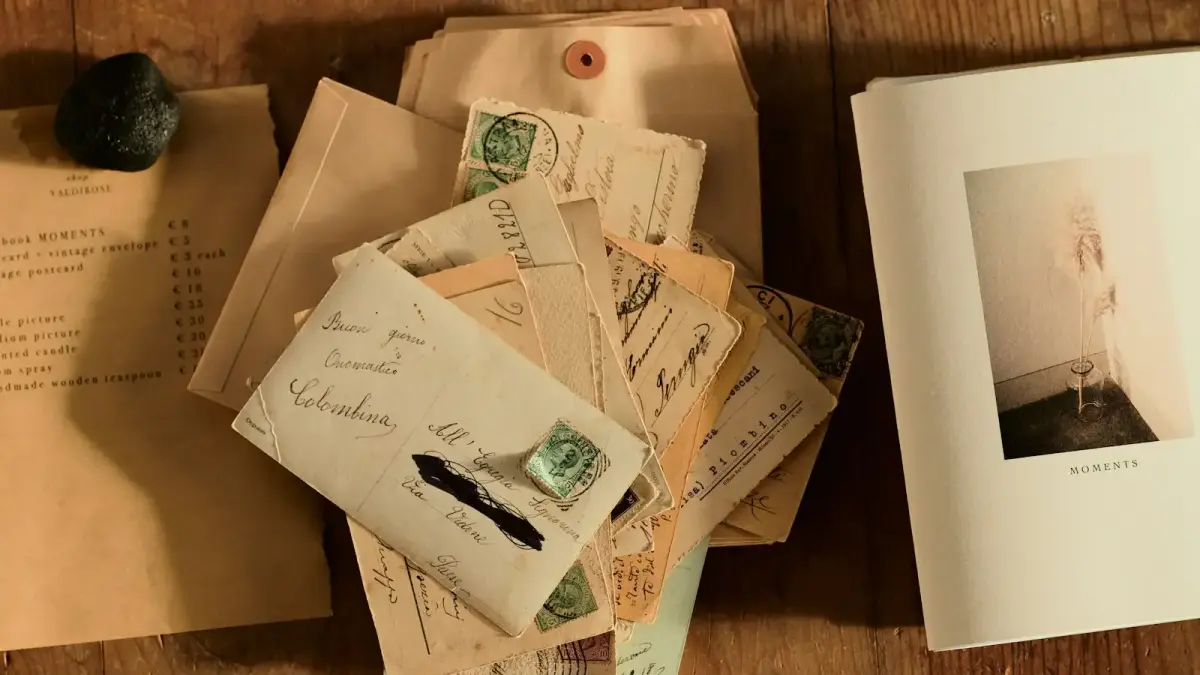
I found the box last winter when I was looking for old tax documents in the back of my bedroom closet. A shoebox - not even a nice one, just a battered Nike box from maybe 2004 - and inside it, every birthday card I’d received since I was thirty. A note from a colleague who’d moved to another city ten years ago. A Post-it from my daughter that just said “love you mom” in purple marker. A thank-you card from a neighbor whose name I barely remember.
I sat on the floor of my closet for forty-five minutes reading every single one.
My husband walked by and said, “You still have all that?” Like it was a question about storage. But it was never about storage. It was about something I didn’t have language for until I was well into my forties - that I grew up in a house where people loved each other but almost never said so, and somewhere along the way, I started collecting evidence.
If you are someone who cannot throw away a handwritten card, I want you to know what’s actually happening inside you. It’s not hoarding. It’s not sentimentality. It’s a very old, very smart part of your nervous system doing exactly what it learned to do.
Here are eight things that tend to be true about people like us.
1. You reread old cards on bad days - not for the words but for the handwriting itself
When the day has been long and your self-worth feels thin, you don’t reach for affirmations or motivational podcasts. You reach for the box. And the thing that steadies you isn’t what the card says. It’s the handwriting.
Because handwriting is physical. Someone’s hand moved across paper for you. They pressed down. They chose ink. They made a mark that cannot be undone or unsent or deleted.
A 2019 study published in Frontiers in Psychology found that handwritten communication activates stronger emotional processing in the recipient than typed messages, partly because the brain recognizes the physical effort embedded in the act. Your nervous system isn’t reading words. It’s reading proof that someone sat down and spent irreplaceable minutes of their life thinking about you specifically.
That is what you’re looking for on bad days. Not encouragement. Evidence.
2. You keep notes from people who are no longer in your life - because the note is the only proof the relationship was real
There’s a birthday card in my box from a friend I haven’t spoken to in eight years. We didn’t have a falling out. We just drifted, the way people do. But I can’t throw the card away because without it, the friendship almost doesn’t exist anymore. No photos together. No shared social media. Just this card with her looping cursive and a joke about turning thirty-five.
People who grew up in emotionally sparse homes often struggle to trust that relationships were real once the relationship ends. If love was rarely spoken aloud when it was happening, it becomes almost impossible to believe it existed once it’s over.
The note is not nostalgia. It is a witness. It says: this happened. Someone knew you. Someone chose to tell you so on a piece of paper they bought at a drugstore, and that small act was more commitment than a lot of what you grew up with.
3. You notice immediately when someone handwrites you a note instead of texting
Everyone else sees a thank-you card and thinks, “That was nice.” You see a thank-you card and something catches in your chest. Because you understand what it cost. Not money. Time. Attention. The vulnerability of putting your handwriting - your actual, imperfect, human handwriting - on a piece of paper and handing it to someone.
Psychologist Adam Grant has written about how acts of generosity that involve personal effort carry disproportionate emotional weight for the recipient. But for people who grew up calibrating how much effort others would spend on them - because effort was the only reliable measure of love - a handwritten note doesn’t just carry weight. It carries meaning that a text never could.
You notice because you were trained to notice. A child in an emotionally quiet home becomes an expert at measuring how much someone is willing to give. A handwritten note is someone giving you their time, not just their words. And you have never once failed to register the difference.
4. You save the envelope too
The card. The envelope. The stamp. The address written out by hand.
Most people tear open the envelope and throw it away. You keep it. Because the envelope tells a story the card doesn’t. Someone looked up your address - or already knew it by heart. Someone chose a stamp, sealed the flap, walked to a mailbox or stood in line at the post office.
Each step is a small act of effort. And you catalogue all of them because you understand something most people don’t have to think about: love is not just a feeling. Love is a series of logistical decisions someone makes on your behalf. Buying the card, finding a pen, remembering the zip code, choosing to mail it instead of texting “happy birthday” at 11:47 p.m.
A 2021 study in the Journal of Personality and Social Psychology found that people consistently underestimate how much recipients value effortful expressions of care. The givers think it’s a small gesture. The receivers - especially those who grew up measuring love by effort - experience it as something much larger.
You keep the envelope because it is a record of all the steps someone took to reach you.
5. You feel guilty throwing away a generic card - even one from someone you barely know
Your dentist’s office sends a birthday card. It’s clearly printed in bulk. Your name is probably auto-filled. And still, you hesitate before putting it in the recycling, because something in you whispers: but they thought of you.
This is one of the quietest signatures of growing up in a home where affection was rare. When warmth is scarce, you lose the ability to distinguish between meaningful and obligatory expressions of care. Everything counts. Everything might be the real thing. And throwing away even a generic card feels like throwing away the possibility that someone meant it.
You’re not naive. You know the dentist didn’t personally select that card. But the part of you that learned to survive on very small portions of affection doesn’t operate on logic. It operates on hunger.
Researcher Brene Brown has described how children in emotionally withholding environments develop what she calls “scarcity thinking” around connection - the persistent, often unconscious belief that love is a limited resource that must be preserved whenever it appears, in whatever form it takes. The generic card gets saved because your nervous system refuses to risk discarding something that might have been real.
6. You write handwritten notes to other people more often than most
Here is the part that breaks my heart a little. People who keep every note they receive almost always write more notes than the average person. Birthday cards. Thank-you cards. Little notes left on a coworker’s desk. A card tucked into a friend’s bag.
You do this because you are trying to give someone else the thing you wished you had received. You know what it feels like to open a mailbox and find something with your name on it in someone’s handwriting. You know the specific warmth of it, the way it says I was thinking about you and I wanted you to have proof.
A 2020 study in Psychological Science found that people who send expressions of gratitude consistently underestimate the positive emotional impact on the recipient. Senders worried their notes would seem awkward or excessive. Recipients described feeling “surprisingly moved.”
You already know this. You don’t need the study. You write notes because you understand in your bones that a piece of paper with someone’s name on it, written by your own hand, is a gift that costs almost nothing and means almost everything.
7. You have a specific place where these things are kept - and you know exactly where it is, even if you haven’t opened it in years
The shoebox. The drawer. The old tin on the top shelf. The ziplock bag inside a suitcase you never use.
Everyone who keeps notes has a place. And they can tell you exactly where it is without thinking. Third shelf, behind the photo albums. Bottom drawer of the desk in the guest room. Closet, left side, under the winter blankets.
You don’t open it often. Maybe once a year. Maybe less. But knowing it’s there is part of what it does. The box is not a collection. The box is an anchor. It holds the physical weight of being cared about, and its existence - even unopened - is a form of reassurance.
Attachment researchers, including the late John Bowlby, described how children who don’t receive consistent emotional attunement often develop what’s called a “secure base” through objects - physical things that stand in for the relational safety they couldn’t consistently access. The teddy bear at five. The journal at fifteen. The shoebox at fifty-five.
The object changes. The function doesn’t. It says: you were here, and people knew your name, and here is the proof.
8. You don’t talk about the box
This is the one that gets me. Because you could explain the box. You could tell someone about the birthday card from 1997 that you still have, the one your aunt sent the year your parents forgot, the one that arrived four days late with a five-dollar bill inside and a note that said “Sorry this is late, sweetheart.”
But explaining why you keep it would mean explaining why it mattered so much. And explaining why it mattered would mean explaining what it felt like to grow up in a house where birthdays happened but celebration didn’t. Where love existed but was never announced. Where you learned to be grateful for any scrap of warmth because you understood, even at seven, that warmth was not guaranteed.
So you don’t talk about the box. You keep it where it is. You know it’s there. And on the days when the world feels a little cold and your worth feels a little uncertain, you pull it out and sit on the floor and read a card from someone who, fifteen or twenty or thirty years ago, picked up a pen and wrote your name.
That’s not sentimentality. That is a child who learned to build their own evidence file. And the fact that you still need it at fifty or sixty doesn’t mean you’re fragile. It means you’re still here, still collecting proof, still believing - quietly, stubbornly, against all the silence you grew up inside - that you were worth the ink.