Boys who were taught that men do not cry, men do not complain, and men do not ask for space often become the men who add twenty minutes to their commute home every day, taking the long way through neighborhoods that are not theirs, because the driver's seat of a parked car at the edge of a cul-de-sac is the only room in their life where they are allowed to stop performing composure
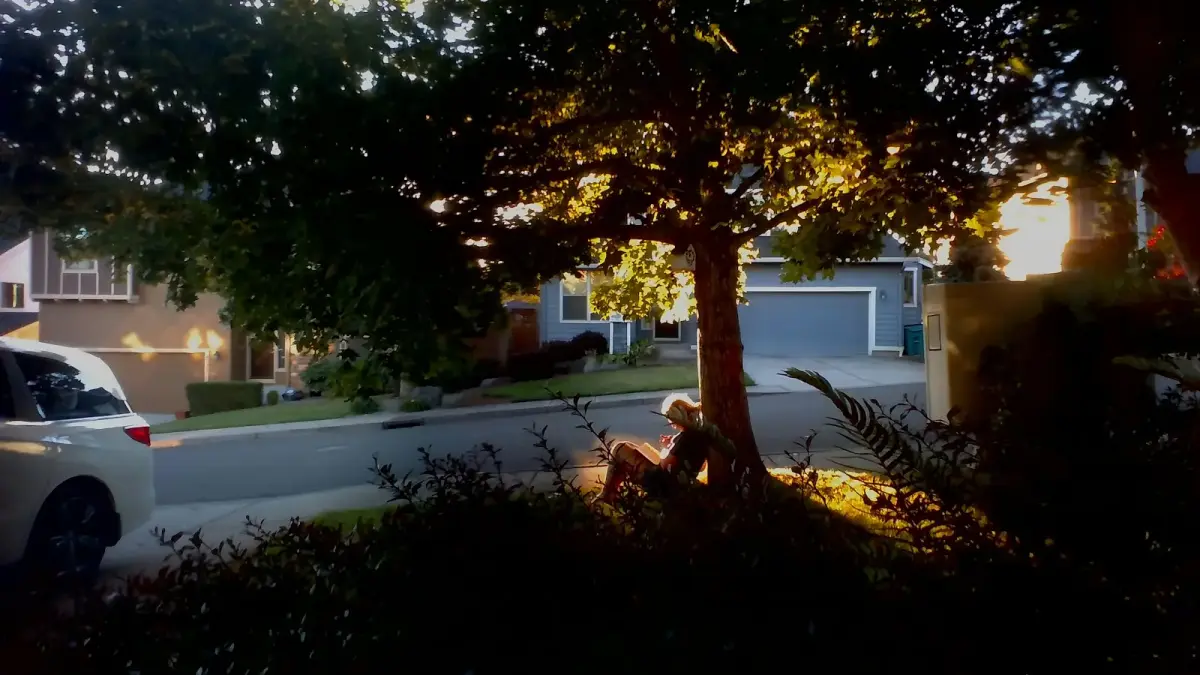
It is a Wednesday in April, and there is a man sitting in a parked car at the edge of a cul-de-sac three streets over from his own house. The engine is off. The radio is off.
The sunset is turning everything copper through the windshield, and his hands are still on the wheel even though he has not been driving for almost seven minutes.
His wife texted him two minutes ago. She wants to know if he wants Thai or pizza for dinner. He has not answered yet.
He is not avoiding her. He is not angry at her. He loves her, in fact, in the steady, unspectacular way he has loved her for twenty-six years.
He is sitting inside the only nine minutes of the day when his jaw is not clenched and his shoulders are not holding up the roof of his own life.
He will start the car in about two more minutes. He will drive home. He will not tell anyone he did this, not because it is a secret, but because he has never had the words for it.
He has been doing this, in one form or another, since his first job in 1992. And until this exact evening, sitting here watching a stranger’s porch light come on, it never once occurred to him that other men might be doing it too.
The cul-de-sac, the engine off, the nine minutes nobody knew about
If you are the man I am describing, you already know the geography of your version of this. You know which side street, which strip-mall parking lot, which church lot on a Sunday afternoon when no service is happening.
You know the exact spot where the trees come down low enough that nobody in a passing car can see you sitting there. You know it the way some people know the location of a chapel.
You did not plan it. You did not decide one day that you needed a hiding place. It just slowly became the route, and then it became the ritual, and then one day you noticed you were taking the long way home not because of traffic but because of something you could not name.
Your wife thinks you got stuck behind a school bus again. Your kids think Dad is just slow at Costco. Your boss thinks you are a guy who runs errands on his lunch break.
Nobody, including you, has ever called this what it is, which is the only nine minutes in your day when nothing is being asked of you.
And here is the part that surprised me when I first started writing about this. The men I have talked to about it almost cried, and not because they were sad. They cried because somebody finally noticed.
What an eight-year-old boy learns about asking for space
You were probably seven or eight when you learned the rule. You may not remember the exact moment, but your body remembers it.
It might have been the time you went into your room after a hard day at school and your dad opened the door to ask why you were “sulking.” It might have been the time you said you needed a minute and somebody, an older brother maybe, called you a baby.
It might have been gentler than that. It might have been the way nobody in your house ever closed a door, the way solitude was treated as a kind of selfishness, the way “being moody” was something you got teased about until you stopped doing it.
Whatever the specific moment, you learned the rule. The rule was: don’t.
Don’t ask for the room. Don’t say you need a minute. Don’t go quiet on people. Don’t make them worry. Don’t make them work to figure out what is wrong with you. Don’t have anything wrong with you in the first place.
Girls, in many households, were given a slightly different deal. They were not given full permission either, but they were sometimes allowed to be “tired” or “having a day.” They were sometimes allowed to close the door.
Boys were given a much narrower vocabulary. The acceptable states for a boy were “fine,” “tired,” and “hungry.” Anything else was a problem to be fixed by an adult, usually impatiently.
So you learned to stop asking. Not consciously. Your nervous system just quietly noted that the cost of asking was higher than the cost of not having the thing.
And then you grew up, and the rule stayed.
Why the car became the only room where the rule did not apply
Here is the thing nobody told you. Your need for solitude did not go away when you stopped asking for it. It just went somewhere else.
It went into the car.
Think about it from the inside of your own life. Every other room in your adult world has a witness in it. The kitchen has your wife. The living room has your kids. The bedroom has the person you sleep next to.
The office has your colleagues, the gym has the guys at the gym, the garage has the project you said you were going to finish six months ago and the unspoken question of when you are going to finish it.
The car is the only room where, by social convention, you are allowed to be alone without anyone asking you why.
Nobody knocks on the window of a parked car to ask if you are okay. Nobody texts you in the driver’s seat to ask what you are thinking. The car is, culturally, a single-occupancy chapel that you happen to also use for transportation.
And so, without ever planning it, you started using it for the thing you were not allowed to ask for anywhere else. You started taking the long way. You started saying you would run to the store. You started volunteering for the airport pickup, the school drop-off, the hardware run.
You were not lying. You were not avoiding anyone. You were doing the only legal version of asking for nine minutes alone that the culture ever taught you.
What your nervous system is actually doing in those nine minutes
I want to be careful here, because I do not want to make this sound like a diagnosis. It is not a diagnosis. It is a description of something your body has been doing on its own behalf for forty years.
Stephen Porges, the neuroscientist who developed polyvagal theory, has spent his career describing what the nervous system needs in order to come down out of vigilance. The short version is that the body cannot rest until it feels safe, and feeling safe is not the same thing as being safe.
You can be in a house full of people who love you and still not feel safe enough to fully exhale, because your body learned a long time ago that being in the presence of other people meant performing a version of yourself.
A 2017 paper in Frontiers in Psychology on the function of solitude found that voluntary time alone is one of the most reliable ways the nervous system has of restoring itself, and that adults who are denied it show measurably higher baseline stress.
Bessel van der Kolk, in his work on how the body holds what the mind cannot, has written that the body needs a container in which it is permitted to downregulate. He does not mean a metaphor. He means a literal physical space where you are not being watched, evaluated, or required to respond.
For most women in midlife, that container is sometimes a bath, sometimes a closed bedroom door, sometimes a walk. For most men in midlife who learned the rule, that container is a parked car at the edge of a cul-de-sac.
Terrence Real, who has spent thirty years writing about the hidden depression of American men, calls this kind of life “covert depression,” and he is careful to say that it is not weakness. It is the long, quiet cost of having been denied an interior life as a boy.
The men he describes are not broken. They are doing exactly what their training told them to do. They are performing composure in every room they enter, and stealing the rest in the only room nobody is allowed to follow them into.
Your nervous system, in those nine minutes, is doing something sacred. It is finally allowed to put the weight down.
The ways this quietly shows up in your adult life
Once you see the pattern, you start to see it everywhere in your own life. The twenty extra minutes on every commute home. The way you always volunteer for the grocery run, even though you secretly hate the store.
The hardware store trip that takes two hours when it should take twenty minutes, because you walked every aisle slowly, not because you needed anything, but because nobody was talking to you in there.
The garage light left off when you pull in at night, because if it is off, your wife will not look up from her book and ask how your day was, and you will get another forty seconds of silence between the car and the kitchen.
The way you always offer to drive on the family road trip, because driving is the one job in the car that gives you a socially acceptable reason to not talk for the next four hours.
The way you take out the trash and stand on the driveway for an extra minute, looking at nothing, before you come back inside.
None of this is avoidance of your family. I want to say that one more time, because I know how easy it would be to read this and feel guilty.
You are not avoiding the people you love. You are doing the only thing your body knows how to do to be able to keep showing up for them tomorrow.
The fact that you have managed to keep showing up at all, for decades, while stealing your rest in nine-minute increments at the edge of strangers’ cul-de-sacs, is not a failure of intimacy. It is, honestly, a quiet kind of heroism that nobody has ever named for you.
What it means that you had to steal the solitude your nervous system needed
So here is the part where I am supposed to tell you what to do about it, and I am not going to do that exactly, because I do not think the work is to stop taking the nine minutes.
The nine minutes are sacred. The nine minutes have kept you alive. The nine minutes are the most honest rest your adult life has ever given you.
The work, if there is work, is gentler than that. The work is to slowly, quietly, over the next few years, build a few more rooms in your life where you are allowed to be still without having to drive somewhere to do it.
Maybe that is a chair in the corner of the bedroom that everyone in the house knows is “Dad’s chair,” and when you are in it, nobody asks you anything for a while. Maybe that is twenty minutes on the back porch every evening before dinner where the rule is no questions.
Maybe it is just telling your wife, once, in plain language, “I sometimes sit in the car for a few minutes before I come in, and it is not because anything is wrong, it is just how I rest.” You do not have to explain it more than that. She will probably understand more than you think.
But even if you never do any of that, even if the parked car at the edge of the cul-de-sac stays your only chapel for the rest of your life, I want you to know something.
You were not selfish for needing it. You were not cold. You were not a bad father or a distant husband or any of the things you have quietly worried you might be on the drives home.
You were a boy who was told at seven years old that there was no room in the house for what you were feeling, and you have spent the forty years since then finding the only room the world would let you have.
Back at the cul-de-sac, the sunset has finished. The streetlights have come on. The man finally picks up his phone and texts his wife back. “Pizza is great. Home in ten.”
He starts the car. Before he pulls away from the curb, he lets his shoulders come down a half inch, consciously, maybe for the first time in his life.
He drives the last three blocks home slowly. The garage light is on. His wife has left it on for him.
He pulls in. He is not healed. He is not fixed. He is not transformed.
But he is a little more inside himself than he was nine minutes ago, and on a Wednesday in April, that is enough.