Children who always counted stairs while climbing them - who needed the number before they could reach the top, who whispered 'seven, eight, nine' under their breath on every staircase - often become adults who track everything, every step, every hour, every percentage, because a child who could not see how much further she had to go learned that the only way to survive something of unknown length was to assign it a number
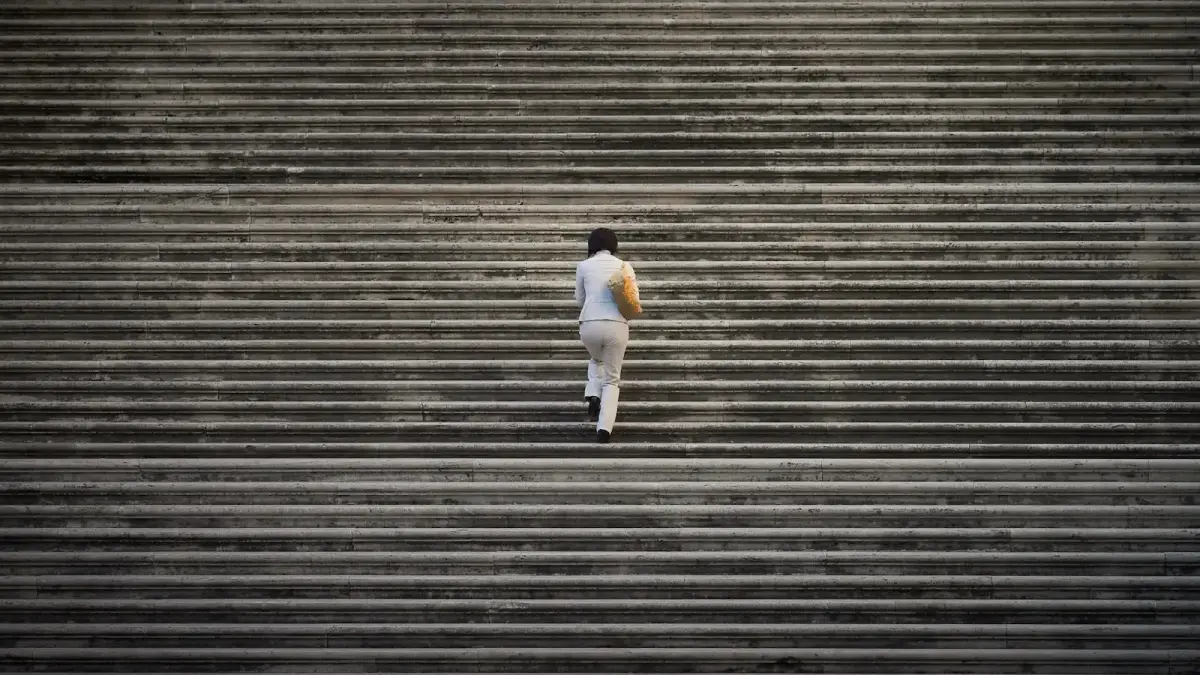
I was standing behind a woman in a parking garage last Tuesday when I heard it. Barely audible, almost swallowed by the echo of her heels on concrete. “Four. Five. Six.” She was counting the stairs. Not loudly. Not performatively. Just a quiet murmur that probably no one else noticed.
But I noticed, because I do the same thing.
I have counted stairs for as long as I can remember. Every staircase. Every building. Every set of porch steps leading to a friend’s front door. Fourteen stairs in my childhood home. Twenty-two in the science building at college. Nine from the sidewalk to my therapist’s office. I know these numbers the way I know phone numbers - they live somewhere permanent in me.
For years I assumed this was a quirk. A harmless oddity. But when I started researching how children develop coping strategies in response to uncertainty, I realized something that stopped me mid-staircase. That counting was never about math. It was about survival. A child who counts stairs is a child who needs to know how far she has left to go - because at some point, not knowing felt genuinely dangerous.
And that child? She grows up. But the counting doesn’t stop. It just changes shape.
Here are the adult behaviors that trace directly back to that quiet, stair-counting child.
1. You check how many pages are left before you can enjoy the chapter
You’re reading a book. The story is good. But every few pages, your thumb slides to the corner to check how many pages remain in the chapter. Not because you want to stop reading. Because your nervous system needs a boundary.
A 2019 study published in the Journal of Experimental Psychology found that people experience measurably less anxiety when they can see a clear endpoint to a task - even when the task itself is enjoyable. The researchers called it “completion visibility,” and they found it was especially pronounced in people who reported high childhood sensitivity to unpredictable environments.
You’re not impatient. You’re not a bad reader. You’re someone whose body learned early that open-ended experiences feel unsafe until you can see where they end.
2. You need to see the loading percentage on a download
A spinning wheel with no percentage? Intolerable. A progress bar that moves from left to right with clear increments? Almost soothing.
This isn’t about technology preferences. This is about a deep, embodied need to know how much is left. The stair-counting child didn’t just want to reach the top - she needed to know she was on step seven of twelve, because “somewhere in the middle with no idea how far” was a feeling her body had learned to reject.
As an adult, that same impulse shows up every time your computer asks you to wait without telling you how long.
3. You look at the mile marker on every highway drive
You know you’re 47 miles from your destination. Not approximately. Not “about an hour.” Forty-seven miles. You checked the GPS, you did the math, and you’ll check again in twelve minutes.
Long, unmeasured stretches of anything - highway, waiting room, afternoon - activate something restless in you. Dr. Gabor Mate has written extensively about how children who grow up in unpredictable environments develop hypervigilance as a baseline state. That hypervigilance doesn’t always look dramatic. Sometimes it looks like a person who simply cannot stop tracking where they are relative to where they need to be.
The mile marker is the adult version of the stair. It tells you: this is not infinite. This has a number. You can survive a number.
4. You count down days on a calendar like they’re oxygen
Vacation in nine days. Dentist appointment in three. Friday in two. You don’t just know what’s coming - you know exactly how far away it is, measured in precise units.
This is the stair-counter’s relationship with time. Unmarked time feels like unmarked stairs - you could be climbing forever. But a countdown gives you structure. It converts the future from a fog into a staircase with a known number of steps.
A 2021 study in Frontiers in Psychology found that children who displayed high “need for cognitive closure” - the desire for definitive answers over ambiguity - were significantly more likely to have grown up in households where routines were inconsistent or emotional availability was unpredictable. The countdown isn’t excitement. It’s architecture. You’re building walls around the unknown so it can’t sprawl.
5. You track your steps, your sleep, your water intake - and feel uneasy on days you don’t
The fitness watch isn’t a fitness tool for you. It’s a containment device. When you can see that you’ve walked 6,200 steps and slept 7 hours and 12 minutes, your body relaxes in a way that has nothing to do with health goals.
Because unmeasured days feel unfinished. They feel like staircases you climbed without counting - you got to the top, but something in your chest didn’t register the arrival.
You probably know people who forget to charge their fitness tracker and shrug it off. You are not one of those people. A day without data is a day without edges, and a day without edges is a day your nervous system doesn’t trust.
6. You need to know the exact runtime of a movie before you commit to watching it
One hour and forty-seven minutes. That’s not too long. You’ll finish by 10:15. You can handle that.
This calculation happens before you press play - not because you’re rigid, but because your brain refuses to enter an experience of unknown duration without first mapping its boundaries. The stair-counting child couldn’t start climbing without knowing there would be a top. The adult version of that child can’t start watching without knowing there will be an end.
A 2020 paper in Psychological Science explored what researchers termed “temporal anchoring” - the tendency to mentally mark the duration of an experience before engaging with it. They found it was most common in individuals who scored high on measures of intolerance of uncertainty, a trait closely linked to early childhood experiences of unpredictability.
You’re not controlling. You’re orienting. There’s an enormous difference.
7. You mentally divide long tasks into smaller numbered segments
A three-hour work block isn’t a three-hour work block. It’s six thirty-minute segments. Or twelve fifteen-minute chunks. You break it down before you begin, because a large unstructured stretch of effort makes your chest tight in a way you can’t quite explain.
This is the stair-counting impulse at its most sophisticated. You’ve learned to take any formless demand on your energy and convert it into something with steps, stages, countable units. Because a child who whispered “seven, eight, nine” on every staircase was doing the same thing - taking a physical challenge of unknown length and giving it a structure she could survive.
Susan Cain has written about how many quietly intense people develop elaborate internal systems for managing the world - not because they’re neurotic, but because their sensitivity demands it. The mental segmenting isn’t dysfunction. It’s engineering.
8. You feel a small, private relief when you reach a round number
Step 10,000. Page 100. Mile 50. The round number lands in your body like a period at the end of a sentence. You didn’t set the goal. Nobody is watching. But something in you exhales.
This relief is real and it’s neurological. The brain’s reward system responds to pattern completion, and for someone who grew up needing numbers to feel safe, reaching a clean milestone activates a sense of arrival that goes deeper than accomplishment.
It feels like reaching the top of the stairs and knowing - because you counted - that there are no more.
9. You feel genuine distress when you can’t measure your progress
This is the shadow side, and it’s worth naming honestly. When you’re in a situation with no metrics, no timeline, no clear endpoint - grief, healing, personal growth, waiting for news - something in you begins to unravel. Not dramatically. Not visibly. But internally, the absence of a number feels like the absence of ground.
Because the stair-counting child wasn’t counting for fun. She was counting because the alternative was climbing without knowing if it would ever end. And for a small body in an uncertain world, “it might never end” was the most frightening thought there was.
As an adult, you’ve gotten better at tolerating ambiguity. But you still reach for the number first.
If you recognized yourself in any of this, I want you to hear something clearly. The counting was never a problem. It was a solution. A small, brilliant, self-generated solution that a child invented to navigate a world that didn’t always tell her what was coming next.
You weren’t strange for whispering numbers on the staircase. You were resourceful. You were a tiny engineer building structure where none was offered, creating safety from raw arithmetic.
And if you still count - stairs, pages, miles, days, steps, minutes - that’s not a flaw to fix. That’s a coping strategy that worked so well your nervous system never saw a reason to let it go.
The only thing that might be worth adding, all these years later, is the knowledge that you did reach the top. Every time. Even the staircases you don’t remember counting - you made it. You always made it.
You can trust that now. Even without the number.