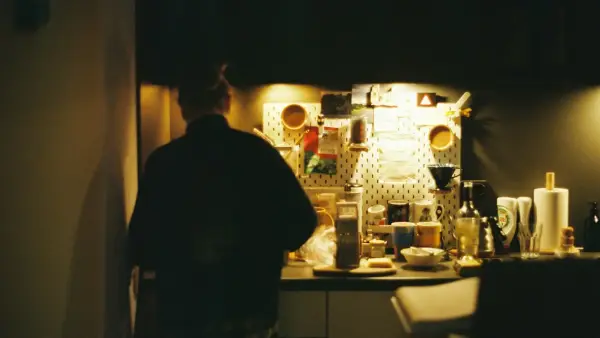
Children who always knew which parent was home by the sound of their footsteps on the stairs - who could tell from the weight of a shoe whether the evening ahead would be safe or something to brace for - often become adults who read every room by listening to how people move, because a child who learned to decode mood from the sound of approaching feet never stopped listening for what the body says before the mouth catches up

I used to lie in my bed as a kid and count the seconds between the front door opening and the first footstep on the stairs. That gap told me everything. A long pause meant coats being hung carefully, maybe a quiet evening, maybe even laughter before bed.
A short pause - door, thud, stairs - meant something else entirely.
I never told anyone I did this. I didn’t have the language for it. I just knew that by the time a parent’s shoe hit the third step, I already understood what kind of night we were going to have. Not from words. Not from faces. From sound.
If you grew up doing something like this - if you mapped the emotional weather of your household through footsteps, key drops, cabinet closings, the particular way a car door slammed in the driveway - then you already know what I’m about to say. You never stopped listening. You just got quieter about it.
And the thing no one tells you is that this skill you built in childhood - this acoustic radar for human emotion - didn’t disappear when you moved out. It followed you into every relationship, every workplace, every room you’ve ever walked into. You became someone who reads the world through sound and movement, and most people around you have no idea you’re doing it.
Here are the ways this shows up in adult life - and why it says something remarkable about who you became.
1. You can tell someone is upset before they say a single word
You hear it in the way they set their bag down. The speed of their breathing when they walk through the door. The difference between a relaxed exhale and a controlled one.
Most people wait for verbal cues. You don’t need them. A 2019 study in the journal Cognition and Emotion found that individuals who grew up in unpredictable emotional environments develop heightened sensitivity to nonverbal auditory cues - tone shifts, breathing patterns, even the rhythm of someone’s gait. Your nervous system learned to process these signals faster than language.
You’re not imagining it when you say “I knew something was wrong before they told me.” You literally did.
2. You listen to how people close doors
This one sounds strange to people who didn’t grow up this way. But you know exactly what I mean. There is a world of difference between a door that clicks shut and a door that gets pushed closed with just a little too much force.
You learned this distinction when you were small enough that a closed door was the boundary of your entire universe. The sound it made when it shut told you whether the person on the other side was calm or carrying something heavy.
As an adult, you still notice. You hear your partner close the bedroom door and you already know whether to give them space or go check in. You’re not overthinking it. You’re reading a language most people never had to learn.
3. You watch how people walk into rooms
Not what they say when they arrive. How they arrive. The speed. The posture. Whether their shoulders are high or low. Whether they make eye contact immediately or avoid it.
You scan all of this in under two seconds, usually without realizing you’re doing it. It’s automatic. It became automatic because in your childhood home, the way someone entered a room was the most reliable forecast you had for what would happen next.
Dr. Gabor Mate has written extensively about how children in emotionally volatile homes develop what he calls “attunement to threat” - a finely tuned awareness of the physical signals that precede emotional events. You didn’t choose to build this system. Your environment built it for you, and it runs in the background like software you can’t uninstall.
4. You know your partner’s mood from the sound of their car pulling into the driveway
The speed they pull in. Whether the engine cuts off sharply or idles for a moment. How quickly the car door opens and shuts. Whether there’s a pause before they come inside.
People who didn’t grow up in emotionally unpredictable homes hear a car pull in and think “oh, they’re home.” You hear a car pull in and you’ve already constructed an emotional profile of the next thirty minutes.
This is not anxiety, exactly. It’s preparedness. You learned early that the people you love don’t always announce their feelings with words. Sometimes the announcement is a key turned a little too hard in the lock. Sometimes it’s the absence of a greeting.
5. You notice micro-expressions that other people miss completely
A jaw that tightens for half a second. A smile that doesn’t quite reach the eyes. The way someone’s hand grips a coffee cup just slightly harder than necessary.
A 2021 study published in Psychological Science found that adults who experienced childhood emotional unpredictability score significantly higher on tests of micro-expression recognition. The researchers called it “perceptual vigilance” - the ability to detect fleeting emotional signals that most people filter out.
You’ve probably been told you’re “too sensitive” or that you “read too much into things.” But research keeps confirming that you’re not imagining these signals. You’re seeing things that are genuinely there. Most people just aren’t calibrated to notice them.
6. Silence makes you work harder than noise
Most people find silence peaceful. You find it informational. When a room goes quiet, you don’t relax into it - you start reading it. What kind of silence is this? Comfortable? Tense? The silence before something? The silence after something?
You learned this because in your childhood, silence was never neutral. It was either the good kind - the kind that meant everyone was okay - or the loaded kind, the kind that meant someone was building toward something. You had to learn the difference, and you learned it young.
As an adult, you can walk into a quiet office and know immediately whether people are focused or whether something just happened. You feel the texture of silence in a way that most people simply don’t.
7. You are remarkably good at reading strangers
Waiters, cashiers, people in line at the grocery store. You pick up on their energy instantly. You know when someone is having a hard day before they’ve said more than “can I help you.”
This isn’t a party trick. It’s the natural extension of a skill you built in the most high-stakes classroom available - your own home. When reading a parent’s body language correctly meant the difference between a calm evening and a difficult one, your brain allocated enormous resources to pattern recognition.
Those resources didn’t disappear when you grew up. They generalized. Now you read everyone, all the time, with a precision that occasionally startles even you.
8. You struggle to turn off the scanning
This is where it gets harder. Because this gift - and it is a gift - comes with a cost. You’re always on. Always reading. Always processing the emotional data of every person in every room.
It’s exhausting in a way that’s difficult to explain to people who don’t do it. You can’t just “relax” at a dinner party. You can’t just “not notice” that your friend’s laugh sounded forced tonight. The radar runs whether you want it to or not.
A 2020 paper in Frontiers in Psychology described this pattern as “hypervigilant empathy” - the tendency to remain in a state of heightened emotional awareness long after the original threat environment has ended. The researchers noted that this trait is strongly correlated with both emotional intelligence and emotional fatigue. You feel more, and it costs more.
9. You are the person people come to when they need to be truly seen
Here’s what’s beautiful about all of this. The same sensitivity that exhausts you is the thing that makes you irreplaceable in the lives of the people you love.
You are the friend who texts “are you okay?” before anyone else notices something is off. You are the partner who knows when to stop talking and just sit close. You are the parent - if you became one - who catches the tremor in your child’s voice that means today was harder than they’re letting on.
You didn’t learn this from a book. You learned it from lying in a dark room, listening to footsteps, trying to predict whether the night ahead would be safe. And somehow, that frightened child became an adult with an almost supernatural ability to make other people feel understood.
That’s not a flaw. That’s not damage. That is one of the most profound forms of emotional intelligence a person can develop.
You were trained by an environment that required you to listen before you could look, to feel before you could think, to know before you were told. And you carried that training into every room you’ve entered since.
The footsteps on the stairs taught you something that most people spend their whole lives trying to learn - that the body speaks first, and it almost never lies.
You didn’t just survive that classroom. You graduated from it with honors. And every person who has ever felt truly seen by you is living proof that what you learned in the dark has become something luminous.