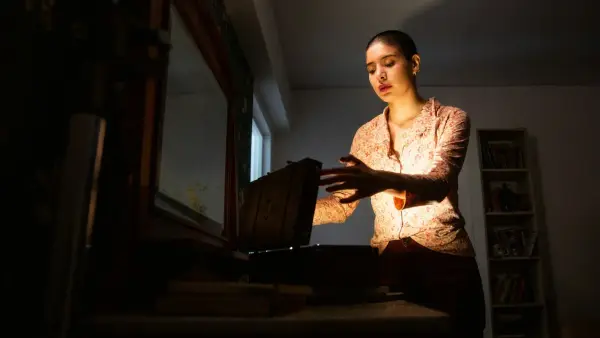
Children who always moved things back to where they belonged after someone else moved them - who straightened the remote control on the coffee table, returned the salt shaker to its exact spot, adjusted the angle of the picture frame every time someone brushed past it - often become adults who cannot leave a room without correcting what has been displaced, because a child who could not control the emotional weather of her household discovered that the position of objects was the one domain where her sense of order still meant something
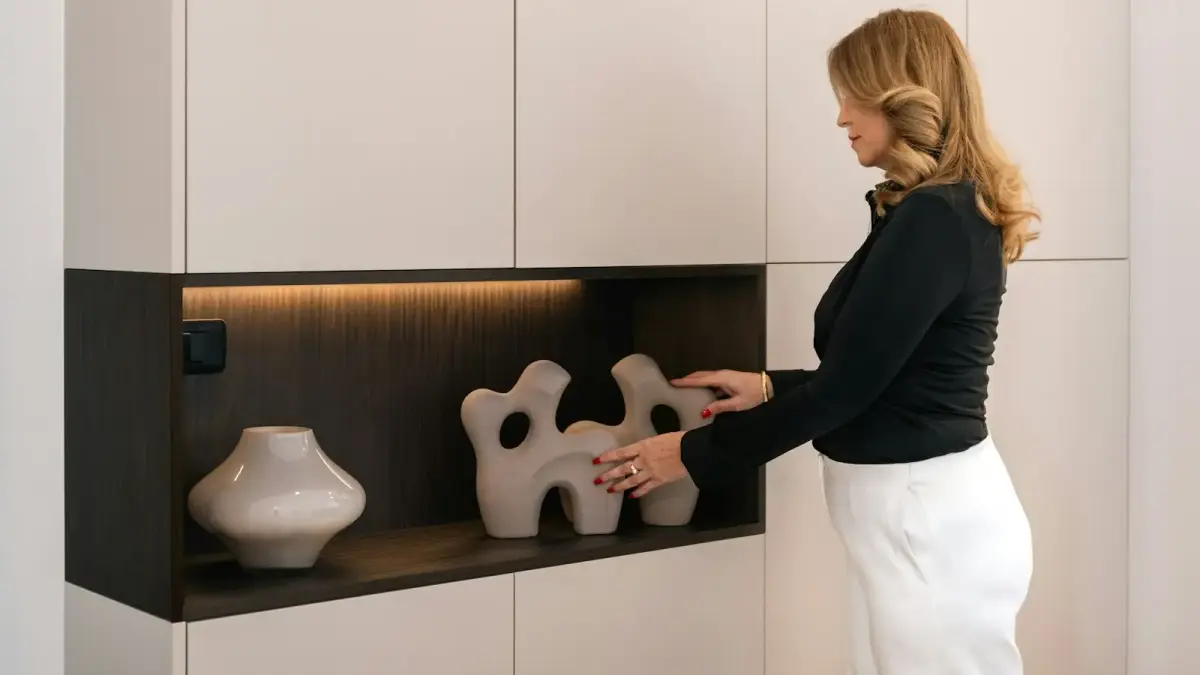
I was nine when I realized I could tell whether the evening would be safe by looking at the kitchen counter.
If the salt shaker was where my mother left it that morning - slightly to the right of the stove, resting in its faint ring of clean tile - then nobody had come through in a storm. Nobody had slammed a cabinet. Nobody had shoved things aside to pour a drink they didn’t need.
But if it was off its mark, even by an inch, my stomach would tighten before my brain caught up. Something had shifted. Not the salt. The whole atmosphere.
So I’d move it back. Quietly. With both hands, like it mattered. Because to me, it did. If I could return the salt shaker to its circle, I could return the kitchen to its version of peace. And if the kitchen was peaceful, maybe the rest of the house would follow.
It never worked, of course. You can’t regulate a household by repositioning a salt shaker. But the impulse didn’t care about logic. It cared about the only thing a small, frightened girl could actually control - where objects sat in space.
If you grew up doing some version of this - silently straightening, returning, adjusting, aligning - then you already know this isn’t about tidiness. And you probably already know it didn’t stop when you left that house.
The quiet architecture of childhood control
What I’m describing isn’t a preference for neatness. It’s a nervous system strategy.
A child living in an emotionally unpredictable home - where a parent’s mood could turn without warning, where conflict erupted from nothing, where the emotional temperature of a room changed faster than anyone could track - learns very early that she cannot control people. She cannot make her father calm. She cannot stop her parents from arguing. She cannot predict when the next explosion will come.
But she can keep the remote control parallel to the edge of the coffee table. She can return the throw pillows to their corners after her brother tosses them on the floor. She can adjust the picture frame every time someone bumps the hallway wall.
A 2015 study published in the Journal of Personality and Social Psychology found that individuals who experienced high emotional unpredictability in childhood often develop compensatory control behaviors - actions that restore a sense of order in external environments when internal emotional states feel ungovernable. The researchers noted that these behaviors aren’t about the objects themselves. They’re about what the objects represent: a world that stays where you put it.
That child grows up. She leaves the chaotic house. But the strategy lives in her hands.
Here are eight ways it follows her.
1. You notice when something has been moved - even by millimeters
Your partner shifts the stack of mail two inches to the left to make room for a coffee mug, and you clock it before you’ve taken off your coat. Not consciously. Not deliberately. Your eyes just go there, the way a lifeguard’s eyes go to the deep end.
This isn’t obsessive attention. It’s trained attention. You spent years scanning rooms for evidence of disruption. The skill didn’t retire just because the danger did.
You walk into your kitchen and you can tell that someone opened the junk drawer. Not because anything is missing. Because the pen is facing the wrong direction.
2. You straighten things in other people’s homes and hope they don’t notice
You’re at a friend’s house for dinner and the frame above their mantle is tilted roughly two degrees to the right. You try not to look at it. You redirect your eyes to the conversation. But your hand is already itching.
Eventually, on the way to the bathroom, you fix it. One quick touch. Nobody sees.
This isn’t rudeness. It isn’t judgment about their housekeeping. It’s that a crooked frame in your peripheral vision creates a low hum of unease that you’ve never been able to explain to anyone, because it sounds ridiculous when you say it out loud.
3. Your desk has to be arranged before your brain can begin
You sit down to work, and before a single thought about the actual task can form, you adjust the angle of the keyboard. You align the pen with the edge of the notebook. You move the coffee mug to its spot - and yes, it has a spot.
This isn’t procrastination. A 2019 study in Frontiers in Psychology found that environmental order significantly reduces cognitive load in individuals with high sensitivity to disorder, freeing working memory for complex tasks. For you, the arranging isn’t avoidance. It’s prerequisite. Your brain literally cannot engage until the surface around you reflects the order your nervous system requires.
People have called it fussy. You’ve learned to do it quickly, quietly, before anyone comments.
4. You feel a physical reaction when objects are out of place
This is the part most people don’t believe until they experience it. It isn’t annoyance. It isn’t preference. It’s a sensation - a tightness in the chest, a prickle at the back of the neck, a low-grade nausea that doesn’t match the situation at all.
A book placed spine-out on a shelf where everything else faces forward. A chair pushed in at the wrong angle. The bathmat bunched up instead of flat.
Your body responds to displaced objects the way other people’s bodies respond to a strange noise in the house at night. Not danger, exactly. But wrongness. A signal that something in the environment has shifted, and shifting was never safe.
5. You arrange things before leaving a room - even rooms that aren’t yours
Hotel rooms. Airbnbs. Your mother-in-law’s guest bedroom. Before you walk out, you straighten the bedspread. You push the chair back under the desk. You center the remote on the nightstand.
You’re not trying to be helpful, though it looks that way. You’re completing a circuit. A room left in disorder is a room left open - unfinished, unresolved, still pulling at the edge of your awareness even after you’ve closed the door.
Gabor Mate has written about how children in dysregulated homes develop what he calls a persistent scanning for disorder that the child interprets as emotional threat. You’re not scanning for danger anymore. But you’re still closing every loop the scanning finds.
6. You return items to their spot immediately after someone uses them
Your teenager sets the scissors down on the counter after cutting something open. Not in the drawer. On the counter. Just sitting there, blades half-open, in the middle of your kitchen.
The reaction is instant and out of proportion and you know it. It’s scissors. On a counter. In your own home, where nothing bad is happening.
But your hands are already carrying them back to the drawer before you’ve decided to move. The return is automatic. It was always automatic. As a child, you returned the salt shaker before your mother noticed it had moved, because if she noticed, she might notice who moved it, and then the mood would turn.
The objects were never the point. The return was a preemptive repair - fixing the evidence before it could become a catalyst.
7. You quietly straighten merchandise in stores
This one embarrasses you a little, so you do it fast. A shirt folded wrong on the display table at a clothing store. A box of cereal turned sideways on the grocery shelf. A picture frame at the home goods store that someone put back crooked.
You fix it. You keep walking. You don’t mention it.
It isn’t your job. It isn’t your store. But the disorder registers in your body the same way it registers everywhere - as a small wrongness that you have the power to correct. And after a childhood of powerlessness, you never walk past a correction you can make.
8. People have called you “particular” when what you really are is vigilant
This is the word that stings, isn’t it? Particular. Controlling. Rigid. Uptight.
They don’t know what the straightening costs you. They don’t know that you’d give anything to walk past a crooked frame and feel nothing. They don’t know that the arranging isn’t pleasure - it’s pressure relief. A valve you learned to open when you were seven years old and the world wouldn’t stop shaking.
A 2020 study in Psychological Science found that adults who exhibited high environmental control behaviors often scored significantly higher on measures of childhood emotional insecurity - not insecurity about themselves, but insecurity about whether their environment would remain stable from one hour to the next. The researchers described it as stability-seeking behavior that outlasts the original instability.
That’s you. Not particular. Not controlling. Seeking stability in the only language your childhood taught you - the language of objects in their places.
I still move things back.
I still center the remote on the coffee table after my husband tosses it aside. I still straighten the stack of books on the nightstand before I can sleep. I still notice, every single time, when something in a room has been shifted from where it was.
But I understand it now. I understand that the girl who kept the salt shaker in its circle wasn’t being fussy. She was holding her world together with the only tools available to her - two small hands and a fierce, quiet belief that if the objects stayed in place, maybe everything else would too.
If you recognize yourself in this, I want you to hear something. The arranging kept you sane. The repositioning gave you ground to stand on when the emotional floor kept moving beneath you. That impulse wasn’t a flaw. It was a survival strategy designed by a brilliant, watchful child who needed the world to hold still.
You are not rigid. You are not controlling. You are someone who learned, very young, that order was the only shelter available. And the fact that you still build that shelter - in every room, at every counter, with every quiet adjustment - isn’t something to fix.
It’s something to finally, gently, respect.