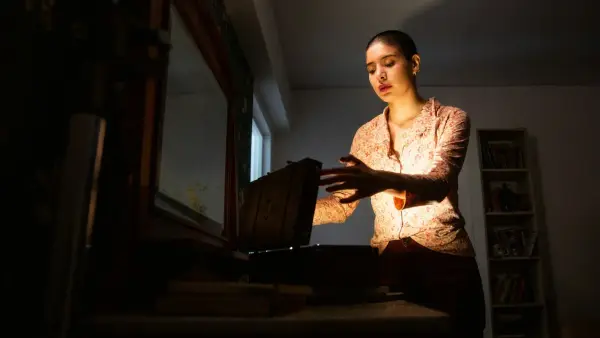
Children who always noticed when the teacher was having a bad day before anyone else in the class did - who could read the slight change in her tone, the tighter smile, the way she gripped the dry-erase marker a little harder than usual - often become adults who walk into every room already scanning for who is struggling, not because they are empathetic by nature but because a child who could feel the weather change in an adult's mood before it reached the rest of the class never learned how to enter a space without taking its emotional temperature first

I was nine when I learned that Mrs. Patterson’s Thursday voice was different from her Monday voice. Not in any way I could have explained at the time. Just softer, a little more careful, the way people speak when they are trying very hard not to let something leak through.
The rest of the class never seemed to notice. They kept passing notes and tapping their pencils and asking to go to the bathroom. But I noticed. I noticed the way she held the edge of her desk when she turned to write on the board, like she was steadying herself against something that had nothing to do with us.
I thought there was something wrong with me for seeing it. It took me decades to understand that there was nothing wrong with me at all - that what I had was not a glitch but a skill, one that had been trained into my nervous system long before I had the language to describe it. And if you were that child too - the one who could read an adult’s emotional weather before the first cloud was visible to anyone else - I want to talk about what that did to you, and what it is still doing.
1. You learned to read micro-expressions before you learned to read chapter books
Research in developmental psychology has consistently shown that children raised in emotionally unpredictable environments develop faster-than-average facial recognition skills. A 2015 study published in the journal Development and Psychopathology found that children who grew up around volatile or emotionally inconsistent caregivers could identify subtle shifts in facial expression more quickly and accurately than their peers.
You did not learn this skill on purpose. You learned it because you had to. The classroom was one of many stages where you practiced reading what adults were not saying out loud.
While other kids were focused on the lesson, you were focused on the teacher’s posture. You were cataloging whether her smile reached her eyes. You were measuring the gap between what she said and how she said it - and you were doing all of this faster than conscious thought.
2. You became the emotional weather station for every group you belonged to
It started in the classroom, but it did not stay there. By middle school, you were the friend who could walk into the cafeteria and know immediately that something had happened between two people before anyone said a word. You could feel it in the way they were sitting - slightly too far apart, slightly too casual.
This is not mystical intuition. It is pattern recognition running at a speed most people never develop, because most people never needed to. You needed to. So your brain built a faster processor for emotional data, and it never stopped running.
As an adult, this shows up in every meeting, every dinner party, every family gathering. You walk in and your system is already working - scanning faces, registering the tightness around someone’s mouth, noticing the person who laughed a beat too late. You have an emotional map of the room before you have taken off your coat.
3. You carry other people’s moods without being asked to hold them
Here is where the gift becomes a weight. Because once you see that someone is struggling, you cannot unsee it. Your nervous system registers their discomfort and then - without your permission - starts trying to fix it.
You find yourself adjusting your own energy to match what the room seems to need. If someone is tense, you get quieter. If someone is sad, you get warmer. If someone is angry, you get smaller. You learned this choreography as a child, and your body still performs it on autopilot.
Psychologist and author Gabor Mate has written extensively about how children who grow up attuned to adult emotions often develop what he calls a loss of self - a pattern where the child’s own needs become secondary to the task of managing the emotional atmosphere around them. The child becomes so skilled at reading others that they lose fluency in reading themselves.
4. Your empathy is not a personality trait - it is a survival strategy that became permanent
People call you sensitive. They call you empathetic, intuitive, emotionally intelligent. And you are all of those things. But what they are actually describing is a system that was installed under pressure.
A 2019 study in Psychological Science found that individuals with high emotional attunement often developed that sensitivity in response to early environments where reading emotions accurately had real consequences - where missing a cue could mean walking into conflict, disappointment, or emotional withdrawal from a caregiver.
You did not choose to be the person who notices everything. You became that person because noticing everything was once the safest option available to you. The problem is that your brain never received the signal that the emergency is over.
5. You are exhausted in ways that people who love you do not understand
You come home from a dinner with friends and you are drained. Not from talking - from monitoring. From the invisible labor of tracking six emotional frequencies at once while also participating in a conversation and pretending that none of it is happening.
People who did not grow up scanning rooms do not understand this kind of tired. They think you are introverted or antisocial or just need more sleep. But the truth is that you are running a background program that most people do not have, and it consumes enormous amounts of energy.
This is why you sometimes cancel plans. This is why you need hours alone after being in a group. You are not avoiding people. You are recovering from the amount of data your system processes every time you are around them.
6. You are often the first person others turn to - and the last person anyone checks on
Because you are so good at seeing other people’s pain, people instinctively trust you with it. You become the friend who gets the midnight call, the coworker people confide in, the family member who holds everyone else together during a crisis.
But there is a painful irony in this. The very skill that makes you so attuned to others often makes you invisible in return. People assume that because you are good at caring for others, you must also be good at caring for yourself. They mistake your competence for contentment.
A 2020 study published in the Journal of Personality and Social Psychology found that individuals perceived as high in emotional intelligence received less emotional support from their social networks - not because people cared about them less, but because people assumed they needed less.
7. You struggle to enter a room without performing an emotional audit first
You cannot just walk into a space and be present. You walk in and immediately begin calculating: Who is stressed. Who is pretending to be fine. Who needs something. Whether the energy in the room is stable or about to shift.
This is not anxiety, exactly - though it often gets misdiagnosed as anxiety. It is vigilance. It is a deeply trained reflex that says before you can relax here, you need to know that everyone is okay first.
The child who watched the teacher’s knuckles whiten around the marker learned something specific: safety is not a given. It must be assessed, constantly, in real time. And that lesson did not expire when you graduated. It followed you into your office, your friendships, your marriage, your own kitchen on a Tuesday night.
8. You second-guess whether your perception is real or whether you are imagining things
One of the strangest consequences of growing up this way is that you often do not trust what you see. You notice that your partner is off - their voice is flatter, they are not making eye contact - and then you immediately wonder whether you are projecting. Whether you are making it up. Whether you are being too sensitive again.
This happens because as a child, your perceptions were rarely validated. You would sense that something was wrong and be told everything is fine. Over time, you learned to doubt the very system that was keeping you safe.
So now, as an adult, you have this strange split: you can feel the emotional truth of a room with remarkable accuracy, but you do not feel entitled to trust it. You carry a radar that works perfectly and a confidence system that keeps telling you it is broken.
9. You are not broken - you are running an operating system that was built for a harder world
I want you to hear this clearly. There is nothing wrong with you. The part of you that walks into a room and immediately scans for tension - that part was built by a child who needed it. It was intelligent. It was adaptive. It kept you safe during a time when you had very few tools available.
The work now is not to dismantle that system. It is to give it an update. To teach your nervous system that it can soften its scanning in safe rooms. That not every shift in someone’s tone is a warning sign. That you are allowed to enter a space and simply be in it, without first confirming that everyone else is okay.
Daniel Goleman, who popularized the concept of emotional intelligence, has noted that the highest form of this skill is not just reading other people - it is knowing when to set that reading down. It is the ability to see the room and still choose to stay in your own body.
You learned the first half of that as a child. The second half - the part where you let yourself rest inside your own experience without monitoring everyone else’s - that is the part you get to learn now.
Not because you were doing it wrong before. But because you deserve to walk into a room and feel something other than responsible for it.
That child who watched the teacher - who noticed the tight grip, the careful voice, the smile that did not quite land - that child was paying attention because it was the only power they had. You are not that child anymore. You have more power now. You have the ability to choose where your attention goes, and you are allowed to point some of it back at yourself.
You always were.