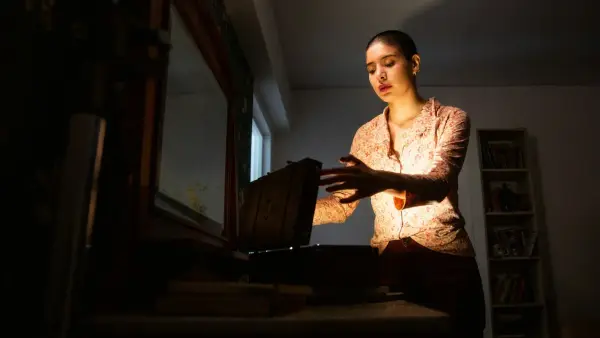
Psychology says the person everyone describes as 'the best listener I know' - who asks the follow-up question nobody else thinks to ask, who remembers what you said three months ago and brings it up at precisely the right moment, who can sit across from you at dinner for three hours and leave you feeling completely seen while revealing almost nothing about her own life - is not generous or naturally curious but someone who learned before the age of ten that the safest way to exist in a room full of people was to make the room about everyone else, because a girl whose visibility once cost her something she could not afford to lose again discovered that listening was the most elegant form of hiding ever invented

I have a friend who knows the name of my childhood dog, the exact month my parents separated, and the thing my ex-husband said on the night I finally asked him to leave.
She remembers the book I mentioned wanting to read in February. She brings up the promotion I was nervous about three weeks after I stopped talking about it - not because I resolved anything, but because I stopped wanting to seem anxious. She noticed that too.
Everyone in our circle calls her the most caring person they know. The one who really listens. The one who makes you feel like you’re the only person in the room.
Last year, at her birthday dinner, I looked around the table at seven women who adore her and realized something that unsettled me for weeks. I could not name her favorite song. I did not know what she was afraid of. I had no idea what kept her awake at three in the morning, or whether anything did, or whether she slept fine and I had simply never thought to wonder.
Seven women who would describe her as their closest friend. Not one of us had ever actually met her.
The Room Was Never Safe Enough to Be Seen In
This pattern does not begin in adulthood. It does not start the first time someone says “you’re such a good listener” and she feels the quiet rush of being valued for something that costs her everything and looks like nothing.
It starts much earlier. It starts in a kitchen, a living room, a childhood bedroom where the walls were thin enough to hear what happened when someone took up too much space.
A 2019 study published in the Journal of Research in Personality found that individuals with high self-concealment tendencies - the chronic withholding of personal information perceived as distressing or negative - frequently trace the origin of those patterns to early childhood environments where emotional visibility was punished or unsafe. The researchers noted that self-concealment is not the absence of a desire for connection. It is the presence of a learned belief that connection and safety are mutually exclusive.
She learned this before she had language for it. A girl in a home where being noticed meant being corrected. Where having needs was inconvenient. Where expressing a preference - about dinner, about the TV channel, about how she wanted to spend a Saturday - was met with irritation or, worse, a kind of focused attention that felt nothing like love.
She did not decide to become invisible. She discovered that invisibility was the only place nothing bad happened.
Questions as Camouflage
The mechanism she developed was brilliant in its simplicity. She learned that a well-timed question could redirect any conversation away from herself. That remembering a small detail about someone else’s life - their daughter’s recital, their sister’s surgery, their worry about the mortgage - created a kind of warmth that looked exactly like intimacy but flowed in only one direction.
She became fluent in the language of other people’s interiors while keeping her own locked in a room nobody knew existed.
This is not generosity. This is architecture. She built a social identity around attentiveness because attentiveness is the one trait nobody interrogates. Nobody pulls you aside and says, “I’m worried about you - you listen too well.” Nobody stages an intervention for someone who remembers birthdays.
The performance is so convincing that she sometimes forgets it is one. She has spent so many years studying other people’s emotional weather that she can feel genuinely interested, genuinely curious, genuinely moved by a friend’s story - and still reveal nothing of herself in the process.
Daniel Goleman wrote about emotional intelligence as the capacity to understand and manage both your own emotions and the emotions of others. But there is a version of emotional intelligence that develops lopsided - exquisitely attuned to everyone else, almost completely disconnected from the self. She can read a room in seconds. She cannot tell you what she actually wants from her own life.
The Loneliness Behind the Performance
Here is what nobody talks about. The person everyone turns to is often the person nobody turns toward.
She sits at the center of every gathering and feels peripheral to all of them. Her phone is full of messages from people who trust her with their deepest fears. Her own fears live in a silence she has maintained so long it has become structural.
A 2021 study in Psychological Science examined the relationship between self-concealment and perceived social support. The findings were striking. Individuals who scored highest on self-concealment measures reported having large social networks and being described by others as empathetic and supportive. They also reported the highest levels of loneliness. Not isolation - loneliness. The distinction matters. They were surrounded by people who loved them. They were known by none of them.
She has built a form of intimacy that runs entirely on the other person’s vulnerability. And because she never asks for anything, never burdens anyone, never shows up at a friend’s door at midnight in tears - she is celebrated for her strength. Her independence. Her emotional maturity.
What looks like maturity is often just a very old fear wearing a very good disguise.
She is not strong. She is vigilant. There is a difference she has never let anyone close enough to see.
The Cost of Never Being Found
The body keeps the score of this, even when the mind has filed it away as personality.
She is tired in a way that sleep does not fix. The exhaustion of tracking every conversation, remembering every detail, performing the role of the person who is fully present while being fundamentally absent - it accumulates. Not as burnout, exactly. As a kind of hollowness.
She can sit with a friend who is crying and hold space with a steadiness that looks almost sacred. She cannot cry in front of anyone. Not because she does not feel it, but because the vulnerability required to be witnessed in pain is the exact vulnerability she eliminated from her life at age seven.
The attachment research calls this dismissive-avoidant. The person who learned that closeness is dangerous, that dependency is weakness, that the safest way to love someone is to need nothing from them. Psychologist Amir Levine, in his work on attachment styles, describes how avoidant individuals often appear highly functional and emotionally composed on the surface while maintaining rigid internal boundaries that prevent genuine emotional exchange.
Her listening is not a bridge. It is a moat.
She Was Never Hiding From You
Here is where the reframe lives, and I want to be gentle with it because this one touches something raw.
If you are this person - if you just read four sections about yourself and felt your chest tighten in a way you would never mention to anyone - I need you to hear something.
You were not born this way. You were not born withholding or distant or “hard to get to know.” You were a child who figured out, with remarkable intelligence, that the spotlight in your house was not a safe place to stand. And you did the only thing a child can do with that information. You stepped out of it.
The listening, the remembering, the asking - all of it was survival. Every follow-up question you have ever asked was a small act of self-preservation disguised as kindness. And it worked. It kept you safe when safety was the only thing that mattered.
But you are not in that house anymore.
The room you are sitting in now - with your friends, your partner, the people who have been telling you for years that they wish you would open up more - that room is not the one you learned to disappear in. The people in it are not the ones who made visibility dangerous.
You Can Be Found Without Being Lost
Letting people in does not have to look like a flood. It does not have to mean telling your whole story in one evening or falling apart in someone’s arms. It can be as small as answering honestly when someone asks how you are. Not the curated answer. Not “I’m good, but tell me about you.” The real one.
It can be mentioning that you are tired. That something is bothering you. That you read something last week that made you cry and you are not sure why.
You have spent years making everyone else feel safe enough to be seen. You deserve the same thing. Not because you earned it through all that listening - you were never earning anything, even though it felt like it - but because being known is not a reward. It is a need. One you have been meeting for everyone except yourself.
Your listening was never the problem. Your listening is beautiful. It is a skill born from pain, refined by years of practice, and genuinely valuable to the people around you.
The only thing that needs to change is the belief underneath it. The old, quiet, bone-deep belief that if people saw what was behind the questions, they would not stay.
They will stay.
They have been waiting to meet you.