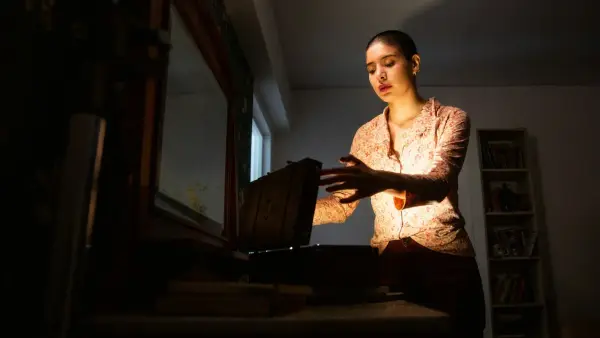
Psychology says the person who always makes something for the people she loves instead of saying the words out loud - who bakes the cake from scratch instead of buying one, who spends three weeks choosing the perfect gift instead of writing I miss you in a text, who has expressed every tender feeling through her hands rather than her mouth for as long as she can remember - is not emotionally guarded or avoidant but someone who learned as a child that the safest container for love was something she could build with her hands, because a girl whose spoken affection was once met with something she could not take back discovered that what you make for someone travels more safely than what you say
She Never Said It Out Loud
I watched my mother wrap a gift once when I was nine years old.
She had been working on it for hours. A scarf she had knitted for her sister’s birthday, folded into tissue paper she had driven to three stores to find.
She tucked a small card inside - not a long letter, just her sister’s name and a tiny heart drawn in blue ink. Then she sealed the box shut and held it in her lap for a moment, like she was saying goodbye to something.
I never once heard my mother tell her sister she loved her. Not on the phone, not at holidays, not even at their own mother’s funeral. But I watched her spend eleven evenings knitting that scarf in a shade of green she knew her sister had admired in a shop window two years earlier.
I did not understand it then. I thought it was just how she was - quiet, practical, someone who showed up with food instead of words.
It took me twenty years and a developmental psychology degree to understand what I had actually witnessed. My mother was not withholding affection. She was delivering it in the only container she had ever trusted not to shatter on arrival.
The Childhood Where Words Became Dangerous
There is a particular kind of home where love is not absent but where the spoken version of it becomes unreliable.
Maybe you told your mother you loved her and she said “don’t be dramatic.” Maybe you drew a picture for your father and he smiled, but when you said “I made it because I love you,” the room changed temperature. Maybe you learned that saying the tender thing out loud invited a response you could not control - indifference, mockery, a sudden shift in mood that taught you the words themselves were the problem.
A 2016 study published in the Journal of Personality and Social Psychology found that children who experienced inconsistent emotional responses from caregivers often develop what researchers call “affect channeling” - the redirection of emotional expression into safer modalities. The child does not stop feeling. She stops using the channel that burned her.
And here is where it gets specific. The child who learns that spoken affection is unsafe does not just go silent. She invents a new language.
She discovers, usually between the ages of six and ten, that an object can carry a feeling across a room without requiring her to stand there while it lands.
A drawing slid under a closed door. A card left on a pillow. A plate of food arranged just so and placed on the table before anyone else wakes up.
The object travels for her. It says what she means. And most importantly, it does not need her to be present for the moment of reception - that terrifying instant when the other person’s face reveals whether the love was welcome.
What Everyone Sees and What They Miss
The adult version of this child is everywhere, and she is almost always misread.
She is the woman who bakes birthday cakes from scratch when a store-bought one would be perfectly fine. She wraps gifts in paper she chose specifically for the recipient - not generic holiday wrapping, but a pattern she saw and thought of you.
She knits scarves. She assembles photo albums. She cooks elaborate meals for people she loves, not because she enjoys the labor but because the labor is the point.
Everyone around her calls this “thoughtful.” They say she has “a gift for giving.” They describe her as creative, generous, meticulous.
What they are actually witnessing is a woman who discovered, at seven or eight years old, that her hands could carry what her voice could not.
This is the part that breaks my heart a little, because I have studied it and I have lived it. The people closest to these women often have no idea what they are receiving.
They see the cake. They eat it. They say thank you.
They do not understand that the fourteen hours she spent in the kitchen - choosing the recipe, adjusting the frosting twice, driving to a specialty store for the vanilla extract she remembered you mentioning once - was not cooking.
It was a love letter she wrote with butter and flour because the spoken version still catches in her throat.
The Science of Making as Emotional Expression
Gary Chapman’s love languages framework, while popular, actually understates what is happening here. Chapman categorized “acts of service” and “gift giving” as separate love languages, but research has since revealed something more layered.
A 2019 study in Frontiers in Psychology on embodied emotional cognition found that tactile, hands-on creation activates neural pathways associated with emotional regulation and attachment bonding simultaneously. When someone makes something by hand for a person they love, the brain processes the act not as task completion but as relational communication - the same neural signature as sustained eye contact or physical touch.
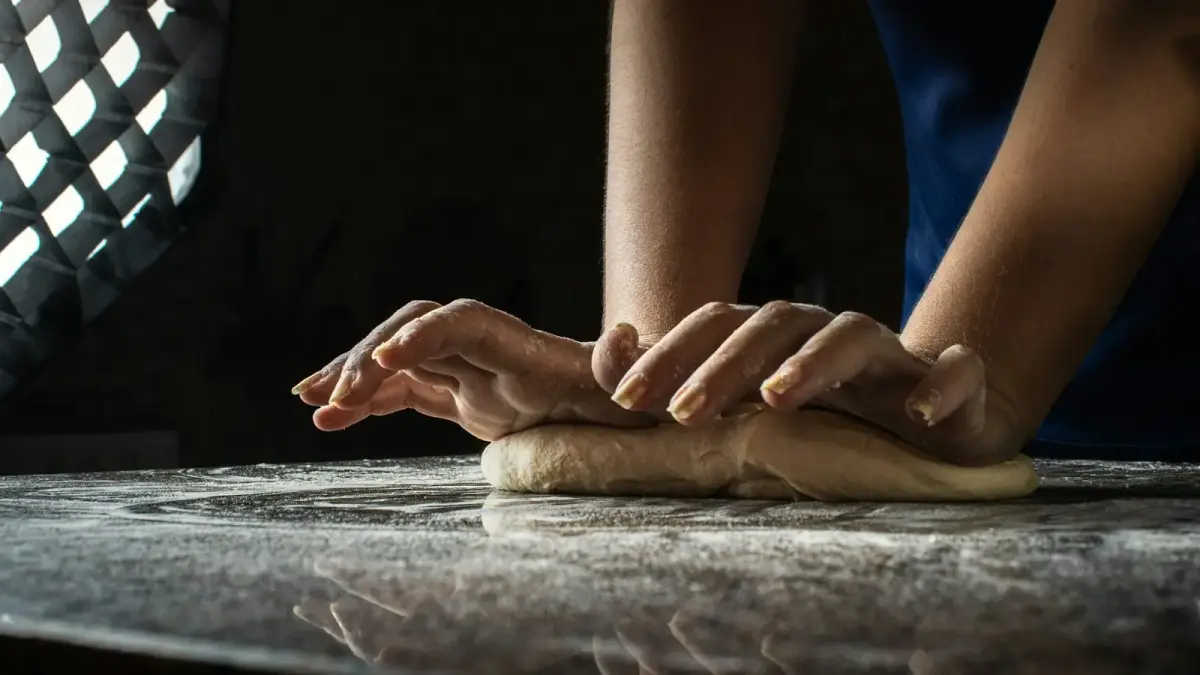
In other words, the woman kneading bread dough at six in the morning before her family wakes up is not performing a domestic task. Her nervous system is engaged in the same process it would use if she were holding someone’s hand.
She is connecting. She is just doing it through a medium that feels survivable.
Dr. Gabor Mate has written extensively about how children who grow up in emotionally unpredictable environments develop creative adaptations - not pathologies.
The child who channels love into objects she can build is not avoiding intimacy. She is practicing it in the only register where she learned it would be received without incident.
This distinction matters enormously.
The Moment She Learned to Build Instead of Speak
If you are this woman, you probably remember the moment. Or rather, you remember the feeling of the moment, even if the details have gone soft.
You said something tender to someone who was supposed to hold it carefully. And they did not.
Maybe they laughed. Maybe they looked away. Maybe they said something back that was small and sharp and lodged itself somewhere beneath your ribs where it still sits, decades later, whenever you open your mouth to say the vulnerable thing.
And then - maybe that same week, maybe that same year - you made something. A card, a drawing, a meal.
And you offered it instead. The person received it warmly. They did not mock or dismiss or look through you.
Your nervous system took notes.
It filed away a simple equation: what you build with your hands arrives safely. What you say with your mouth might not. From that point on, every birthday cake, every hand-wrapped gift, every carefully chosen present became your vocabulary.
You were not becoming guarded. You were becoming fluent in a language you could trust.
Why This Is Not Avoidance
Here is where I want to push back against the easy clinical read, because I have seen it applied too carelessly.
A 2021 study published in the Journal of Research in Personality examined the relationship between handmade gift-giving and attachment style. The researchers expected to find that people who preferred making gifts over verbal expressions of love would score high on avoidant attachment. They did not.
Instead, they found that consistent makers - people who habitually expressed love through created objects - scored highest on a measure the researchers called “protected secure attachment.” These individuals were deeply bonded to the people they loved.
They thought about their loved ones constantly. They demonstrated extraordinary attentiveness to the preferences, memories, and emotional needs of others.
They simply delivered all of this through a channel that did not require them to stand exposed while the love was being received.
This is not avoidance. This is one of the most sophisticated emotional strategies a person can develop.
The woman who spends three weeks choosing your gift is not hiding behind it. She is putting the most vulnerable part of herself into an object that can cross the room without her having to watch your face as you receive it.
She is not afraid of love. She is afraid of the moment between offering it and knowing whether it landed.
The object solves that problem. It carries her tenderness across the distance she needs in order to feel safe.
The Handmade Thing Was Never a Substitute
I think the hardest part for these women - for us, if I am being honest - is the quiet worry that what we offer is not enough. That a cake is not the same as saying it. That a carefully chosen gift is a lesser version of the three words spoken plainly.
But I want you to hear this if it is your story.
The cake you baked at midnight, the one where you adjusted the recipe three times because you remembered she does not like things too sweet. The gift you wrapped in paper that took you forty minutes to choose. The scarf you knitted on the couch after everyone went to sleep, in the color you remembered him wearing the day he looked happiest.
That was not a substitute for “I love you.”
That was “I love you,” spoken in a language you invented because the original one was not safe. And inventing an entire language to carry a feeling you were once punished for expressing - that is not avoidance or guardedness or emotional limitation.
That is one of the bravest things a person can do.
You learned young that your words could be turned against you. So you put your love into objects that could not be thrown back.
You discovered that what you make with your hands travels more gently than what you say with your mouth. And you have been speaking this way ever since - fluently, beautifully, in a dialect most people do not even recognize as language.
But it is. And the people who receive what you make for them are holding something far more intimate than they know.
They are holding the words you never learned to say out loud, shaped into something you could trust to carry them safely across the room.