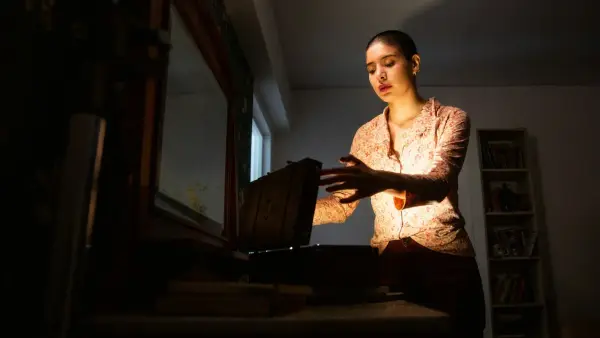
Children who were always the one sent to check on the parent who had gone quiet - who knocked on the bedroom door at nine years old and brought the glass of water nobody asked for - often become adults who cannot walk past a closed door without listening for distress on the other side, because a child appointed as the household's emotional paramedic never found the moment when the shift ended
I was nine the first time I brought my mother a glass of water she hadn’t asked for.
She had been in her room for two hours. The house was quiet in the wrong way - not peaceful, but held. My father was watching television with the volume low, which meant he knew something was happening but had decided not to be the one who walked down the hallway. My older brother was outside. And I was standing in the kitchen, filling a glass from the tap, because somebody needed to knock on that door and I had already understood - at nine - that the somebody was going to be me.
I didn’t have words for what I was doing. I didn’t know the term “parentification” or understand that I was performing a role reversal that developmental psychologists would later describe as one of the most quietly damaging patterns a family can produce. I just knew the house felt wrong, and that the wrongness would continue until someone small and unthreatening appeared at the edge of her bed and said the thing that needed saying.
Are you okay?
I have spent the last fifteen years studying what happens to children like me - children who were recruited into emotional labor before they could spell the word “emotion.” What I have found is that we do not outgrow the role. We refine it. We carry it into friendships, marriages, workplaces, and parenting with an efficiency that looks like empathy but feels, from the inside, like a fire alarm that never stops ringing.
Here are seven ways this pattern follows us.
1. They scan every room for the person who has gone quiet
Walk into a dinner party with one of these adults, and within ninety seconds they will have identified who is having a bad night. Not the person being loud about their problems. The quiet one. The one smiling a half-second too late, or checking their phone with a certain kind of focus, or positioned slightly outside the circle of conversation.
This is not a party trick. It is surveillance equipment installed in childhood and never decommissioned.
A 2004 study published in the Journal of Family Psychology found that children who assumed caregiving roles for emotionally distressed parents developed heightened sensitivity to nonverbal cues - micro-expressions, postural shifts, changes in vocal tone - that persisted well into adulthood. The researchers called it “precocious empathy.” The children might have called it the only way they knew how to keep the house from falling apart.
2. They cannot hear a door close without tracking what happened before it closed
A partner walks into the bedroom and shuts the door. That’s it. That’s the entire event. But for someone who spent their childhood monitoring closed doors for emotional emergencies, a shut door is never neutral. It is a data point. It requires interpretation.
Was the conversation tense before they left? Did their voice drop? Were they quieter than usual at dinner?
These adults will tell you they are not anxious. They will tell you they are fine. And they are, technically, fine - in the way that someone standing next to a fire extinguisher at all times is technically relaxed. The readiness never leaves. The closed door is never just a closed door. It is the opening scene of a story they have been trained since childhood to finish.
3. They apologize for emotional weather they did not create
Someone at work is frustrated about a deadline. It has nothing to do with them. They know this intellectually. And still, somewhere beneath the knowing, there is a small voice asking what they could have done to prevent it.
This is the signature of a child who was made responsible for a parent’s emotional state. When a nine-year-old learns that their mother’s sadness is something they are expected to manage, the lesson is not about empathy. The lesson is about jurisdiction. The child absorbs a belief that they are somehow responsible for the interior lives of the people around them - not because anyone said it out loud, but because the household operated as though it were true.
In adulthood, this looks like apologizing when a friend cancels plans. Apologizing when a partner has a hard day. Apologizing for rain.
4. They become the first responder to every emotional emergency in their adult relationships
When someone in their life is in crisis, these are the adults who show up. Every time. Without being asked. They bring the food. They make the calls. They sit in the hospital waiting room. They hold the crying friend at 2 a.m.
And if you told them this was extraordinary, they would look confused. Because to them, this is not generosity. This is simply what you do when someone is hurting. The idea of hearing that someone they love is struggling and choosing not to act feels physically impossible - like being told to hold their breath underwater and just relax.
Gregory Jurkovic, whose research on parentification at Georgia State University remains some of the most cited work in the field, described this pattern as “destructive parentification” - not because the child’s caregiving was harmful in itself, but because it was compulsory, unreciprocated, and invisible. The child never chose the role. The role chose the child. And the child became so competent at it that no one ever thought to relieve them of duty.
5. They feel responsible for the emotional temperature of every space they enter
A meeting goes quiet after someone makes an awkward comment. Most people feel the discomfort and wait for it to pass. These adults feel the discomfort and believe it is theirs to fix. They will crack a joke, redirect the conversation, smooth the tension - not because they want attention, but because an unmanaged silence feels dangerous.
This is the architecture of a childhood spent reading rooms. When you grow up in a household where silence meant someone was about to break, you learn to treat silence as a threat. You learn to fill it before it fills itself.
The tragedy is that this skill is genuinely useful. These are the people everyone wants at their dinner table, on their team, in their corner. They are warm and attuned and effortlessly good at making other people feel comfortable. But what looks like social grace is often a stress response wearing a pleasant expression.
6. They struggle to distinguish between love and being needed
This is the one that takes the longest to see.
When you spend your childhood being needed - when your value in the family was directly tied to your ability to sense and soothe another person’s pain - you learn to read “being needed” as love. The two feelings merge. They become indistinguishable.
A 2019 study in Developmental Psychology examined adults who had served as emotional caregivers for their parents during childhood. The researchers found that these individuals were significantly more likely to select romantic partners who required emotional caretaking - not because they were drawn to dysfunction, but because the dynamic felt familiar. It felt like home. It felt, in a very literal sense, like being loved.
Unlearning this takes years. It requires sitting with a terrifying question: if I am not needed, am I still wanted? For someone whose entire childhood taught them that those two things were the same, the question can feel like standing at the edge of a cliff.
7. They do not know how to rest when everyone around them is fine
This is perhaps the most telling sign of all. These are adults who can handle a crisis with stunning composure - who are calm and clear and effective when everything is falling apart - and then fall to pieces on a Tuesday afternoon when nothing is wrong.
Because their nervous system was calibrated in childhood to operate at high alert, the absence of a problem does not feel like peace. It feels like the moment before the problem arrives. The quiet is not comforting. The quiet is suspicious.
They will fill the space. They will find something to worry about, someone to check on, a text to send. Not because they are anxious by nature, but because the child who was trained to be the household’s emotional paramedic never received the one thing they needed most - a clear signal that the shift was over. That someone else was on call now. That they could put the glass of water down and go play.
That signal never came.
If you recognized yourself in any of this, I want to tell you something that took me years of studying this pattern to fully understand.
What you have is not a disorder. It is not codependency, though it can look like it from the outside. It is not people-pleasing, though that label gets applied to it constantly. What you have is a set of skills - real, sophisticated, hard-won skills - that were built by a child under conditions no child should have had to navigate.
You learned to read a room before you learned to read a chapter book. You learned to hold space for someone else’s pain before anyone held space for yours. You became competent at emotional caregiving at an age when your biggest responsibility should have been remembering your lunchbox.
That competence is real. It is yours. And it does not have to run your life.
The shift can end. Not all at once, and not without grief for the child who never got to put the glass down. But it can end. You are allowed to hear a closed door and let it be a closed door. You are allowed to sit in a quiet room and let the quiet be peace.
You were never broken. You were a child who was asked to carry something enormous, and you carried it beautifully. The fact that you are still carrying it does not mean you have to. It just means no one ever told you that you could stop.
I am telling you now.