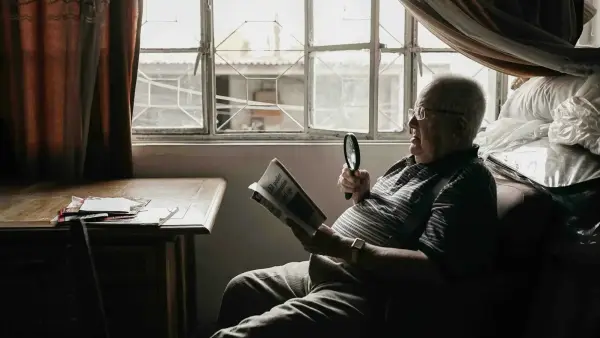
Children who always watched the weather forecast with their father - not because they cared about rain but because those five minutes when he stood still with a coffee mug in his hand were the only moments of the day when they could sit beside him without needing a reason - often become adults who check the weather every morning as a ritual of proximity they never named

I still check the weather every morning. Not a quick glance at the notification on my phone - a full, deliberate ritual. Coffee in hand, standing in the kitchen, scrolling through the hourly forecast with the kind of focused attention you’d give something that actually determined the shape of your day.
The weather has never once determined the shape of my day.
But for years I couldn’t figure out why it mattered so much to me. Why skipping it felt wrong, like forgetting to lock the front door. Like leaving something important unfinished.
Then one afternoon, visiting my parents, I watched my father do exactly what he’d done every evening of my childhood. He walked in from the garage, set his coffee on the counter, and stood in front of the television for the 6 o’clock forecast. He didn’t sit down. He just stood there, still, for about five minutes.
And I felt my whole body relax.
Not because of the weather. Because that stillness - his body not going anywhere, not reaching for his keys or checking his phone or heading toward the next task on his invisible list - was the closest thing to emotional availability I had access to as a child. Those five minutes were the window.
The only window where sitting near him didn’t require an excuse.
I wasn’t watching the weather all those years. I was watching him be reachable. And when I check the forecast now, alone in my kitchen at forty-one years old, some part of me is still sitting cross-legged on that living room carpet, pretending to care about whether Thursday would bring rain.
If this sounds familiar to you - if you have routines that feel strangely sacred but would look completely meaningless to anyone else - you might be carrying a proximity ritual from childhood. One your body remembers even if your mind never gave it a name.
1. You have daily routines that feel emotionally necessary but logically unnecessary
Maybe it’s the weather. Maybe it’s checking sports scores for a team you don’t genuinely follow, or watching the evening news even though you already read every headline online three hours ago. The content doesn’t matter. The ritual does.
Children who learned to time their proximity around a parent’s habits develop a deep attachment to the routine itself. The habit becomes a container for the feeling of closeness, long after the original person has left the room - or left the house, or left this life entirely.
A 2003 study from the Boston Change Process Study Group, published in the International Journal of Psychoanalysis, described something called “implicit relational knowing” - the ways we learn to be with other people that never become conscious or verbal. These knowing patterns are stored in the body, not in the thinking mind. You don’t decide to perform them.
You just do them, every single morning, like clockwork. And if someone asked you why, you’d probably say something about wanting to know if you need an umbrella.
2. You feel most connected to people during mundane shared activities, not deep conversations
Some people feel closest during long, searching talks at the kitchen table. You feel closest during the car ride to the hardware store, or sitting in the same room reading different books, or watching someone cook while you lean against the counter not saying much of anything.
This isn’t a limitation. It’s a blueprint your childhood wrote.
Developmental psychologists have a term for this: parallel play. It usually describes toddlers playing side by side without interacting. But for children whose parents were physically present yet emotionally just out of reach, parallel existence becomes the primary language of love. You learned that closeness doesn’t require conversation. It requires only two bodies, occupying the same space, with neither one about to leave.
If your earliest template for intimacy was standing next to someone during a weather forecast, then your nervous system built its entire definition of love around quiet co-existence. That’s not a wound. That’s an adaptation so intelligent you didn’t even know you were making it.
3. You struggle to ask for closeness directly
Here’s what a child learns when the only available intimacy is accidental: you learn to never ask for it on purpose.
You learn to appear in the room casually. To engineer proximity without naming it. To sit on the couch because someone else is already there - not because you said “I need to be near you right now” but because you happened to feel like reading in that exact spot at that exact moment.
Research on attachment and emotional communication, including work by psychologist Ed Tronick at the University of Massachusetts, has shown that children adapt their proximity-seeking behavior to match what their caregivers can tolerate. If a parent becomes overwhelmed by direct emotional bids - a child running up and saying “hold me,” a child crying for attention - the child learns to make the bid indirect instead. Quieter. Deniable.
And those indirect strategies don’t disappear in adulthood. They just become so woven into who you are that you forget they’re strategies at all. You think you’re just someone who likes being in the same room. You don’t realize you trained yourself to want only what was safely available.
4. You confuse physical presence with emotional availability
Your father was there. He was in the house every evening. He was in the room.
But there’s a vast difference between a person being physically present and being emotionally reachable, and children who grow up with parents who are around but not truly available often struggle to tell those two things apart. They never had the chance to experience them as separate.
This can show up in adult relationships as a quiet frustration you can’t quite put into words. Your partner is sitting right next to you on the couch, but something essential feels missing. Or you feel an unexpected wave of comfort when someone simply stays in a room with you - not talking, not looking at you, not engaging, just staying - because that motionless presence was the ceiling of closeness you were offered as a child.
Your body still reads it as enough. Even when a deeper part of you suspects it isn’t.
5. You have strong emotional responses to the concept of stillness
When someone you love is rushing around the house - grabbing things, getting ready, always already on the way to somewhere else - you might feel an old, familiar ache rise up from a place you can’t quite locate. Not anxiety exactly. Something closer to homesickness.
Because the opposite of that rushing - stillness, a body that has temporarily stopped moving, a person who is not in the process of leaving - was the signal your childhood brain learned to read as safety. Stillness meant stay. Stillness meant available. Stillness meant now.
A 2018 study published in Developmental Psychology found that children’s felt sense of security is shaped less by grand gestures of affection and more by the consistency and predictability of small, repeated relational moments. It was never about the forecast. It was about the predictability of those five minutes every evening. The one appointment your father kept without knowing he was keeping it - the appointment with the room you happened to be sitting in.
6. You form deep attachments to specific times of day
Maybe you feel a pull toward early mornings that has nothing to do with productivity. Or late evenings carry a warmth that doesn’t match anything specific you’re doing during them. You might not be able to explain why 6 PM feels like the most emotionally important hour, or why Sunday afternoons have a texture to them that the rest of the week doesn’t.
Children who accessed closeness through routine learn to attach emotionally to the routine’s coordinates - the time of day, the room, the quality of light, even the muffled sound of a television playing in the background. These sensory details become inseparable from the memory of safety. The feeling isn’t in the clock. It’s in the echo of a moment when someone was briefly, accidentally, yours.
You’re not nostalgic for the past exactly. You’re nostalgic for a version of closeness that only existed inside a very specific window, and somewhere beneath conscious thought, your body keeps trying to open that window again.
7. You carry gratitude for something no one else would recognize as a gift
No one would look at a father standing silently in front of a weather forecast and call it love. There’s no Hallmark card for “thank you for being physically still for five minutes a day.” No one writes about it in Father’s Day essays or eulogies.
But you know it was everything.
Because you were a child who couldn’t say “I just want to be near you.” A child who understood, without being taught, that wanting closeness was not something you announced out loud. And in the absence of permission to ask, you found a way around asking entirely.
You sat down during the forecast. You appeared in the garage while he was fixing something. You developed an unexplained interest in whatever he was interested in - not because you cared about lawnmower engines or stock tickers, but because caring about those things meant you had a reason to be in the same room.
John Bowlby, the father of attachment theory, wrote that proximity-seeking is the most fundamental of all attachment behaviors. It is the thing we do before language, before logic, before any conscious understanding of what love even is. We move our bodies toward the people who feel like safety. And when safety is only available in small, unpredictable windows, we learn to build our entire lives around those windows without ever questioning why.
You’re not strange for checking the weather every morning.
You’re not strange for feeling most at peace during the boring, in-between parts of the day, or for loving someone most when they’re just standing in the kitchen not doing anything in particular.
You learned closeness in the margins. In the five-minute gaps between a parent’s tasks. In the silence of a room where no one was asking anything of anyone, and that silence felt like the safest place on earth.
That wasn’t a lesser kind of love. It was the kind your child self could reach without risking rejection. And carrying it forward into your adult life - in your routines, your rituals, your quietly desperate need to know whether tomorrow will be cloudy - isn’t a flaw in how you attach.
It’s proof that you always knew how to find your way to the people you loved. Even when the only path available was as small and quiet as a weather forecast.