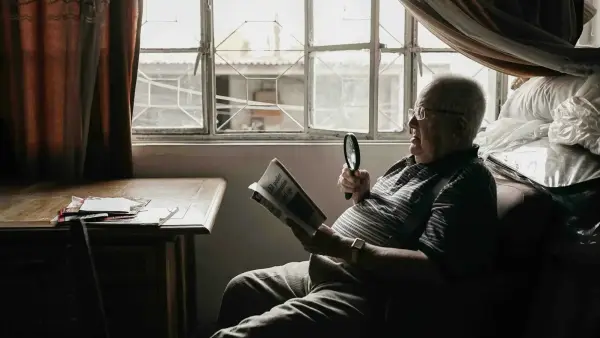
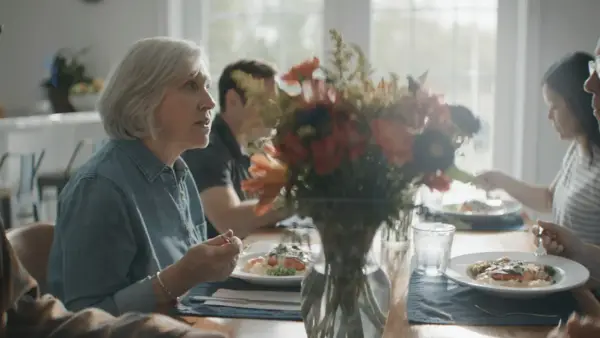
She is 64 and just realized she has never once received a gift without immediately calculating what she owes in return - not the birthday presents or the flowers left on her counter or the coffee a friend insists on buying - because a girl who watched every act of kindness arrive with a price tag learned that receiving without repaying is a debt the body carries even when the mind has forgotten who first taught her that nothing is free

Her daughter brought her flowers on a Thursday. Not for a birthday, not for Mother’s Day, not because anything was wrong. Just flowers. A small bouquet of sunflowers from the farmer’s market, wrapped in brown paper, left on the kitchen counter with a note that said “just because.”
She stood there for a full minute looking at them. And the first thing she felt was not happiness. It was arithmetic.
How much did these cost? Has her daughter’s anniversary coming up - should she send something bigger than usual? Did she forget something - a phone call, a date, an occasion that would explain why the flowers had arrived? She picked up her phone and almost texted “you didn’t have to do that” before catching herself. Almost. She sent it anyway.
She is sixty-four years old. She has a beautiful life, a family that loves her, friends who show up. And she has never once - not once in six decades - received a kindness without immediately opening a ledger in her mind and beginning to calculate what she owes.
If any of this sounds like you, what follows is not a lecture about gratitude. It is an explanation. And it begins a very long time ago.
The kitchen table arithmetic
There was a kitchen table in her childhood, too. Not the one with the sunflowers - a different one, older, with a vinyl tablecloth that stuck to your elbows in summer and a crack along one leg that her father kept meaning to fix.
Her mother sat at that table every Sunday night and paid bills. It was not a quiet process. It was a performance of worry - envelopes spread across the surface, a checkbook open, a pencil working numbers on the back of a grocery receipt. The sound of her mother’s breathing changed when she did the bills. The whole house changed.
And the lesson the girl absorbed, sitting across from that table doing homework while her mother turned envelopes over and over in her hands, was simple: everything costs something. Everything arrives with a number attached. And if you do not know the number, you are not paying attention.
A 2018 study published in Psychological Science found that children who grew up in financially stressed households developed what the researchers called “transactional vigilance” - an automatic cognitive tendency to assess the cost and reciprocal obligation of any interpersonal exchange, even those that most people would classify as freely given. The pattern persisted into adulthood regardless of the individual’s actual financial circumstances. The researchers noted that the pattern was not about money. It was about safety. The child had learned that unaccounted-for generosity was unstable ground.
She did not learn to be careful with money. She learned to be careful with kindness.
The price of a favor
Here is what the arithmetic sounds like in practice.
Her neighbor drops off a bag of tomatoes from his garden. She accepts them, says thank you, and by the time she is back inside, she is already thinking about what to bring over. Banana bread? Too simple. A casserole? Too much. She settles on a jar of homemade jam and delivers it the next morning, even though nobody asked her to, even though the tomatoes were free in every sense of the word except the one that matters to her.
Her friend pays for coffee. She says “you don’t have to do that” twice before accepting, and then she insists on paying next time, and then she puts a reminder in her phone so she does not forget, because forgetting would mean she owed something, and owing something - even a four-dollar latte - produces a low hum of anxiety that does not go away until the balance is settled.
Her husband buys her a necklace for Christmas. She loves it. She wears it. And she spends the next three weeks quietly recalculating whether the gift she gave him was equivalent in value, because if his was more expensive, she is behind, and being behind feels like the moment before someone says “after everything I’ve done for you.”
Nobody has said that to her in forty years. But her body remembers it anyway.
The strings she learned to see
There were strings. That is the part that matters. Not imagined ones - real ones.
When her aunt took her shopping for school clothes, her mother spent the rest of the week reminding her how generous Aunt Linda was, how she should write a thank-you note, how she better not complain about anything for a while because some children don’t get new clothes at all. The gift was not free. It came with a week of performance - gratitude as labor, receiving as a kind of test she could either pass or fail.
When her father fixed the neighbor’s fence, he came home and said, “he’ll owe me for that.” Not bitterly. Just factually. As if the world ran on a ledger, and every act of kindness was a deposit that would eventually require a withdrawal.
Brene Brown describes the inability to receive without calculating as a hallmark of what she calls “scarcity culture” - an environment where resources, including emotional ones, are treated as finite and conditional. In her research, Brown found that the people who struggled most to receive gifts, compliments, and help were not ungrateful people. They were people who had learned, usually very young, that generosity was never neutral. It always meant something. It always cost something. And the person who did not immediately calculate that cost was the person who would eventually be caught unprepared when the bill arrived.
The girl at the kitchen table did not choose to see strings. She was shown them, pointed at them, taught to follow their path from one person’s hands to another’s. And the woman at sixty-four who cannot accept a bouquet of sunflowers without opening a spreadsheet in her mind is not anxious. She is fluent in a language of exchange that was her first language, learned before she had any other.
What the people around her see
They see a generous woman. They see someone who always reciprocates, who never forgets a birthday, who shows up with something in her hands every time she walks through a door. They say things like “you didn’t have to” and “you’re so thoughtful” and “you always remember.”
They do not see the engine driving it. They do not know that every casserole she delivers is not generosity but repayment. That every thank-you card she sends is not courtesy but a cleared debt. That the beautiful reputation she has built for being the woman who always gives back is actually the architecture of a child who could not tolerate the imbalance of having received something she had not yet earned.
Her daughter once said, “Mom, you don’t have to bring something every time you come over.” She heard it as: you are doing too much. What her daughter meant was: your presence is enough.
But “your presence is enough” is a sentence that does not compute in a system built on transactions. In her system, presence without contribution is freeloading. Arrival without an offering is taking up space you have not paid for. And “just because” - the note on the sunflowers - is not a comfort but an incomplete equation. Just because what?
A 2022 study in Frontiers in Psychology examined what the researchers called “reciprocity compulsion” in adults who reported high levels of conditional regard from caregivers during childhood. The study found that these individuals experienced measurable anxiety - elevated cortisol, increased heart rate - when receiving a gift or favor that they perceived as unmatched. The anxiety did not subside until a reciprocal gesture had been completed. The researchers compared it to leaving a door unlocked - not dangerous in itself, but producing a persistent sense of something unfinished, something that requires attending to before rest is possible.
She does not feel generous when she gives back. She feels relieved. And the difference between those two things is the entire distance between a woman who loves to give and a girl who learned she was not allowed to simply receive.
The inheritance
She watches her own daughter accept gifts with ease. The sunflowers sit in a mason jar on the counter for a week, and her daughter does not bring anything in return. She does not calculate. She does not text with a preemptive thank-you that is really a preemptive payment. She just enjoys them.
And the sixty-four-year-old woman watches this with a feeling she cannot quite name. It is not resentment. It is something closer to wonder, mixed with a faint ache - the ache of seeing someone do effortlessly the thing she has never been able to do, and realizing that the difference is not character but conditioning.
Her daughter was not raised at the kitchen table with the checkbook and the grocery-receipt arithmetic. Her daughter was raised by a woman who gave so much, so consistently, so automatically, that the child never had the chance to learn that receiving was dangerous. The cycle broke not because she planned it but because she over-corrected so thoroughly that her daughter grew up in a house where generosity appeared to have no cost at all.
She broke the pattern by burying it. And the only person still paying the price is her.
Just because
Here is what I want to say to you, if you recognized yourself in any of this.
The ledger in your head is real. The arithmetic is real. The low hum of anxiety when someone is kind to you for no visible reason - that is real, and it is not a flaw. It is the remnant of a system you built when you were too young to know you were building it, in a house where everything had a price and the safest thing a girl could do was make sure she never owed anyone anything.
You are not bad at receiving. You are exceptional at protecting yourself from the vulnerability that receiving requires - which is the vulnerability of believing you are worth something that you did not earn, that someone might give you something simply because they wanted to, that “just because” is a complete sentence.
The sunflowers on the counter do not need a response. The coffee your friend bought does not need a repayment. The compliment your husband gave you this morning does not need to be deflected or matched or returned with interest by Friday.
You are allowed to receive something and let it sit there - unbalanced, unmatched, un-repaid - and feel the discomfort of that, and stay with it, and discover that the bill you have been waiting for your entire life is one that nobody is going to send.
Nothing is owed. Nothing was ever owed. The girl at the kitchen table did the best she could with what she was given. And the woman at sixty-four who still calculates the cost of a bouquet of sunflowers is not ungrateful. She is the most careful person in the room, in a world that never told her she was allowed to stop counting.