She is 62 and just realized she has never once eaten the last piece of anything at a family dinner - the last slice of pie, the last roll, the last spoonful of potatoes - not from generosity but because a girl who took the last piece once and watched her mother's face fall learned that a woman's hunger is always less important than the possibility that someone else might still be hungry
The Thanksgiving She Still Remembers
I was nine, maybe ten. Old enough to know what a dinner table expected of me and young enough to forget.
There was one roll left in the basket. Golden, still a little warm. I reached across the table and took it. Not dramatically. Not greedily. I just picked it up because I was still hungry and it was there.
My mother’s face changed. It was fast - a flicker, not a speech. Her mouth tightened. Her eyes moved to my father’s plate, then to my brother’s, then back to me. She didn’t say anything. She didn’t have to. That single glance carried an entire curriculum.
Someone else might have wanted that.
I put the roll on my plate and ate it, but something had already shifted. I had broken a rule I didn’t know existed until I broke it. And I spent the next fifty-two years making sure I never broke it again.
The Invisible Syllabus
No one sits a girl down and says, “Your hunger matters less.” No one writes it on a chalkboard. It arrives in smaller deliveries than that.
It arrives in the way your mother always ate last, standing at the counter, picking at what was left after everyone else’s plates were full. It arrives in the way she cut herself the thinnest slice of cake and said she wasn’t that hungry. It arrives when you watch her scrape the serving dish clean onto your father’s plate and then rinse the dish before she’s had a single bite.
You don’t learn the rule. You absorb it. The way fabric absorbs dye - slowly, completely, until you can’t tell where the original color ends and the new one begins.
The rule isn’t just about food. Food is where it starts, but it radiates outward. Take the smallest portion. Take up the least space. Make sure everyone else is comfortable before you check in with yourself. Scan the room for needs that aren’t yours. Attend to them first. Then, if there’s anything left - time, energy, attention, the last spoonful of mashed potatoes - you can have some.
A 2019 study published in the journal Appetite found that women consistently serve themselves smaller portions than men in social dining settings, even when they report identical levels of hunger. The researchers noted that this wasn’t about appetite. It was about what they called “gendered food practices” - deeply internalized beliefs about who is entitled to how much.
It starts at the dinner table, but it doesn’t stay there.
The Woman Who Makes the Smallest Plate
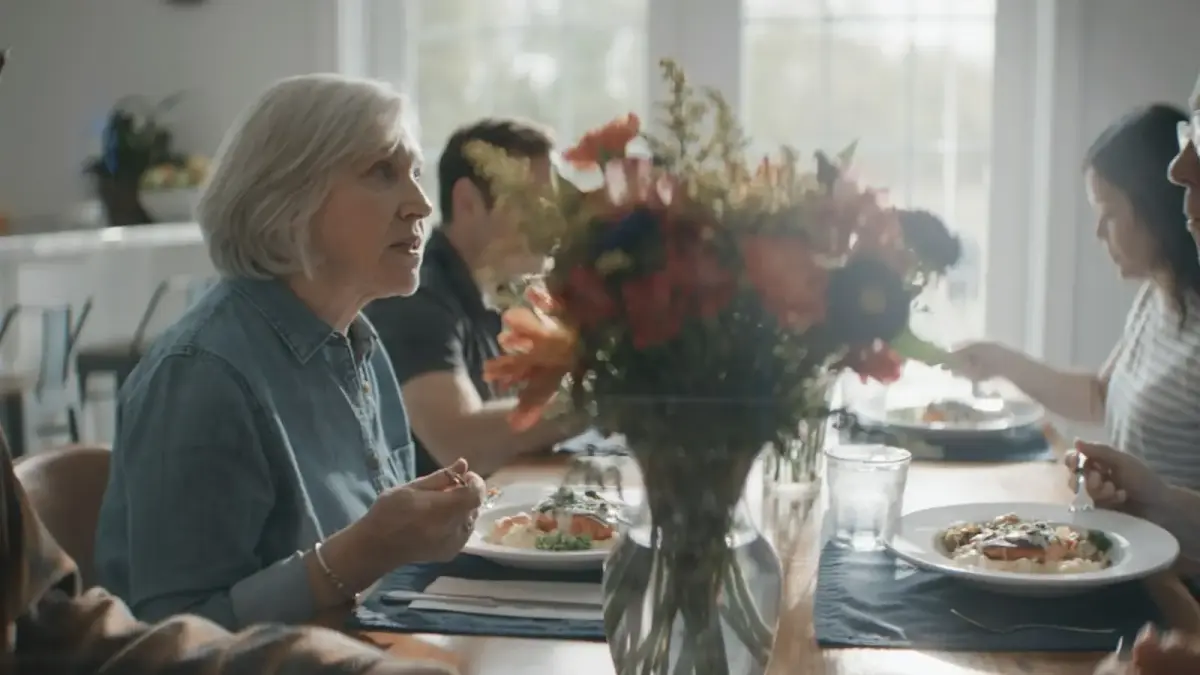
She is sixty-two now. Her children are grown. Her husband knows how to make his own plate. There is no practical reason for her to serve everyone else first, to wait until all the chairs are filled before she sits down, to take the smallest portion of everything and then insist she’s full before she actually is.
But she does it anyway. Every single time.
She does it at Thanksgiving. She does it on a Tuesday night with leftover soup. She does it at restaurants, ordering the salad when she wanted the pasta, splitting a dessert when she wanted her own, saying “I’ll just have a bite of yours” when what she meant was “I want the whole thing.”
She scans. That’s the word for it. Before she reaches for anything, she scans the table. Are the kids still eating? Does anyone look like they might want more? Is there enough? Even when there is clearly, obviously, mathematically enough - she scans.
It looks like thoughtfulness. People praise her for it. “You’re so generous,” they say. “You always think of everyone else.”
And she smiles, because the alternative is saying something she has never quite been able to articulate: I’m not generous. I’m trained. There is a difference between choosing to give and believing you are not allowed to take.
What the Research Actually Shows
The psychology of gendered self-denial runs deeper than table manners. It sits at the intersection of caregiving identity, self-worth, and what researchers call “compulsory altruism” - the expectation that women’s selflessness is not a choice but a character trait.
Harriet Lerner, the psychologist who spent decades studying women’s emotional patterns, wrote extensively about how women are socialized to be the emotional regulators of their families. The woman who monitors everyone else’s plate is the same woman who monitors everyone else’s mood. She learned early that her role is to notice, to anticipate, to provide - and to do it quietly enough that it looks effortless.
A 2021 study in Frontiers in Psychology examined what the authors called “self-silencing” in women over fifty. They found that women who had spent decades prioritizing others’ needs reported significantly higher rates of what the researchers termed “identity erosion” - a gradual loss of connection to their own wants, preferences, and even physical sensations like hunger and fatigue. These women didn’t just put others first. Over time, they lost the ability to clearly identify what they themselves wanted.
Read that again. They lost the ability to know what they wanted.
Not because they were weak. Not because they lacked intelligence. Because they practiced self-denial so consistently, for so many decades, that the muscle atrophied. You cannot spend fifty years ignoring a signal and expect the signal to keep coming in clear.
Brene Brown has talked about how worthiness is not something we earn through service to others. But for many women of a certain generation, service was the only currency they were given. You proved your value by what you gave away. Your love was measured by what you went without.
The last piece of pie was never about pie. It was a referendum on your character.
The Things That Aren’t About Food
Once you see the pattern at the dinner table, you start seeing it everywhere.
She’s the woman who sleeps on the worse side of the bed. The side closer to the door, or farther from the window, or the side with the broken spring she’s been meaning to mention for three years but hasn’t because it feels like a small thing to complain about.
She’s the one who says “I don’t care, you pick” when asked where she wants to eat - not because she doesn’t have a preference, but because expressing a preference feels like an imposition.
She’s the one who waits in the car while everyone else runs into the store, who sits in the middle seat on airplanes, who wears the coat that’s a little too thin because the warmer one felt like an extravagance.
She gives the bigger piece of chicken to her husband. The better towel to the guest. The last hour of the evening to someone else’s phone call. And she tells herself she doesn’t mind, and she mostly believes it, until one day she’s standing at the counter at ten o’clock at night eating cold leftovers straight from the container and something in her chest goes very quiet and very heavy and she thinks: when did I stop sitting down to eat?
A 2017 study in the Journal of Research in Personality found that women who scored high on measures of “unmitigated communion” - a psychological term for extreme other-focus at the expense of the self - showed elevated levels of depression, anxiety, and chronic physical complaints. The researchers were careful to note that caring for others is not the problem. The problem is when caring for others becomes the only way you know how to exist.
When generosity stops being a choice and starts being a compulsion, it is no longer generosity. It is a survival strategy wearing generosity’s clothes.
The Girl and the Roll
Here’s what I want to say to the nine-year-old who reached for that roll.
You were hungry. That’s all. You were a child and you were hungry and there was food on the table and you reached for it because that is what a hungry person does.
Your mother’s face - that flicker - was not about you. It was about her. It was about the rule she learned from her mother, who learned it from her mother, who learned it from a world that told women their bodies were a problem to be managed and their appetites were something to apologize for.
She didn’t mean to teach you that your hunger was inconvenient. She was just passing along the only lesson she knew.
But the lesson was wrong.
Your hunger is not less important. Your needs are not an afterthought. You are not the person who gets what’s left over. You were never supposed to be.
Eating the Last Piece
She is sixty-two. She is standing in her own kitchen after Thanksgiving dinner. The dishes are mostly done. The family has moved to the living room. There is one slice of pumpkin pie sitting on the counter.
She looks at it. She does the scan. Automatic, decades old. Is anyone still hungry? Should she wrap it up for someone’s breakfast? Should she offer it around one more time?
And then something new. Something that feels almost rebellious, almost dangerous, almost like reaching across the table at nine years old.
She picks up a fork. She doesn’t cut it in half for later. She doesn’t put it on a napkin to eat standing up. She gets a plate. A real plate. She sits down at the table.
She eats the last piece.
Not because no one else wanted it. Not because she checked first. Not because she earned it by cleaning the kitchen and serving everyone else.
She eats it because she’s hungry. Because it’s there. Because after sixty-two years, she is finally learning something that should have been obvious from the start.
Her hunger is allowed.
It was always allowed.
She just couldn’t hear it over the sound of everyone else’s plates being filled first.