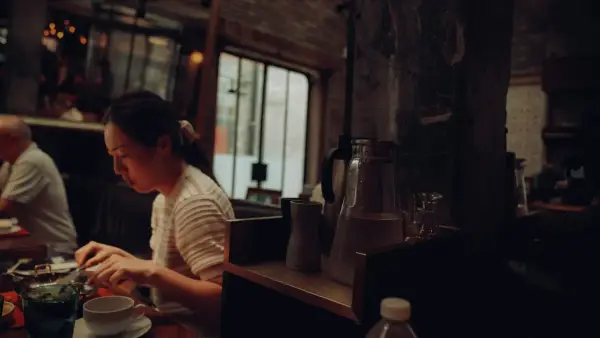
Children who found a hiding spot somewhere in their house - behind the couch, inside the hall closet, under the basement stairs - and returned to it not to play but to be somewhere no one would think to look for them, often become adults who feel safest in the smallest room, the farthest table, the corner seat with their back to the wall, because a body that discovered stillness at seven never stopped searching for the architecture of disappearance
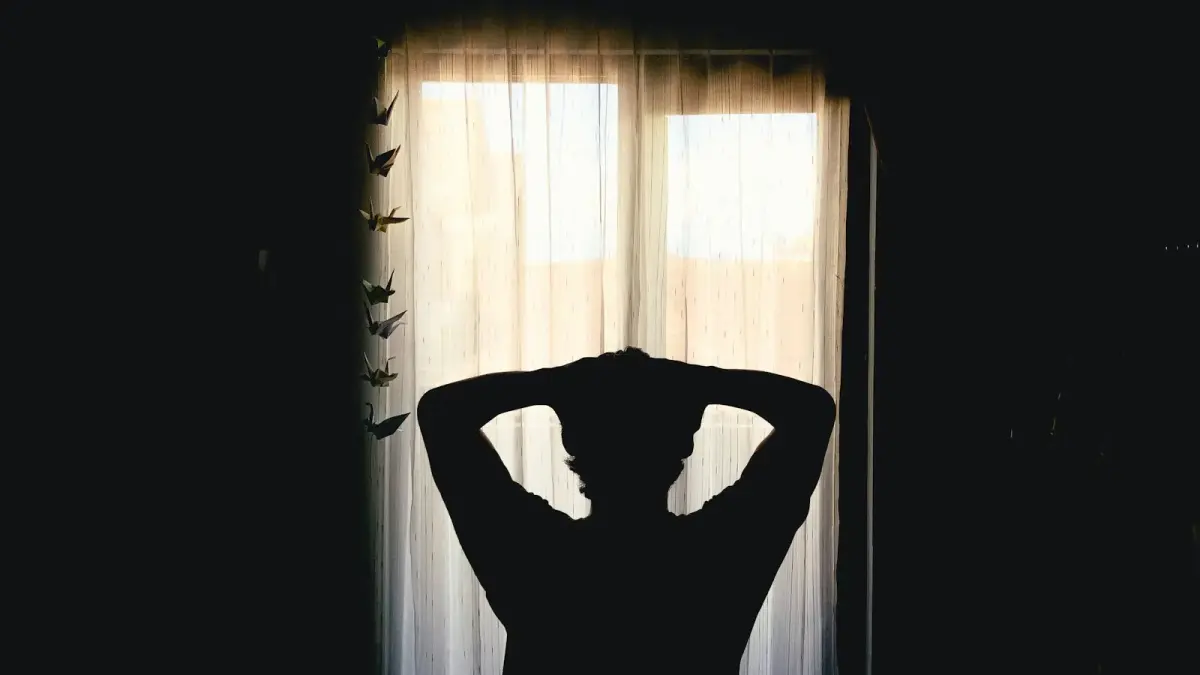
Mine was the space between the back of the couch and the living room wall.
It was maybe eighteen inches wide. The carpet was rougher there because nobody ever vacuumed it. If I pressed my shoulder blades against the wall and pulled my knees up, I fit perfectly - not comfortably, but completely. The sounds of the house changed in that gap. My mother’s voice in the kitchen became weather instead of language. The television became a hum. My own breathing got louder, and for a few minutes every afternoon, I existed in a way that didn’t require anything of me.
I wasn’t hiding from anyone in particular. I wasn’t upset. I wasn’t playing a game. I was seven, and I had discovered something I didn’t have the words for yet - that there was a difference between being alone and being unfound. Being alone meant someone knew where you were and chose not to come. Being unfound meant you had slipped out of the architecture of expectation entirely. Nobody was ignoring you. Nobody was looking. You had simply become invisible on your own terms.
I think about that gap behind the couch more often than makes sense for a thirty-eight-year-old with a PhD.
The Spot You Kept Returning To
If you had one, you already know exactly where it was. You don’t need to think about it. The location is stored somewhere below memory, in the part of your body that still registers certain small spaces as permission.
Maybe it was a closet with a door that didn’t latch all the way. The space under the basement stairs where someone had stacked old blankets. A corner of the attic where the ceiling sloped so low that only a child could sit upright. The bathroom with the lock - the only lock in the house you were allowed to use.
What matters is that you went back. Not once, like a kid exploring. Again and again, like a person who had found something they needed.
A 2019 study published in the Journal of Environmental Psychology found that children as young as five develop what researchers call “restorative place preferences” - specific locations they associate with nervous system regulation and emotional recovery. These weren’t random choices. The children in the study consistently selected spaces that shared three features: enclosure, reduced sensory input, and the absence of social expectation.
In other words, the hiding spot wasn’t arbitrary. Your body was solving a problem your mind hadn’t identified yet.
What the Hiding Spot Actually Was
Here is what nobody told you when you were small: you were not antisocial. You were not avoiding your family. You were not broken or strange or too sensitive for the world you’d been born into.
You were doing something remarkably sophisticated. You were regulating your nervous system using the only tool available to a child who couldn’t drive anywhere, couldn’t ask for therapy, couldn’t articulate that the volume of ordinary family life sometimes made their skin feel too thin.
You were using architecture.
Dr. Stephen Porges’ polyvagal theory describes how the human nervous system constantly scans the environment for signals of safety and threat. For children in high-stimulation households - and “high-stimulation” doesn’t mean chaotic or abusive, it can simply mean loud, busy, full of people who love you very much but take up a lot of room - the nervous system can spend long stretches in a mild state of activation. Not fight-or-flight, exactly. More like the hum of a motor that never fully shuts off.
The hiding spot shut off the motor.
Behind the couch, inside the closet, under the stairs - these spaces did something no amount of being told to “calm down” or “go play” could accomplish. They reduced the sensory field to a size your body could manage. They removed the need to monitor other people’s moods, respond to questions, perform okayness. They gave you back the experience of existing without audience.
That is not avoidance. That is one of the earliest forms of emotional self-care a human being can practice.
The Architecture Follows You
Now you are an adult. You have a job and a car and the ability to go anywhere you want. And yet.
You request the corner booth. Not the center table, never the center table, even when the hostess gestures toward it with a smile. You want your back to the wall and the room in front of you and ideally a little bit of shadow.
You chose the smallest bedroom for your office. Your partner thought it was generous - “You take the bigger room, I don’t need the space.” But you didn’t want the bigger room. The bigger room felt like standing in the middle of a parking lot. The small room with the one window and the door you could close - that felt like the space behind the couch, scaled up for a body that had grown but hadn’t changed.
On planes, you want the window. Not for the view, though you’ll look. For the wall. One solid surface on your left, the curve of the fuselage creating a tiny enclosure you can lean into. The middle seat is a nightmare not because of the elbows but because of the exposure. Nothing on either side that belongs to you.
A 2021 study in Frontiers in Psychology examined spatial preferences in adults who self-identified as introverted or highly sensitive. Participants consistently chose seating positions that maximized two things: boundary on at least one side, and a clear sightline to the room’s exit. The researchers described this as “defensive spatial orientation,” but I’ve always disliked that term. It implies you’re defending against something. I think you’re building something. You’re reconstructing, in every restaurant and airplane and office layout, the fundamental experience of that childhood space where your presence didn’t need to be performed.
The Performance You Learned to Stop
This is the part that people who never had a hiding spot don’t fully understand.
For many children, home was a stage. Not a traumatic one, necessarily. Just a space where you were always, on some level, being watched, assessed, responded to. Your mood was noticed. Your silence prompted questions. Your desire to be alone was treated as a symptom rather than a preference.
“Why are you being so quiet?”
“Don’t you want to come sit with us?”
“Are you okay? You seem off.”
These questions came from love. They came from parents who were paying attention, who cared, who wanted to make sure you were alright. But for a child whose nervous system was already working overtime to process the sensory and emotional information in a busy household, each loving question was another thing to respond to. Another performance of okayness. Another moment where your internal state had to be translated into something legible and reassuring for someone else.
The hiding spot was the one place where the performance stopped.
Not because you were being inauthentic everywhere else. But because that small, enclosed, forgotten space was the only location in your world where existing was enough. Where you didn’t need to produce evidence that you were happy, engaged, fine. Where the fact of your breathing body was the entire content of the moment.
That experience changes a person. Not in dramatic ways. In architectural ones.
Why Small Spaces Still Feel Like Coming Home
Susan Cain, in her research on introversion and temperament, has written about how approximately one-third to one-half of all people process stimulation more deeply than average. These individuals don’t have less capacity for the world. They have more awareness of it. Every conversation, every background noise, every shift in someone’s facial expression registers with a specificity that most people don’t experience.
For these children, the hiding spot wasn’t escape. It was equilibrium.
And here’s what I find most interesting from a developmental perspective: the spatial strategy you invented at six or seven doesn’t just persist into adulthood. It evolves. It becomes more refined, more intentional, more beautiful.
The child under the stairs becomes the adult who turns the guest bedroom into a reading nook with one chair, one lamp, and a door that closes. The child behind the couch becomes the adult who walks into a coffee shop and immediately identifies the seat that offers the most enclosure with the least social obligation. The child in the closet becomes the adult who, when overwhelmed at a party, doesn’t leave - they find the kitchen, the porch, the one room where the crowd hasn’t reached yet.
You are still doing what you taught yourself to do before you could tie your shoes. You are still reading a room - not for social cues but for geometry. For the architecture of disappearance. For the spot where you can exist at the volume your body actually needs.
The Hiding Spot Was Never About Hiding
I want to say this clearly, because I think some of you have carried a quiet shame about this for decades.
The fact that you needed a hiding spot did not mean your family was failing you. It did not mean you were failing your family. It did not mean you were too sensitive, too withdrawn, too anything.
It meant that at a very young age, you understood something about yourself that most people don’t figure out until their thirties or forties - that you require, in a physical and neurological sense, periodic access to spaces where the demands of social existence are temporarily suspended. Where you can hear your own thoughts without translating them. Where your body can settle into its baseline frequency without adjusting to anyone else’s.
That is not a flaw. That is a feature of a nervous system that processes the world with unusual depth.
A 2022 study in the Journal of Research in Personality found that individuals who scored high on sensory processing sensitivity - the trait underlying what we casually call “being highly sensitive” - showed markedly different cortisol patterns when given access to private, enclosed spaces during stressful tasks. Their stress hormones normalized faster. Their self-reported sense of safety increased. The researchers’ conclusion was straightforward: for high-sensitivity individuals, access to enclosed, low-stimulation spaces is not a luxury. It is a regulatory necessity.
Your seven-year-old self already knew this. You just didn’t have the vocabulary. You had the space behind the couch.
What to Remember
You are not avoiding the world. You never were.
You are someone who learned, before you had language for it, that you experience the world at a different resolution than most people around you. The noise is louder for you. The emotions in a room land harder. The simple act of being perceived takes energy that others don’t seem to spend.
And so you found a spot. A small, enclosed, forgotten corner of your house where the resolution could drop to something manageable. Where you could stop being a child who was fine and just be a body breathing in the dark.
That you are still looking for that spot - in restaurants, on airplanes, in the way you arrange your home - is not a sign that something went wrong in your development. It is a sign that something went exactly right. You figured out what you needed. You built a practice around it. And you have been faithfully, quietly maintaining that practice for your entire life.
The hiding spot was never about hiding. It was the first place you ever felt free to simply be. And every corner booth, every tiny office, every window seat you choose is just your grown-up body remembering what your childhood body already knew.
Some of us exist most fully in the smallest rooms.
That was always okay. It still is.