Children who grew up on the free lunch program at school - who carried a different colored ticket than the rest of the line, who learned to time their arrival at the cafeteria so nobody was watching when they handed it over, who folded the voucher so small it disappeared inside their palm before they reached the register - often become adults who cannot let anyone else pay for a meal without a specific heat rising in their face, because a child who ate on someone else's account learned before ten that hunger had paperwork and being fed was never free of the cost of being seen
I was nine when I learned how to make a piece of paper disappear.
Not magic. Not a trick anyone would applaud. It was a government-issued lunch voucher, printed on paper stock slightly thicker than the ones the other kids carried, and it was a different color. Theirs were white. Mine was yellow. I didn’t know what it meant at first - only that when I handed mine over, the cashier paused a half-second longer than she did for the kid in front of me. That half-second was its own education.
By October of fourth grade, I had developed a system. I would fold the voucher in half, then in half again, then once more until it was a tight square no bigger than a postage stamp. I’d hold it in my left palm, pressed against the skin with my thumb, and when I reached the register I would slide it across the counter in a single motion - fast, quiet, like passing a secret note I never wanted read aloud.
Nobody taught me to do this. No adult sat me down and said, “Hide it.” The cafeteria itself was the teacher. The lunchroom taught me that eating was a performance, and my family’s bank account was the script.
The choreography nobody rehearses
Every child who used the free or reduced-price lunch program developed their own physical choreography. Yours might have looked different from mine, but I’d bet money it existed.
Maybe you memorized which days the cafeteria served something worth the visibility and which days you packed whatever was in the pantry - crackers, a bruised apple, nothing that needed refrigeration - because on those days the line felt too long and too exposed. Maybe you learned the precise window of time when the cafeteria was crowded enough that nobody was paying attention to what you handed the cashier. Too early and you were alone. Too late and the line thinned. There was a sweet spot, usually about seven minutes after the bell, when the noise and the bodies provided cover.
Maybe you rehearsed the handoff the night before without realizing it. You just knew where the voucher lived in your pocket and how your fingers would find it without looking down.
A 2019 study published in the Journal of Research in Personality found that children from lower socioeconomic backgrounds develop heightened self-monitoring behaviors significantly earlier than their peers - an acute awareness of how they are being perceived that becomes, over time, a fixed part of their personality architecture. The researchers called it “socioeconomic vigilance.” I call it what it actually was: a nine-year-old who couldn’t eat lunch without a surveillance strategy.
The moment someone noticed
For most of us, there was a moment. A single, precise moment when the system failed.
Maybe the cashier said the word “free” louder than necessary. Maybe she called over another cashier to confirm something about the voucher, and now two adults were staring at a piece of paper that felt like your family’s tax return laid open on the counter. Maybe a classmate standing behind you tilted their head and said, “Why is your card a different color?”
That question - asked casually, without cruelty, maybe even with genuine curiosity - could rewrite the entire architecture of a child’s nervous system.
Because the question wasn’t really about the card. The question was: why are you different from me? And the answer, which you understood in your body before you could articulate it in language, was: because my family cannot afford to feed me, and yours can. Because someone had to fill out paperwork so I could eat today. Because my hunger required approval from an office I’ve never seen, signed by a parent who came home too tired to explain what the form meant.
You probably said something like, “I don’t know.” Or you shrugged. Or you pretended not to hear. But your face did something involuntary - a flush, a tightening around the eyes - and that sensation filed itself away in a place your body would remember for decades.
Hunger had paperwork
Here is what no one talks about when they talk about childhood poverty: the bureaucracy of being fed.
The free lunch program required forms. Your parent or guardian filled them out at the beginning of every school year - household income, number of dependents, signatures - and submitted them to the school office. You may not have known the details, but you knew the ritual. You knew that eating lunch at school was not automatic for you the way it was for other children. It was conditional. It was approved. It could, theoretically, be taken away.
Pierre Bourdieu, the sociologist, had a term for this kind of knowledge. He called it habitus - the way social class installs itself in the body as a set of dispositions, reflexes, and tastes that feel like personality but are actually the residue of economic position. The child who folds the voucher isn’t making a conscious choice about shame management. The child is expressing a habitus. Class is not something that happened to you. It is something that moved into your muscles and your posture and the particular way your hand closed around a piece of paper at 11:45 every weekday.
You learned, before you had the language for it, that need is never neutral. That needing something - food, specifically, the most basic thing - came with a visibility tax. You were fed, yes. But you were also seen being fed. And being seen was its own cost.
The lunchroom as a theater of class
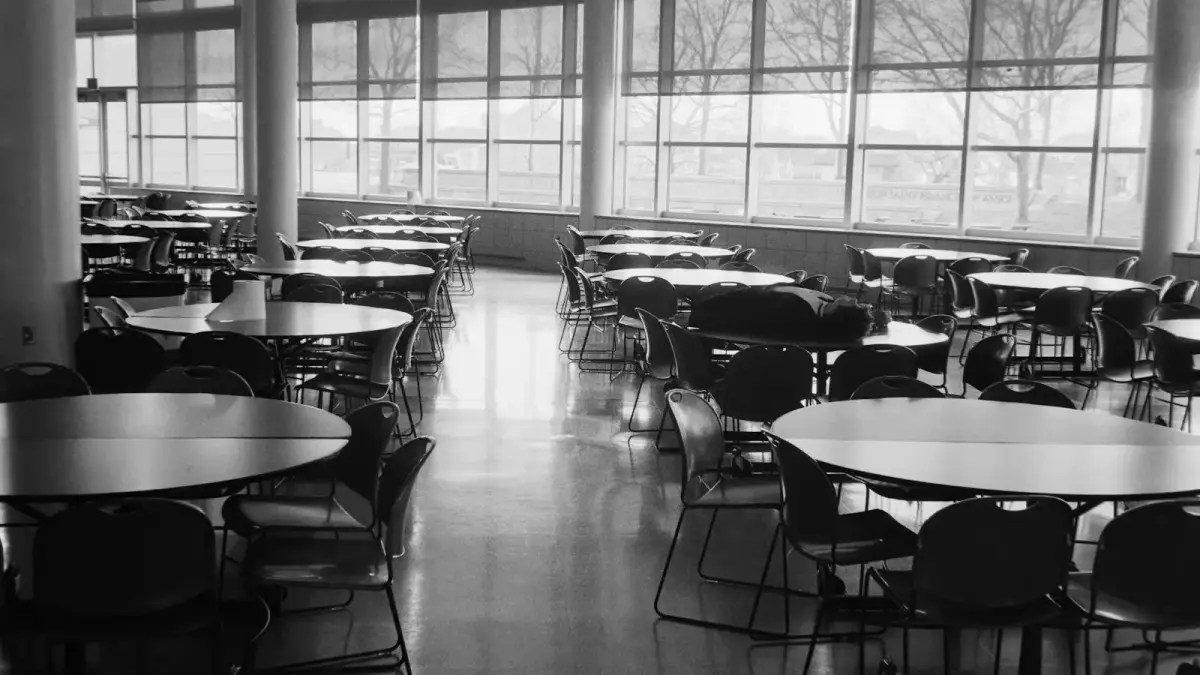
Think about what the cafeteria actually was.
It was the one room in the school where every child’s economic reality was performed simultaneously, five days a week, with no script and no rehearsal. The kid who brought a lunchbox from home - the expensive kind, with the cartoon character on the front and the matching thermos. The kid who bought the hot lunch with cash their parents handed them that morning. The kid who used a voucher. The kid who had nothing and tried to look like they weren’t hungry.
Every child knew their role. Nobody assigned it. The lunchroom sorted you.
A 2021 study in the journal Social Psychology of Education examined how school meal programs - despite their essential nutritional function - can inadvertently create visible markers of socioeconomic status among students. The researchers found that children who used free meal programs reported significantly higher levels of social anxiety specifically in cafeteria settings compared to other school environments. The cafeteria wasn’t just where you ate. It was where you were classified.
And the cruelest part is that the program itself was a kindness. It fed millions of children who would otherwise have gone hungry. The cruelty wasn’t the program. The cruelty was the visibility. The different-colored ticket. The separate line. The cashier’s pause. A system designed to nourish somehow also designed to expose, and the children caught inside it learned both lessons equally: you will be fed, and everyone will know why.
The body that still remembers
Gabor Mate writes about how the body stores experiences that the conscious mind has long since filed away. You might not think about the free lunch program anymore. You might not have thought about it in years. But your body kept the receipt.
You’re fifty-three now, and when the check comes at a restaurant, something happens in your chest before your hand even reaches for your wallet. A tightening. A small urgency. You need to pay. Not want to - need to, the way you need to breathe.
You reach for the check before anyone else can. You say things like “I’ve got this” or “Please, let me” with a warmth that sounds generous but feels - if you’re honest - more like defense. If you pay, no one can see you receive. If you pay, you are the one providing, and the one providing is never the one being pitied.
You overtip. Not 20 percent. Twenty-five. Thirty. Because somewhere in the math between the total and the tip, you’re proving something to a cashier who hasn’t existed in forty years. You’re telling a room full of fourth graders that you’re fine now. That you don’t need the voucher anymore.
A 2022 study published in the Journal of Personality and Social Psychology found that adults who experienced socioeconomic disadvantage in childhood were significantly more likely to engage in compensatory financial behaviors - overspending on visible goods, refusing financial help, and insisting on paying in social dining situations - regardless of their current economic status. The researchers noted that these behaviors were most pronounced in situations that echoed the original context of the childhood experience. A restaurant is an echo of a cafeteria. A check is an echo of a voucher. Your body doesn’t distinguish between then and now. It just knows: someone is about to see.
1. You grab the check before anyone can offer
It looks like generosity. It feels like survival. The motion is so practiced, so seamless, that your dining companions probably think you’re just the kind of person who likes to treat. And you are. But the liking is built on top of something older and more urgent - the need to never again be the person at the table who cannot pay.
2. You cannot accept a gift without doing the math
Someone gives you something - a birthday present, a holiday gift, a bottle of wine brought to your dinner party - and your first thought is not gratitude. It’s calculation. What do I owe now? How do I make this even? A child who received a free meal every day learned that receiving is a form of debt. The gift economy, for you, has a ledger.
3. You know the price of everything in the grocery store
Not because you’re frugal by philosophy. Because price awareness was a survival skill installed so early it became invisible. You know the exact cost of a gallon of milk, a dozen eggs, a loaf of bread - not because you check, but because a part of you never stopped checking.
4. You feel a specific discomfort at potlucks and buffets
Free food in a group setting. Your nervous system reads it differently than other people’s. There’s a flicker of something - not quite anxiety, not quite shame, something in between - that passes through you when you’re standing in line for food you didn’t pay for, surrounded by people who might be watching what you take.
5. You have never told most people
This might be the most telling behavior of all. You grew up on the free lunch program, and the number of people who know this about you is vanishingly small. Not because it’s a secret exactly, but because telling it feels like handing someone the different-colored voucher all over again. Telling it makes you visible in the specific way you spent your childhood trying not to be.
Brene Brown’s research on shame identifies secrecy as one of shame’s primary survival mechanisms - the belief that if the thing is never spoken, the feeling attached to it loses its power. But Brown also found the opposite is true. The things we never speak about are the things that run us most completely.
The cost of being seen
Here’s what I want you to know, if any of this sounds familiar.
The child you were - the one who folded the paper, who timed the arrival, who memorized the cashier’s rhythm so the handoff would be invisible - that child was brilliant. Not broken. Brilliant. You were managing a complex social performance with no training, no support, and no language for what you were feeling. You were nine, and you were already fluent in a dialect of class awareness that most people never learn to speak.
The adult you became - the one who pays the check, who overtips, who cannot receive without calculating what’s owed - that adult is still running the program the cafeteria installed. And the program worked. It kept you safe. It kept you invisible when being invisible felt like the only option.
But you’re not in the cafeteria anymore.
You’re allowed to be seen now. You’re allowed to let someone else pick up the check, not because you can’t afford it, but because receiving isn’t debt. It never was. The voucher told you a lie about what it costs to be fed, and your body believed it so completely that forty years later you’re still paying the bill.
The lunch was always free. It was the being seen that cost you everything.