Children who learned that visible anger was dangerous often become adults whose eyes go flat the moment they feel it rising, not because they have mastered self-control but because a child's face learned at seven that the wrong expression could change the temperature of an entire house, and the flatness at forty-five is not composure but a mask the body installed before the mind had any say
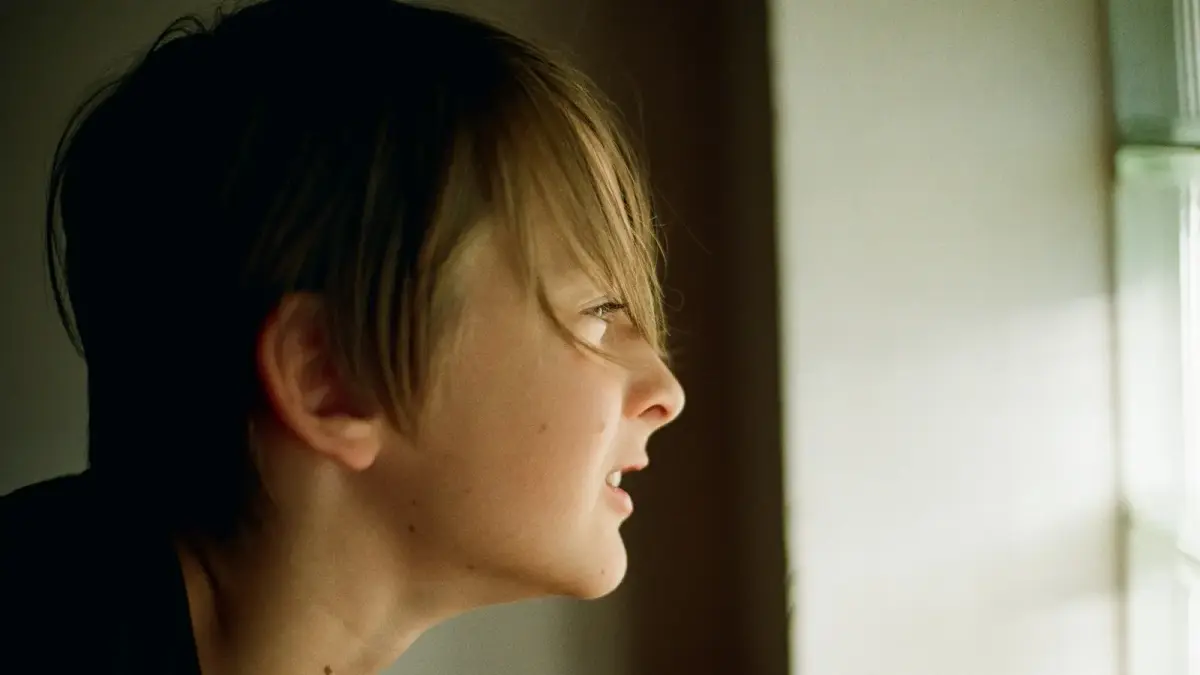
I watched my mother’s face do it once at a family dinner. My uncle said something cutting about her cooking - something small and mean that didn’t deserve the silence it got - and I watched her eyes empty out. Not close. Not narrow. Empty. One second she was there, laughing, passing the bread, and the next her face was a wall. Smooth. Still. Like someone had reached behind her expression and turned off the power.
I was maybe twelve. I didn’t have the language for what I’d seen. But I remember thinking: where did she go?
It would take me another twenty years - and a developmental psychology degree - to understand that she hadn’t gone anywhere. She was right there, feeling everything. Her face had simply learned, decades before I was born, that showing anger was not safe. And by the time I watched it happen at that dinner table, the mask had been on so long she didn’t know she was wearing it.
If you recognize this - the sudden flatness, the eyes that go still when something lands wrong, the jaw that locks into neutral the instant heat rises in your chest - I want you to know something. That’s not your personality. That’s not composure. That’s a seven-year-old’s emergency protocol, still running in an adult body that no longer needs it.
The face learns before the mind understands
Children are not born knowing how to hide their feelings. Watch a toddler get angry and you’ll see the most honest face on earth - scrunched, red, wide open with fury. There’s no filter. No calculation. The emotion arrives and the face announces it like a headline.
But somewhere between three and eight, certain children learn something different. They learn that their face is not just an expression - it’s a trigger.
In some households, a child’s visible anger changes the room. A furrowed brow from a six-year-old produces a slap, a withdrawal, a slammed door, a parent who won’t speak for two days. The child doesn’t learn that anger is wrong. The child learns that the appearance of anger is dangerous.
Paul Ekman, the psychologist who spent decades mapping the human face, identified what he called “display rules” - the unspoken cultural and familial codes that dictate which emotions are allowed to show and which must be hidden. Every family has them. But in emotionally volatile households, the display rules aren’t cultural guidelines. They’re survival instructions.
The child’s nervous system picks them up faster than the conscious mind ever could. Before the child can articulate “Dad gets scary when I look mad,” the face has already learned to go blank.
What the flatness actually looks like
You might not recognize it as a pattern because it looks like nothing. That’s the point. It was designed to look like nothing.
Here’s what happens in the body. The anger arrives - a flush of heat, a tightening in the chest, a surge that in another person might produce a sharp word or a clenched fist. But in this person, something intervenes before any of it reaches the surface. The eyes, which were alive a second ago, go still. Not sad. Not withdrawn. Flat. The jaw releases into a neutral position. The mouth settles into a line that could mean anything or nothing.
If you asked this person what they’re feeling in that moment, many of them would say “nothing.” Not because they’re lying. Because the suppression happens so fast and so early in the chain that the feeling itself gets intercepted. The face doesn’t just hide the anger. Over decades, it learns to short-circuit the experience of anger altogether.
A 2012 study published in the Journal of Personality and Social Psychology found that habitual expressive suppression - the regular practice of keeping emotions off the face - was associated with reduced emotional experience over time. People who consistently hid their feelings didn’t just look calmer. They began to feel less. The mask, worn long enough, starts to reshape what’s underneath it.
The house where the wrong face was expensive
Let me be specific about what kind of childhood produces this.
It’s not necessarily a household with yelling. Sometimes it’s the opposite - a house so tightly controlled that any display of negative emotion from a child was treated as a disruption, an insult, a personal attack on the parent’s authority or fragility.
A child furrows their brow at the dinner table and the parent says, “Don’t you look at me like that.” A child’s lip trembles and the parent says, “Go to your room until you can fix your face.” A child clenches their fists and the parent - without raising a voice - goes cold. Withdraws. Becomes unreachable for hours or days.
The child learns the math instantly. My angry face costs me connection. My angry face makes things worse. My angry face is the problem.
So the face stops. Not gradually. Not thoughtfully. The nervous system installs a circuit breaker - a split-second override that catches anger at the jaw, the eyes, the forehead, and smooths it all into nothing before anyone can see it. Before the child can even fully feel it.
Developmental psychologist Edward Tronick, known for the still-face experiment, demonstrated how profoundly children are affected by a parent’s emotional unavailability. But what gets discussed less often is the reverse - how children learn to perform their own version of the still face when they discover that their authentic expressions produce pain.
The adult who can’t show anger even when it’s warranted
Fast forward thirty years. The child is forty-five now. They’re competent, well-liked, described by colleagues as “even-keeled” and by partners as “hard to read.”
They sit in meetings where someone takes credit for their work and their face does nothing. They listen to a partner say something dismissive and their eyes go smooth as glass. They absorb insult after insult - small ones, the kind that accumulate like water damage - and the face stays flat, stays neutral, stays safe.
People around them often interpret this as strength. “You’re so calm,” they hear. “I wish I had your composure.” “Nothing seems to bother you.”
And here’s the part that hurts: the person hearing this usually believes it, too. They’ve worn the mask so long they’ve mistaken it for their own skin. They genuinely think they’re not angry. They think they’ve transcended the petty frustrations that seem to consume other people.
But the body keeps the account. A 2013 study in Psychological Science found that emotional suppression increases sympathetic nervous system activity - heart rate, blood pressure, cortisol. The emotion doesn’t vanish because the face doesn’t show it. It goes inward. It becomes headaches, jaw tension, insomnia, a vague sense of exhaustion that no amount of rest resolves.
The face is calm. The body is at war.
The moment you realize the mask isn’t yours
There’s often a specific moment when this pattern becomes visible - when the person wearing the flat face finally sees it from the outside.
Sometimes it’s therapy. Sometimes it’s a partner who says, during an argument, “I can’t tell if you’re angry or if you don’t care, and honestly I don’t know which one is worse.” Sometimes it’s watching your own child express anger freely - red-faced, messy, loud - and feeling something between admiration and terror.
I’ve spoken to people who describe this recognition as one of the strangest experiences of their lives. Because the mask was installed so early and so completely that removing it doesn’t feel like liberation. It feels like danger. The body still believes, at a level deeper than logic, that showing anger on the face will produce catastrophe.
One woman told me she practiced angry expressions in her bathroom mirror at fifty-two years old. Furrowed her brow. Clenched her jaw on purpose. Let her lip curl. She said it felt ridiculous. She also said it made her cry, because she realized she’d never once let her face do that in front of another person. Not once in fifty-two years.
The flatness is not a flaw - it’s a record
Here’s what I want you to understand, and I want you to understand it not as a concept but as something true about your body if this is your body.
The flat face is not a personality trait. It’s not emotional maturity. It’s not evidence that you’re “above” anger or that you’ve evolved past it.
It’s a scar. A specific one, with a specific origin. A child’s nervous system - your nervous system - made a brilliant, desperate calculation: if my face stays still, the danger passes. And it worked. It kept you safe in a house where safety required invisibility.
But you’re not in that house anymore. You’re forty-five, or fifty-three, or sixty-one, and the person whose reaction you were managing is no longer in the room. Maybe they’re no longer alive. And still your face goes flat when the anger rises, because the body doesn’t update its protocols based on changed circumstances. It updates them based on new experiences that contradict the old ones.
Research by James Gross at Stanford has shown that people can shift from suppression to what he calls “cognitive reappraisal” - but only when they first become aware of the suppression itself. You can’t change a pattern you don’t see. And this pattern was specifically designed not to be seen.
What it means to let the face come back
I’m not going to tell you to “express your anger” or give you five steps to emotional freedom. That would be insulting to the complexity of what your body has been doing for decades.
But I will say this: the first step isn’t expression. It’s recognition. It’s noticing the moment - the exact moment - when your face goes flat. Not trying to change it. Just seeing it. Oh. There it is. The wall just went up.
Because once you can see it, something shifts. You stop mistaking the mask for your face. You stop believing you’re not angry when your chest is tight and your jaw aches and your sleep is broken. You start to understand that the flatness was never about you. It was about someone else’s inability to tolerate a child’s honest face.
And there is something quietly revolutionary about a person at forty-five or fifty or sixty letting their face do what it was always trying to do. Not rage. Not explosion. Just the small, honest crease between the eyebrows that says: that hurt. I didn’t like that. I’m allowed to show that I didn’t like that.
Your face learned to disappear because someone else needed it to. You get to decide, now, that it can come back.
Not all at once. Not dramatically. Just one honest expression at a time, in rooms that are safe enough to hold it. Your face was never the problem. It was the solution a child found when no one offered a better one.
You’re not that child anymore. But you might need to let your face know.